
Stories
Read Wayne’s Story and Sample Some of His Most Creative Moments!
Although Wayne is no longer actively performing in public, he is still involved in creative projects, including songwriting, recording and writing stories for people of all ages. From this location online, you can connect to nearly 100 of his original songs, all downloadable FOR FREE.
As you explore the STORIES on this page, you’ll find photos, videos, recordings and more samples of Wayne’s creative work through the years! In addition, Wayne’s YouTube Site is loaded with many videos of Wayne performing on episodes of a local PBS show produced by the Minnesota Association of Songwriters and aired on PBS stations across America. Another section of YouTube videos capture his performance in a 1980 production of Side By Side By Sondheim by a professional theatre company in Frederick, Maryland. Links to all of the above are included on this page. But let’s begin at the beginning…
BORN IN THE NATION’S CAPITOL
Wayne was born to loving parents on the Summer Solstice, June 21, in the year 1947. They lived in a tiny cottage built for them by her father in McLean, Virginia, which was very close to America’s Capitol, Washington, DC. The nearest hospital was Doctor’s Hospital, just a few miles away in the Northwest quadrant of the city.
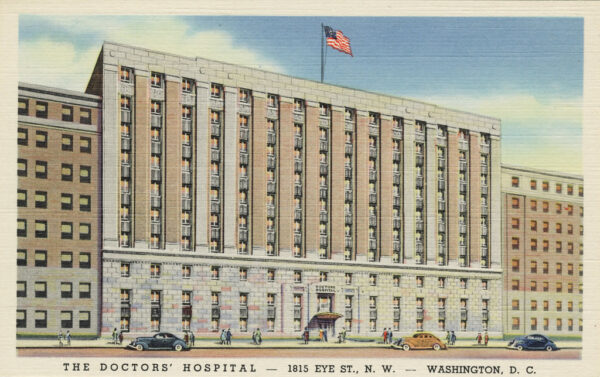
The Doctors’ Hospital 1815 NW Eye Street, Washington, DC
After WWII, Wayne’s father worked for the Federal Government; specifically, he worked for the Veteran’s Administration (VA) in a building on Constitution Avenue in Washington. He took an early bus to work the few miles to his job. When he got off the bus, he had to cross Constitution Avenue to get to his office. Each morning, President Harry Truman was also crossing that same street, in the opposite direction, at the same time as part of his famous “morning constitutional”. Every morning, without breaking stride, dad would say, “Good morning, Mister President.” And every morning, without breaking stride, President Truman replied, “Good morning, son.”
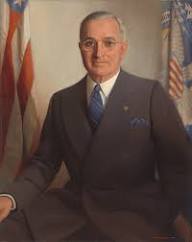
Harry S. Truman, US President 1945-1953
It was a very different world back in the late 1940s. Twenty-five feet behind the President was his Secret Service detail, which dad described in later years like this: two agents with their jackets open, hands in their pockets and their hats pushed back, each with a cigarette bouncing up and down between his lips as they told each other the latest jokes.
Because dad went to work early, mom could drive in, park the family’s coupe in a shady spot that afternoon. Wayne and his mom would sit nearby on a park bench and wait for him to drive them home. Each day, Wayne’s mom would ask him if he had to “tee-tee” before they left the house. Wayne always shook his head no. However, Wayne invariably changed his mind as they approached the place where they’d meet dad:
Good thing Wayne’s mom came fully equipped with extra diapers!
Sometimes, on special days (Wayne was too young to understand why), Wayne and his mom would cross the street and go into the building where dad worked. He learned later that dad was one of the first people to work with new machines called “Mainframe Computers.” But to Wayne, the very best part about going inside the building where dad worked was THAT was where he got to visit with a man who, in the future, would teach him a lot of stuff about a lot of things. That man was his dad’s boss, and his name was Pete Petrola.
WAYNE’S SURROGATE GRANDFATHER
Wayne’s dad didn’t talk much about his relatives in South Carolina, the place where he was born and where he grew up. He told stories about how Wayne’s grandfather delivered the mail to everyone in the small town of Easley and that made it hard for Wayne’s grandfather to get away and come visit Wayne in Virginia. Dad told Wayne that Easley was a “factory town”. Some of the factories turned cotton into cloth and other factories turned the cloth into shirts, pants and dresses. Wayne also knew that his dad’s stepmother (“Mama Gladys”) was a school teacher in the same little town and it was equally hard for her to get away for a visit.
But it was clear to everyone in Wayne’s family that Pete Petrola liked dad and everyone in dad’s family. Pete owned several hundred acres of land in Fairfax County and Prince William County, Virginia. On that property, he had a large, two-story house and a couple of barns, plus plenty of mechanical farm equipment. Wayne was too young to think about this much while growing up, but since Pete also worked a full-time job for the Federal Government, it was clear he paid others to plant and harvest crops on his land and Pete shared in some of the harvest from each of the crops, which appeared to Wayne’s un-trained eye, to be things like hay, corn and grains as feed for the animals he kept in his fields and barns.
Pete’s acreage was heavily forested and Occoquan Creek ran through his property. Dad told Wayne that people paid Pete for permission to hunt on his land and fish in his section of the creek. Wayne’s first experience with what he called “Pete’s Creek” was at about age two. Dad took his fishing rod, a tin can with earthworms and Wayne (wearing a floatation vest) down to the creek. He showed Wayne a fast-water channel that ran next to a slower, wider, deeper pool where he would be fishing. He said, “See where the water’s moving fast?” Wayne nodded. “OK. You run upstream as far as you want and jump into that channel. When you get to where I’m fishing, just stand up, run toward me on the beach, then run back up to where you first jumped in and JUMP IN AGAIN!
Wayne did that until he was tired. Then his dad broke out the sandwiches mommy had made and they sat on the sandy beach of Occoquan Creek and had lunch. When Wayne’s dad had caught what he called “his limit”, they walked up to Pete’s house to visit with Pete. That night, they ate dad’s fish for dinner!
In late 1950, mom gave birth to fraternal twins; first a sister, then, fifteen minutes later, a brother! That slowed down Wayne’s visits with his dad to Pete’s, because mom needed more help taking care of THREE children. So dad and Wayne helped mom as much as they could. The only time Wayne was nowhere to be found was when “the kids” needed their diapers changed!
When their children were small, Wayne’s parents made sure to keep life interesting. For example, mom scheduled regular visits to Washington DC’s National Zoo. That’s where they met an injured bear cub that was rescued from a New Mexico fire in 1950. The firemen who saved him named him Smokey, and he grew up with the Hamilton twins, who visited him often. Smokey was so popular, the US Postal Service issued him his own Zip Code in 1963: 20252
Likewise, dad was in charge of a family adventure that happened annually, on July fourth. Today, MEGA fireworks displays take place all over America. But after WWII, there were fewer professional providers of such shows and the cost for staging them was far less than we see today. Wayne’s dad LOVED July 4th celebrations, so when the Federal Government decided to stage a huge fireworks show on the National Mall that night every year, he and his family would be there. Here’s how he did it:
1. He and mom packed up a delicious July fourth picnic dinner for the whole family
2. Everyone piled into the biggest car they had and headed for the OUTBOUND (northbound) lanes of the George Washington Parkway (the lanes that were closest to the Potomac River)
3. Dad, the driver, exited at the FIRST PULL-OFF (a place to leave the flow of traffic) and parked our car in one of the “angular” parking spaces
4. We waited for the sun to set; for a short time, the Mall monuments and Federal buildings were electrically lit as they were every night
5. Suddenly, the entire city seemed to black out. NONE of the Mall monuments were lit. A few seconds later, the first rockets streaked into the air next to the Washington Monument and exploded into a red, white and blue starburst of light.
You could hear the crowds cheering all around us and from a mile away. Tens of thousands of people were there to experience America’s biggest fireworks show! Oh, they televised it, but very few TV sets in American homes (including ours) had COLOR TVs, but WE got to experience the show LIVE and IN COLOR, along with a live audience of thousands!
All the Hamilton kids climbed to the highest spot off the ground, the roof of the car. Wayne usually had one of the twins on his left and the other one on his right. Dad spent about half his time watching the show and the other half making sure none of his kids got too close to the edge of the car roof. But nobody ever fell off.
On the way home, the twins were usually sound asleep from excitement. Wayne was busy trying to describe every explosion to his parents. What a night!
For the next few years, Wayne and his dad and, as they got older, Wayne’s younger brother and even his younger brother’s twin sister ALL “visited with Pete”, usually on Saturdays, sometimes on Sundays, sometimes on both. And it was always an adventure, at least to Wayne. When he was about five, Wayne was wandering around Pete’s house, trying to count all of Pete’s guns. They were everywhere! One day, Wayne walked up to Pete and asked him, “Pete, are all these guns loaded?”
Pete laughed and said, “Of COURSE they’re loaded, son! Every single one of them is loaded. A gun is pretty much useless if it’s not loaded, isn’t it?” After thinking about it for a second, Wayne agreed and nodded his head in agreement. Pete went on to say, “The thing is, you’ve gotta know what you’re doin’ around firearms, son. ‘Cause if you don’t, they can hurt you or even kill you.” He reached out his hand to Wayne’s forehead and pushed his little head back so he and Wayne were looking straight into each other’s eyes, and Pete said, “If you’re not careful, guns will KILL YOU. Understand?”
Wayne gulped and blinked and nodded, in that order, as much as he could under the weight of Pete’s hand. He knew Pete was serious, because he’d never seen him like this before. Serious.
“Good. Now which one of these guns would you like to shoot today? Pick one.”
Wayne marched into Pete’s “library”, which was a room jammed with shelves that were jammed with books. He came out struggling to carry a long, black rifle that looked like it was made of iron. Pete’s eyebrows arched up in surprise as he looked at Wayne’s dad and said, “That’s an old Swiss goose gun made in 1910. Got a kick like a Georgia mule. Kid’s got taste. This oughta be fun.” He took the gun from Wayne and cracked it open to check the ammo gauge, then took a few rounds from a cabinet drawer and put them in his pocket. “OK. Let’s take this old cannon outside.”
Pete had a number of small outbuildings near his house. He went in one and came out with a 2′ x 2′ target tacked onto a 1″ stake and a 5-pound sledge hammer. In no time, Pete had the target in the ground forty feet in front of Wayne. Behind the target was fifty acres of nothing. Behind that was a forest full of old-growth trees. Pete showed Wayne the “sitting” firing position and, knowing the shotgun was far too heavy for the little boy to support with his left arm, drove a “Y” support into the ground for Wayne to rest the barrel. “There ya go, sport. Now, I’ve shown you how to line up the front part of the sight with the back part. When you get both lined up on the target, take a deep breath, hold the gun steady and slowly squeeze the trigger.”
Pete stepped away to stand next to Wayne’s dad. Wayne followed Pete’s instructions to the letter, and when the gun fired, it was the loudest sound Wayne had ever heard. The recoil of the shotgun was tremendous, pushing Wayne (much to his surprise) into a backward somersault, and his right shoulder hurt like nothing he’d ever felt before. But Wayne was so thrilled that he’d fired a gun for the first time, all he could hear was Pete and his dad applauding and cheering. Wayne didn’t even notice that he’d completely missed the target! When the applause quieted down, the first thing Wayne said was, “Can I try that again?”
That sunny afternoon, young Wayne learned a few things. He learned that adult experts (well, at least one) with weapons were usually eager to help young people like Wayne become smart about safely using firearms. He also learned that Pete was always happy to let Wayne fire ANY of the weapons at his house, because he was expected to CLEAN all the weapons he used. And Wayne also learned that Pete was the right guy to ASK about WHICH weapon Wayne should be working with whenever he came over for a visit (so he didn’t try to take on more gun than he could handle as he was growing up). At subsequent visits, Pete steered young Wayne toward pistols and rifles in the 22-caliber range, guns with which Wayne had much more success in his early years.
Wayne’s dad also helped Pete build a minnow pond. It was a twenty five-foot circle made of boulders and concrete and less than three feet deep. Pete hauled creek water up and dumped it into the pond. Before it was stocked with minnows, Wayne used it as his private little swimming pool. One day, Wayne was practicing “swimming underwater” and when he surfaced, he was staring in the face of a two-foot-long water moccasin (he didn’t KNOW it was a water moccasin, but he saw the fangs and DID know that was bad)! Wayne’s dad was standing on the edge of “Wayne’s pool”, so Wayne, without thinking, started screaming “SNAKE! SNAKE!” while half swimming, half running toward his father, who was about ten feet away. The snake must’ve been just about as afraid of Wayne as Wayne was of the snake, because it was swimming as fast as possible directly toward Wayne’s dad as well!

Water Moccasin
When they got close enough, Wayne’s dad reached down and grabbed Wayne’s wrist with his right hand and grabbed the tail of the snake with his left hand. He put Wayne on his feet on the edge of the minnow pond to his right and whipped the head of the snake against the rock edge of the pond to his left over and over until the snake was very dead. Then he let go of the snake’s tail. The snake did not move. But dad picked up a quartz rock about the size of a softball and smashed it down on the snake’s head several times, just to be sure.
Pete usually had a selection of hand-made and manufactured fishing lures in one of the sheds near the house, but Wayne and his dad helped in the live bait department by building a 2′ x 2′ x 6′ plywood box and filling it with all the ingredients for an earthworm bed: strips of cardboard and newspaper, dark, black soil mixed with used coffee grounds, dried and shredded leaves, wood chips, peat moss, manure, straw, garden soil and a little water. Wayne thought Pete had better live bait than fake lures, but what did he know? He was only seven years old.
There were many more adventures at Pete’s place, to be sure. Eventually, Fairfax and Prince William County Governments decided to build a dam across Occoquan Creek and create Occoquan RESERVOIR. Pete was ready for them; he purchased a fleet of flat-bottomed, pole-driven fishing boats and stocked the reservoir with game fish that attracted fishermen from all over the East Coast. Though he lost forestry and game acreage, he gained fishing acreage. Wayne was especially fascinated to watch archers attach fishing line to their arrows and shoot fish with their bows while standing up in those flat-bottomed boats. When the water got too deep for pole boats, Pete changed his business model again to build docks and charged for power boat launches, etc.
As sure as sunup, Wayne found new interests and new activities as he grew older. There was Little League Baseball when they moved from McLean to Falls Church. Wayne’s coaches tried him out at everything, but Wayne liked playing catcher best.
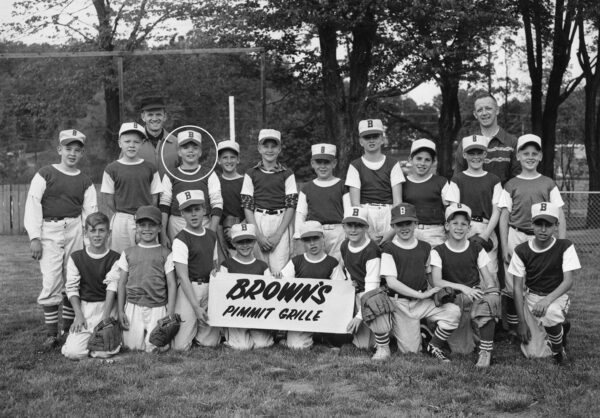
HOME PROJECTS, FAMILY AND A PET
And there were projects around their house as well. Mom always planted a garden along the back fence, which was chain link, and she always found a way to use the rickety bird houses that Wayne brought home from school. Meanwhile, Dad single-handedly dug out the basement of their crackerbox Pimmit Hills house. Wayne tried to help, using a little red wagon. Mom’s father and uncle were Masons and knew how and when to add the next layer of cinderblock, when it was time to lay the concrete floor and how and where to add the steel support pillars and the sump pump.
Wayne’s mom had two sisters, both older than her. The “next oldest”, Aunt Florence, preferred living way out in the country, so Wayne never saw too much of her. The oldest of the three sisters was Aunt Gertrude, or “Greta”. She and Wayne’s mom were very close, so Greta and her two sons, Bruce and Jim, usually lived in apartments not far from wherever Wayne’s family was living. Bruce was about a year older than Jim, and Jim was about four years older than Wayne.
At some point, Wayne asked his dad where Bruce and Jim’s father was. Dad explained, “He was killed in the war. His name was Avery and he was my best friend. We grew up together in South Carolina. He moved to DC to find work, and he encouraged me to move here so he could help me find a job and because he thought your mom would be a great wife for me, and he was right.”
“But how did he die?” Wayne asked.
“Our friends in England were at war with the Germans for years before America decided to help them by sending American soldiers there. Before that happened, Avery went to England on his own and volunteered to help them fly food and supplies to English towns that had been damaged by German air raids. Unfortunately, the Royal Air Force, or RAF (that’s the English Air Force), thought Avery’s supply plane was a German bomber. They mistakenly shot Avery’s plane down and he died in the crash.”
Wayne’s mom was a good cook, and always had tasty dishes for family meals. And Aunt Greta was no slacker in that department either, so the Hamilton kids were always happy to see her. Because when she came to visit, she always seemed to have some delicious baked goods with her. They were especially fond of her lemon pound cake!
While they were living in Pimmit Hills, Greta and her boys moved from one apartment complex to another. Sometimes a different apartment complex did not allow dogs or even cats, so Wayne’s family inherited Greta’s full-grown Boxer, “Shaka”. Neither Greta nor Wayne’s mom could bear the thought of turning the dog over to the County Dog Pound, and when the two of them teamed up, what they demanded was typically granted.
Shaka was not a big boxer, but he was smart, young and he loved to play. Wayne had a toy harmonica that he didn’t know how to play, but when he and Shaka were sitting on their crackerbox front porch and Wayne blew into the instrument, Shaka would raise his chin up and howl. He LOVED to SING! That ate into Dad’s evening reading time, so Wayne and Shaka would only sing in the afternoon, usually outdoors and usually after school.

Their back yard at the crackerbox was nicely fenced in, but they lived on a cul-de-sac street, where most of the kids played in their un-fenced FRONT yards so they could see which of their neighbor friends were also at home and at play. When Wayne’s younger siblings were just learning to walk, Wayne’s job was to make sure neither of them got too close to the street.
Here’s how Shaka helped: If EITHER of the diapered little ones were waddling “too close” to the street, the dog would stand across their path to stop them. If they tried to walk around him, he swiftly shifted his position to stop them again and barked. The bark was not for the toddler, it was a call for big brother Wayne: “Hey, bud, better get over here and move this kid closer to the house. You can pick these kids up; I can’t!”
NEW HOUSE, NEW SCHOOLS, NEW MUSIC, NEW DISEASE
When they moved to Annandale, Wayne got involved in competitive age-group swimming. Pete recommended Wayne’s dad for a Civil Service promotion to a new job at the State Department.
Wayne inherited an outgoing personality from his fun-loving mother. His first school in Annandale was for seventh grade, but classes were being held in an old elementary school within sight of the high school. This is where he met, at about age 12, fellow students he still counts as friends today. Fairfax County was growing so fast that the school system was having trouble keeping up with the population increase. Looking back, Wayne was grateful for the effort; he received his entire public school education in that one county.
His eighth grade classes met in an entirely new kind of school in Fairfax County: an INTERMEDIATE school. Not Elementary and not High School, but “something in the middle”! Brand new structures sprang up like mushrooms, exclusively for seventh and eighth graders ONLY. Wayne’s was called Edgar Allan Poe Intermediate School. Quite a mouthful. ALMOST like a high school, but not quite. That year was the only year he had to ride a bus to school.
However, when he finally got to Annandale High School, which was only a few blocks from the Hamilton family’s new home in that town, Wayne had to ride a bus AFTER he had walked to school! The high school was so overcrowded and his freshman class was so big, the school’s administration had to split the class into two equal parts, population-wise. The afternoon half ate their lunch at the Annandale cafeteria, then got on buses and were transported to a refurbished building with the words “Franconia School” on the outside. Wayne recalls the bus trip through Annandale on Route 236 almost to a point where the bus HAD to turn left into the Franconia school (formerly an elementary school) parking lot to discharge students OR cross over Interstate 95 into the Alexandria, Virginia school district!
If they’d been paying attention during their ride to Franconia, the students would likely have noticed a string of yellow Fairfax County school busses full of fellow freshman classmates headed in the opposite direction TOWARD Annandale high school to have their lunch and FINISH their day on the AHS campus! That was the morning half of his freshman class, who had been bussed out to Franconia as soon as they had arrived at the high school that day.
At the end of the day, none of the AHS students who rode busses to and/or from home could leave to go home until the students who spent their afternoons at Franconia School had been safely bussed back to the AHS campus from that location. It was a logistical nightmare, but somehow it all worked out.
At one point during that freshman academic year, Wayne was at home, at his desk doing his homework on a Saturday afternoon. For some reason, he simply could not stay awake. He decided to fold his arms over his book, rest his head on his arms and take a little nap.
When he woke up, he was in the Emergency Room at the year-old Fairfax Hospital. Needless to say, he was a very confused young man. His parents were there with him. They told Wayne that the ER doctors had diagnosed him with Type I Diabetes, known today as T1D. In 1962, insulin had only been available as a treatment for diabetes since 1922. Pharmaceutical companies like Eli Lilly extracted the insulin from cattle and pigs. And a new type of medical practice, Endocrinolgy, was born.
Wayne spent a WEEK in the hospital, getting “regulated” for diabetes (where the doctors take great pains determining how many calories per day the patient may ingest and how much insulin must be injected to balance the ingested calories). A few weeks after he was released, Wayne was also diagnosed with Ulcerative Colitis, e.g., bleeding ulcers inside the large intestine. This condition is typically caused by one or both of two factors: 1) Massive change in caloric ingestion and/or 2) Stress.
So here we have a 15 year-old male who was eating over 2,000 calories per day who is suddenly restricted to 800 calories per day. At the same time, he is faced with the fact that he will be chained to a series of DAILY insulin injections for the remainder of his life! Moreover, he is told that there is virtually NO medication to treat ulcerative colitis, so he is possibly going to bleed to death.
Lovely prognosis, right? Wayne decided to adopt a positive mental attitude and applied that attitude to every possible aspect of his life moving forward. He also decided not to be a crybaby. To a large extent, the less his fellow school mates knew about all this, the better. So, with a few exceptions, Wayne kept his medical condition(s) to himself.
He was also given two or three glass syringes and a few steel needles. To sanitize these, he was told to put them in a small saucepan after each injection, run some water into the saucepan until the parts were submerged, put the water on the stovetop and heat it until it boils, then extract the parts from the saucepan onto a sterile towel, cover them with a sterile towel and store them in a sterile container until they are needed for another injection. What an archaic process, compared to the disposable plastic syringes and insulin pumps of today! But that was YESTERYEAR!
Fortunately, Wayne made friends easily and went to all the school-sponsored dances, which were typically held in either a school’s lunchroom or gymnasium. He was also invited to parties that were outdoors at his friends’ homes during warm weather. Most of the new houses in Annandale had patios and some even had private swimming pools!
Wayne loved to dance, and at some of those outdoor parties, there were bands performing live music. At one, the band members included a keyboard player, a bass player, a guitar player and a drummer. They were all teenagers, and two adults did all the singing. Wayne was most interested in the drummer, who was a classmate of his at school. Wayne didn’t know him very well, but knew they were in the same grade. It was obvious he’d taken lessons, because Wayne thought he played pretty well.
As he watched his classmate play the drums, Wayne found his hands and feet doing the basic “back beat” moves of each musical measure right along with him:
– bass drum with the right foot on the steady “1, 2, 3, 4”
– high hat with the left foot on every other beat from the right “rest 2 rest 4”
– ride cymbal with the right hand twice the tempo of the bass “1, 2, 3, 4, 5, 6, 7, 8”
– snare drum with the left hand “1, 2, rest 3”
Wayne did this for a few more tunes until it was time for the band to take a break. As the musicians moved toward the refreshments, Wayne asked his classmate: “Would you mind if I tried out your drum set for a minute, please? I really like what you’re doin’ up there!”
“Sure, no problem. Go right ahead” came the reply. At which point, Wayne walked over to the drum set, picked up the drum sticks, sat down on the stool and very quietly tried out the beat described above. The more he tried it, the better it sounded and the more confident he felt.
The next thing Wayne knew, his trained drummer classmate and several other people were standing around the drum set listening to him play this simple beat. Wayne immediately stopped, stood up, put the drumsticks back across the snare where he had found them and stepped away from the drums. Somebody said, “Hey, Wayne, I didn’t know you played the drums.”
Wayne said, “Yeah. Y’know…neither did I.” Looking at the drum set owner, Wayne said, “Thanks a lot. Appreciate it.” That gave birth to an idea, and Wayne talked to people he thought could help him out, starting with some of the employees at Capone’s music store in beautiful downtown Annandale. He went out where live music was being performed and talked with the guys in the bands and the venue bookers who hired them. Eventually, Wayne borrowed $250 (a small fortune in 60’s purchasing power) from his mom, who sold shoes at Hahn’s shoe store at Seven Corners in Falls Church, to buy a really ugly set of USED drums from Capone’s. He organized a six-piece rock-and-roll band (he sang and played drums) that eventually played all over the DC and Baltimore metro areas.
The TorKays
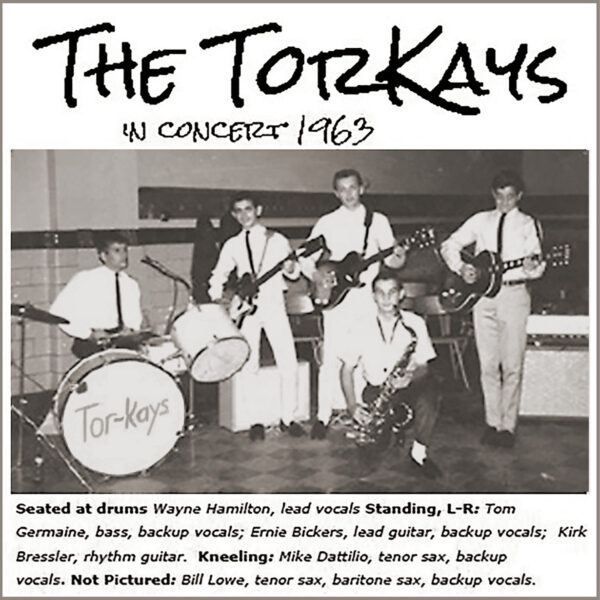
With the money he made playing music, Wayne quickly repaid his mom and traded the ugly drums in on a brand new set of sparkle blue Ludwigs with A-Zildjian cymbals. That first band, the TorKays, consisted of three musicians from Woodson High School (Ernie Bickers, lead guitar, Kirk Bressler, rhythm guitar and Tom Germaine, bass guitar) and three from Wayne’s own Annandale High (Wayne on drums and Bill Lowe and Mike Dattilio on saxophones). Over the next four years, the six members of that band became like brothers.
Rehearsals were in the “rec (short for recreation) room” at Wayne’s house every Saturday afternoon. New songs were learned, rehearsed and usually played that same night at a gig somewhere within fifty miles of Wayne’s house. Wayne’s mother, happily helped by his sister, served lunch on the patio out back. Mama H would dance her way through the day upstairs and occasionally yell down the stairs, “That’s a good one!” when the guys got it right.
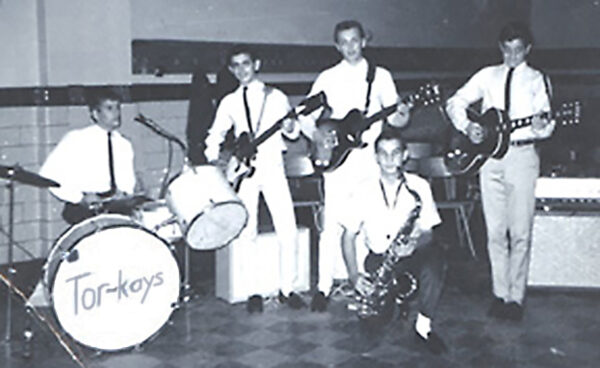
L-R: Wayne, Tom, Ernie, Kirk. Kneeling, Mike Dattilio. Not pictured: Bill Lowe
Though each band member was encouraged to “work the phones” and “get gigs”, Wayne did the lion’s share of that work. He spent some of his own band earnings at a local print shop to have some business cards printed up with his family’s phone number on it. But all of the band members brought in ideas about what songs the band would play. They quickly gelled into a tightly knit “band of brothers” who had a great time working together.
The six bandmates were also encouraged by “real” family members to “put on a good show.” If Mama H was out shopping and saw something she thought would make the guys in the band look sharp, she’d think nothing about bringing home enough sweaters or ties or whatever for everybody. She brought six of these zip-up sweaters home and didn’t even have to guess to get the right size for each musician:
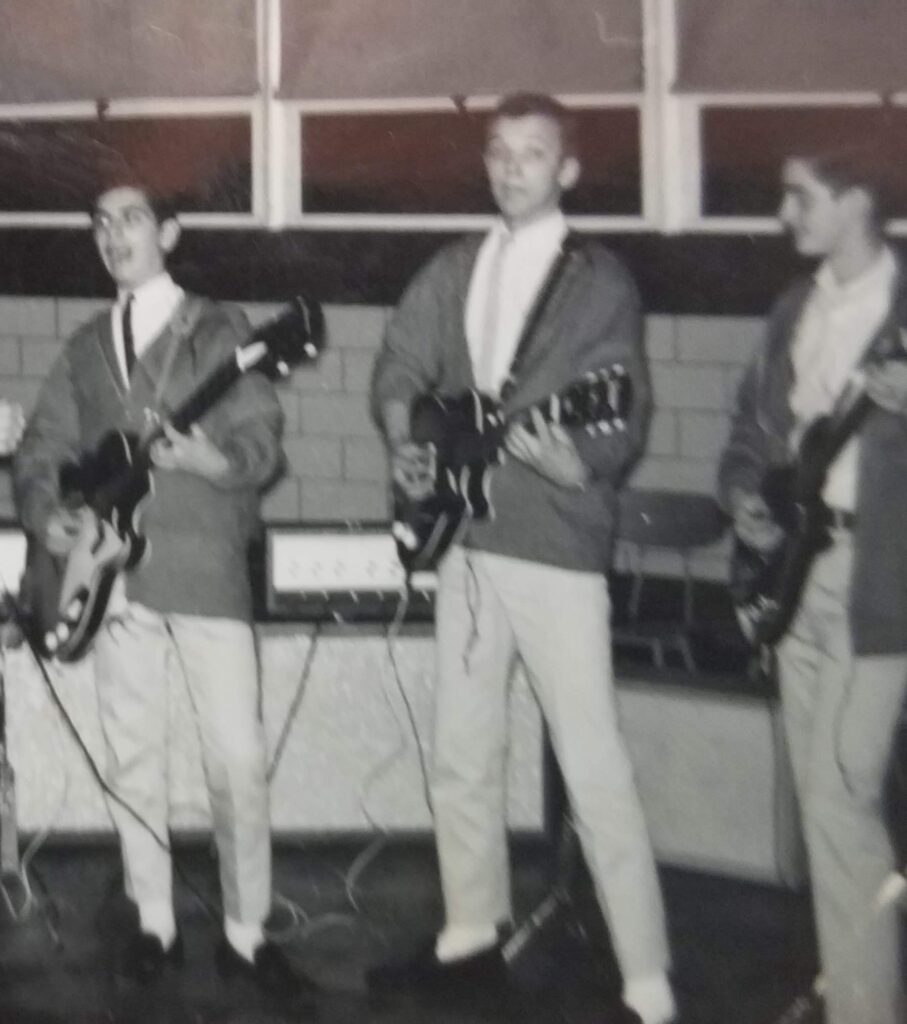
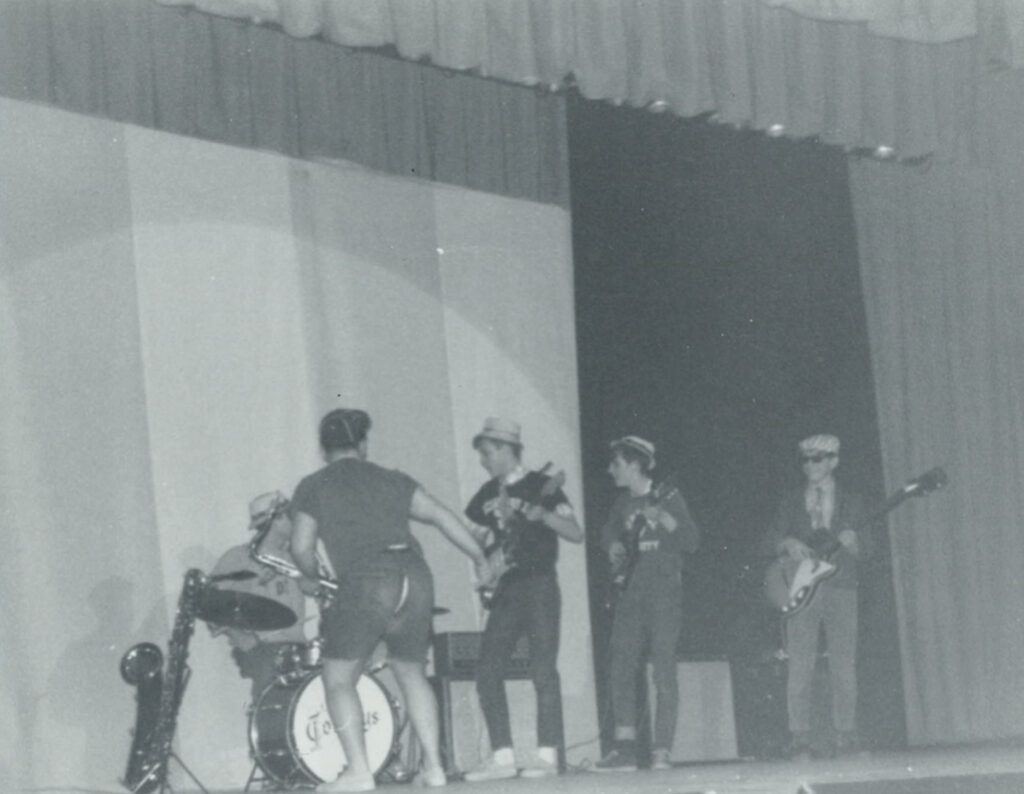
There were other times when each band member came up with his own outfit for some special occasion. In the shot below it was probably a “Sadie Hawkins dance”. Who knows?
Back in those days, an organization would rent a public facility, like one floor of a city’s fire station, to host a fund-raising event. Sometimes, the event was an effort to raise funds for the organization’s treasury. Fortunately, the guys in the band didn’t have to worry about such things and left “getting the crowd to the event” up to the organization that hired the band. But Wayne and the guys never objected to the occasional “hype” in the publicity:
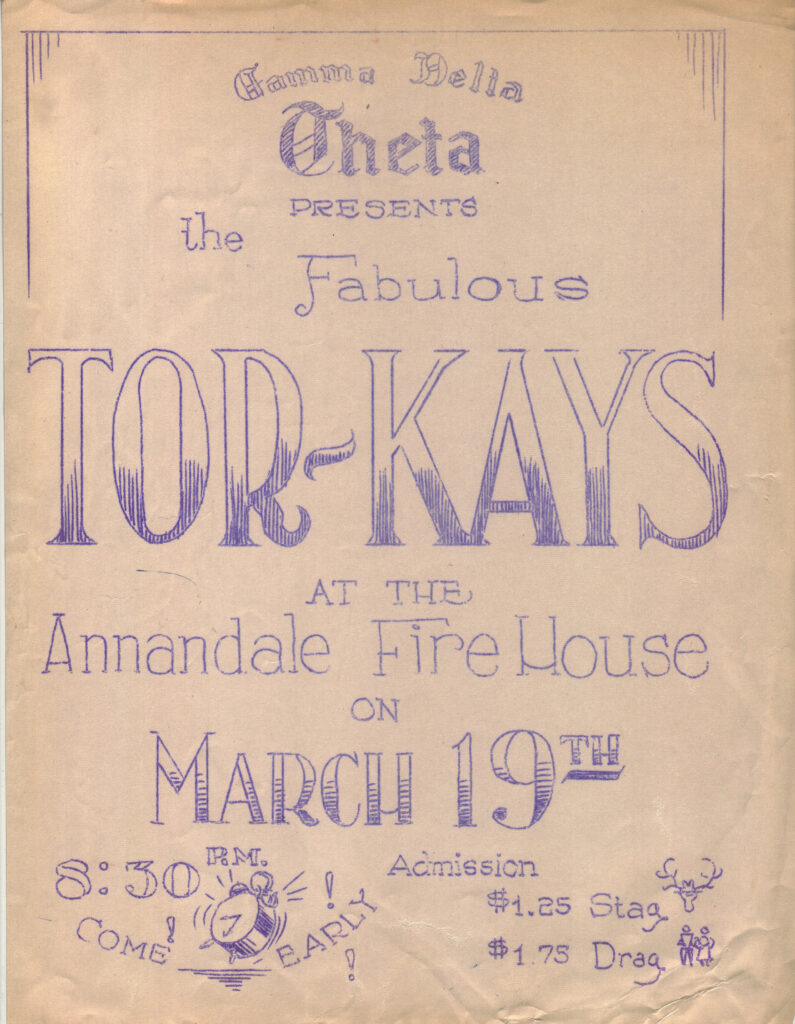
Their job was to get there early, set up their gear, put on their outfits (whatever was prescribed) and play great R&B and Rock & Roll from start time to finish time. Wayne tried to make sure they were there early enough to be all set up before the doors even opened to the public. And even though all six of the guys in the band were still in high school, they were busy almost every weekend and sometimes even the occasional weeknight. And their parents understood that the money they were making at each gig far exceeded a week’s earnings flipping burgers at McDonalds!
Wayne used to complain that he always had plenty of money to spend if he wanted to go on a date, but he never had the TIME to go on a date because he was so BUSY making the money. On the other hand, if he DID have the time to go on a date, it was likely he didn’t have the MONEY to go on a date because he hadn’t been BUSY making the money!
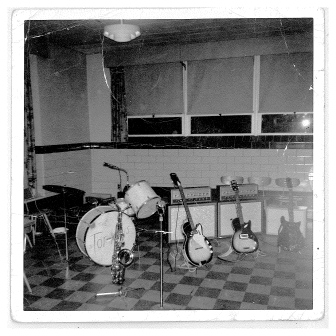
SOUNDS FROM THE PAST
At some point during their four years together, lead guitarist Ernie Bickers quietly brought a stereo recording device and a single microphone and set it up somewhere near his position on the bandstand, where he could turn that machine on and off and tape any songs the band played that night. The ten-inch reel that held Ernie’s recording followed him around for decades, including the years he spent in the US Navy, getting married and raising a family in Texas and telling at least one of his sons, Scott, stories about the TorKays and the songs that were recorded on that tape.
When Ernie died in 2022, Scott inherited the tape, remembered his dad’s stories, and decided to look for other members of the TorKays. He also had the songs on the tape converted into mp3 files, which enabled him to electronically share his dad’s recording with his siblings and his friends.
Scott eventually found Wayne’s web site and reached out via email. Scott offered all 23 of the recordings his father had made to Wayne, saying: “I don’t know if these recordings I have would ever be worth sharing, but they are yours. Feel free to use them however you want.”
With the help of Wayne’s friend, Richard Schletty, owner/operator of Schletty Sound.com in St. Paul, Minnesota, we’ve taken the low-resolution mp3 files and manipulated them as much as possible to allow identification of 21 of the songs. The link below will allow you to hear the result of Rich’s work. Click the link below to hear all 23 recordings. And Scott, thanks to you and your siblings for reaching out!
Listen to 23 recordings of the TorKays in concert
EMERGENCY AVERTED
Typically, Wayne got calls from Kiwanis Clubs, Rotary Clubs, Golf Clubs, Fire Stations, Lions Clubs, YMCAs, YWCAs, High Schools, Colleges, Fraternities, Sororities and anyone else wanting to celebrate something or raise money for something. Every now and then, he’d get a call from a group that was a little “out of the ordinary”. One example was the call from Marshall Hall Amusement Park in Maryland, located just a little downstream of Mount Vernon on the opposite side of the Potomac river.
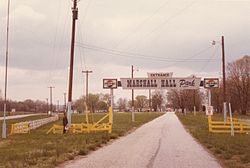
Looking for a way to increase patronage, the Park had purchased an excursion boat to ferry visitors between Marshall Hall and the Potomac docks in Alexandria. They hired the TorKays to perform on the boat while it was moving between the two ports, with a short stay at each one! This was a FULL DAY of music at multiples of the group’s pay, with free food and drinks to boot! What could possibly go wrong?

Here is just a LITTLE about what can go wrong: First, two of Wayne’s band members brought dates along for the long day. Second, Wayne’s young sister was one of the two dates accompanying a band member. Third, this sounded like so MUCH fun to Wayne’s parents that THEY decided to take part in the fun and invited some other adult couples along for the ride. And all of the adults started partying before they even got on the boat in Alexandria.
All went well on the first leg down river from Alexandria to Marshall Hall. But the excursion boat Captain gave Wayne’s group unclear signals about when to return to the dock for the return trip UP river. Marshall Hall patrons could return to Alexandria whenever they wanted, but the TorKays were hired to play in BOTH directions, So as the boat pushed off, Wayne started counting noses. When he had finished, he realized that his party was short one band member and one younger sister. For whatever reason, the couple had “missed the boat” when it departed Marshall Hall. He reported this to his father, and thought his dad was going to dive off the boat immediately and swim back to retrieve his beloved daughter. Fortunately, cooler heads prevailed.
Anticipating his father’s next move, Wayne quickly apologized to the boat Captain and re-negotiated the day’s contract at ONE round trip instead of two and, consequently, the band’s pay rate. Wayne was grateful for the Captain’s understanding. He also asked his band mates to pack up his drum gear for him and get it safely home. He did all of this to enable him to keep up with his dad and his equally angry (and inebriated) buddy.
Wayne nervously played with the band as the boat made its way up river to Alexandria. As soon as it was docked there, the first three people off the boat were Wayne’s dad, Dad’s buddy and Wayne, who all ran to his dad’s car. Wayne got into the back seat and his dad, in the front passenger seat, yelled at him in surprise. “What the hell are you doin’ here?”
“Never mind!” said Wayne. “We gonna go get my sister or not?”
Wayne was worried about 1) the two adults in the front seat of the car HE was in and 2) his sister and especially his band mate, waiting for them (he hoped) at Marshall Hall. Fortunately, the men in the front seat were in such a hurry to get back to the amusement park they didn’t stop to pick up any more beer. They had already crossed the Potomac and were FLYING South down Maryland’s Indian Head Highway, a curvy, two-lane road, and they were not being very careful about staying in their lane or staying within the speed limit. Wayne hoped they would sober up (at least a little) in the time it would take them to retrieve the tardy couple.
Wayne knew the blame for “missing the boat” would be laid at the feet of HIS friend and fellow musician. Yes, he was dating Wayne’s sister, and yes, he was older and should have been more responsible, but Wayne’s dad had always been over-protective when it came to his only daughter. Wayne was hoping to intervene if dad’s anger got out of hand.
They had to slow down in the Marshall Hall parking lot, and Wayne saw the sought-after couple first. As soon as it was safe enough, Wayne jumped out of the back seat and ran in their direction. Wayne got between them and put an arm around each neck as if to hug them, while quickly explaining their situation to them through his teeth. The two men had to park the car and, probably because they wanted to appear in complete control of their faculties, approached the youngsters more slowly. “See?” said Wayne with a laugh. “Safe and sound! Where WERE you two, anyway?”
Suddenly, Wayne’s sister threw herself into her father’s arms. “Oh, daddy, I’m so sorry. It’s all my fault. We heard the boat whistle but we didn’t know that meant it was time to leave. It was all my fault!” At which point my father melted down and consoled her. Wayne walked everyone back to the car through the Midway and stopped everyone at the hot dog stand. He bought everyone a hot dog and a coke. Then everyone piled into dad’s car. Wayne drove (very carefully), with his kid sister next to him and his dad next to her. Dad’s buddy and Wayne’s bandmate sat quietly in the back. All was right with the world, and Wayne breathed a sigh of relief as he drove at or below the speed limit toward home.
FAMILY FUN AND A NEW (?) RIDE
Once or twice a summer, on an “off” (no-gig) weekend, Dad and Mom H would pack up the five Hamiltons in two cars on Saturday, invite the guys in the band, and led a multi-car caravan to Ocean City, Maryland or Rehoboth Beach, Delaware on the DELMARVA peninsula, where they’d rent enough on-beach campsites for everybody, build a driftwood campfire, call hot dogs and s’mores a meal, swim in the ocean and get sunburned. Then they’d do more of the same until about noon on Sunday before wearily making their way back home for a few hours rest before work or school Monday morning. Though dad had brought and pitched tents, his snoring was so loud most of the entourage chose to sleep in their cars — and kid Papa H about it all the way back home!
The band was such a central part of Wayne’s life throughout high school, no one in his family could mistake its importance to him. One problem was hauling a lot of gear. His drum set obviously had a lot of pieces and accessories. Plus, as lead singer, he took on the responsibility for hauling around the PA (public address) system, which included a mixing board, speakers, mics, mic stands and cables. The other guys helped him set it all up and tear it down, but he carried it from gig to gig. That’s where dad came in. He had a buddy who had inherited a 1937 Plymouth P4 (known as a “luxury model” auto in its day), and dad saw a solution. It had PLENTY of room for all of Wayne’s band gear, so he bought the car for Wayne to use for gigs. However, Dad told him, “It’s still MY car.” In 2021, Wayne released a song he called “Old Nellie” about this car. Looking back, it was just what he needed in the 1960s!
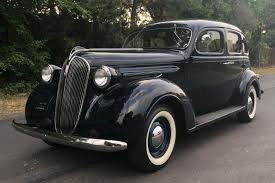
Old Nellie
Note: Even the most casual reader of this site will no doubt take notice of the plethora of two and four wheeled vehicular photographs that appear herein and wonder about the reason for their inclusion. Wayne is not mechanically inclined, but he favorably recalls almost ALL of the modes of transportation he has ever owned, so much so that he insists on including visual representations of them here!
One of the six TorKays found himself working in the middle of rock royalty in the early 1970s, years after the band members had gone their own ways. Kirk Bressler had joined the Marine Corps after the TorKays broke up in 1965. There, he became an expert in avionics, able to wire any Marine Corps aircraft to fight and fly. In 1972, Kirk was a civilian living in Tulsa, Oklahoma when legendary rock star Leon Russell bought an old stone church there and announced his plan to turn the church into a recording studio.
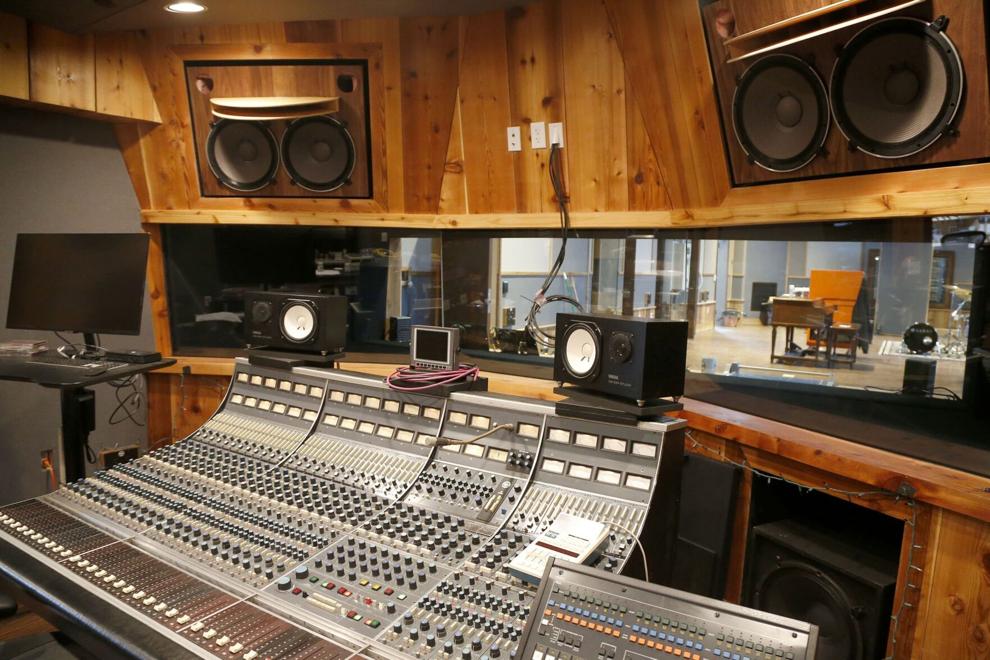
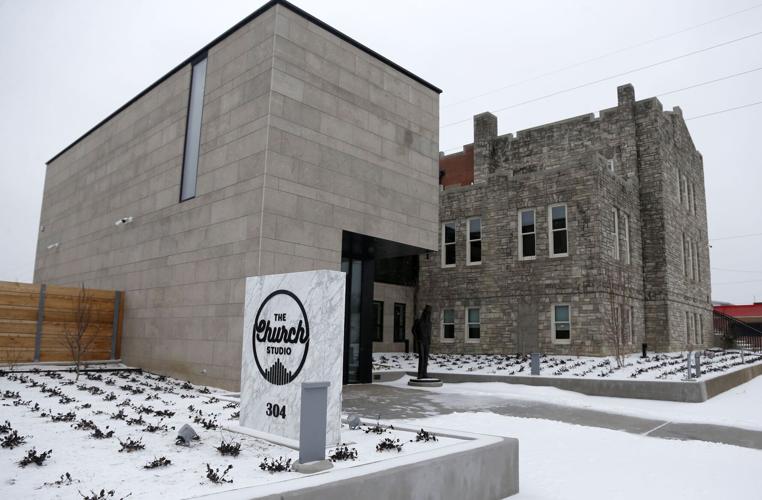
Above: Leon Russell’s stone Church Studio in Tulsa, Oklahoma
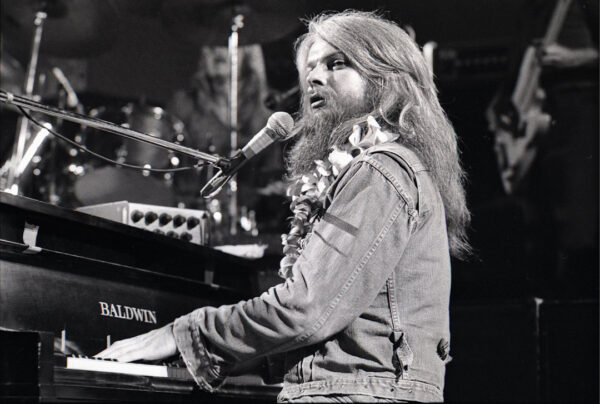
The Man Himself, Leon Russell
Russell put out the call, near and far, for help in making that happen, and nobody was any closer than Kirk. He had a hand in wiring up every sound board, microphone, speaker and amplifier. For the next decade, all the famous rock performers wanted to record there, so Kirk rubbed elbows with the biggest stars, from Petty to Clapton and Dylan to Joplin.
When the studio was sold in 2021, Tulsa World magazine published a commemorative article and interviewed former employees, including Kirk. During the interview, Kirk was asked if he was ever IN a band or if he was strictly interested in the engineering side of the recording process. Kirk replied, “In high school, I played guitar in a band that majored in R&B.” Undoubtedly, the TorKays!
There were other bands and other musicians, but those first four years with those “almost like brothers” guys put Wayne on a musical path he would never forget. He hauled his trap set around for decades, used them in various combinations of other performers and even bequeathed them to his sons, but Wayne’s boys saw them as old-fashioned “toys” that couldn’t be equalled by the electronic wonders of their own generation. Eventually, Wayne sold the Ludwigs in 1998 to help pay for the pressing and packaging of his first CD. He had found a new instrument on which to focus his attention: the six-string guitar. But more on that later.
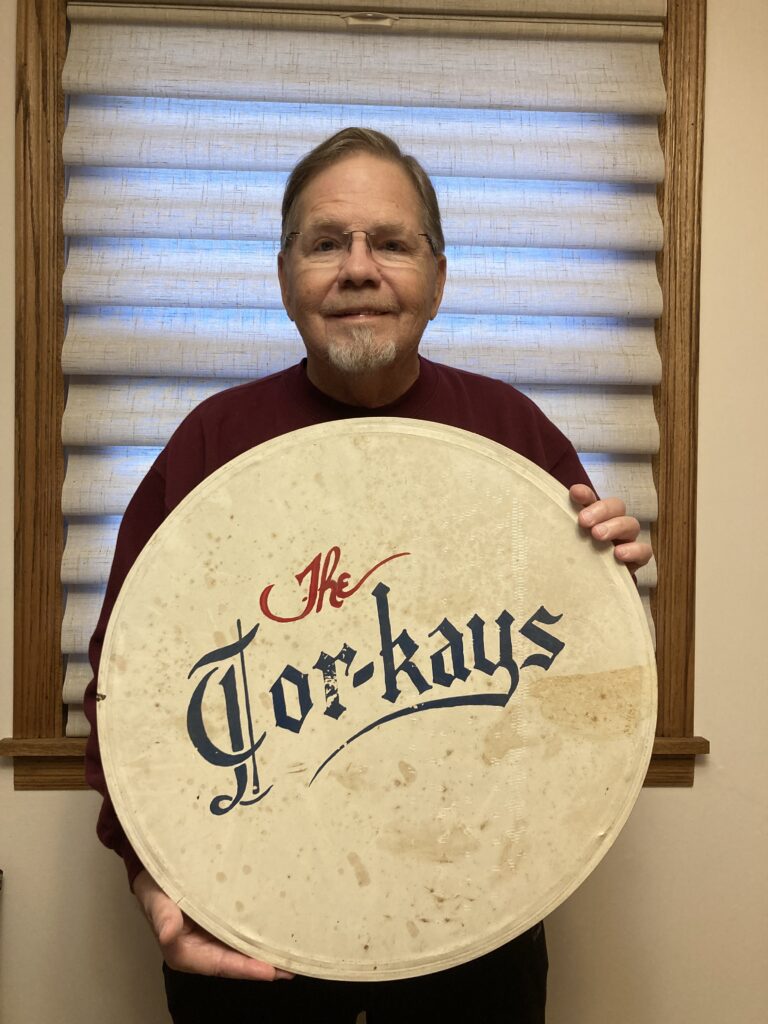
The last vestige of Wayne’s Ludwig drum set
In summer months, Wayne was also an Amateur Athletic Union (AAU) competitive swimmer from age 12 to age 18. His family belonged to the popular Greater Annandale Recreation Center (GARC) where Wayne’s coach, Ed Solotar, regularly led GARC age-group swimmers to the championship of the Northern Virginia Swimming League (NVSL). Just a few years later, Coach Solotar guided swimmers from around the country to Olympic Gold Medals.
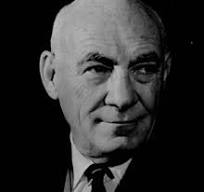
Wayne’s Swimming Coach Ed Solotar, 1908-1984
As soon as he was eligible (age 16), Wayne earned his Red Cross Senior Life Saving and Water Safety Instructor certificates and got paid to manage swimming pools, coach AAU swim teams and teach people of all ages how to swim. Wayne loved his summers!
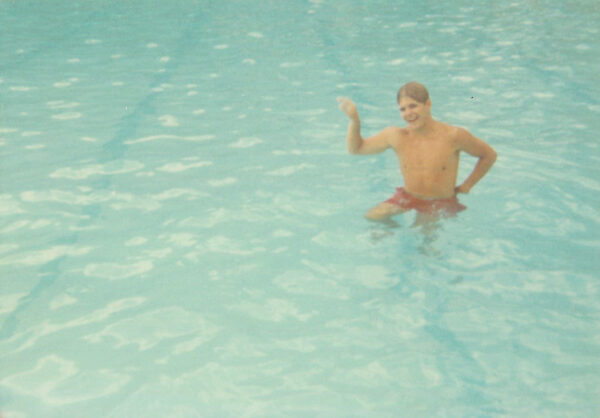
Wayne headed for his next shift on the guard chair
He woke up early, put on a swimming suit, a T-shirt, some flip-flops and was at the pool where he was coaching before 9 am. It was coaching, then class lessons, then private lessons, then the pool opened at noon. Thirty minutes for lunch and/or dinner, depending on his schedule, and he was back at “his” pool for a final backwash, then lockdown and lockup at 9 pm.
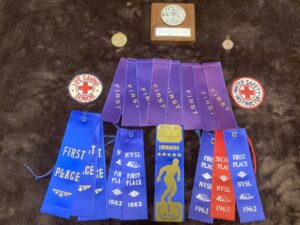
Some of Wayne’s memorabilia from swimming, coaching and being a lifeguard
It was during those golden days of summer that Wayne befriended a fellow NVSL coach named Dennis Shaw. Dennis, four years older than Wayne, was not only a friend, he also advised Wayne to “check out” his own undergraduate alma mater, Emory & Henry (E&H) College, located in the Southwestern corner of their home state of Virginia. Dennis thought his college would be a perfect fit for Wayne.
After Dennis graduated from E&H, he became a teacher and coach at T.C. Williams High School in his home town of Alexandria, which boasted the first racially integrated football team in the state. In 1971, T.C. Williams won the state championship in football, and Dennis was on the mixed-race coaching staff of that remarkable team. It was such a remarkable story that it resulted in the release, in 2000, of a major motion picture starring Denzel Washington titled “Remember the Titans”.
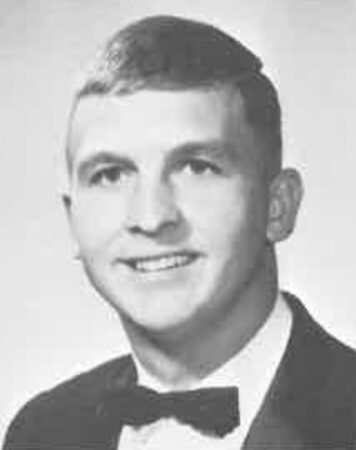
Dennis Shaw
In Wayne’s early teens, Dad had Old Nellie at his job in Arlington, Mom worked retail hours, which no one in the family could figure out, and his brother had his own car and after-school job. Wayne could sometimes share a car with his sister, but the company he worked for staffed pools that were all close to his family’s house.

Wayne’s Lambretta V200 scooter
The money Wayne made from the TorKays enabled him to buy an old Lambretta scooter to zip around in. It was all beat up, but he never had far to go and a tank of gas lasted him a long time. And in those days, gas was only 25 cents per gallon, so he could always get where he needed to go!
FIRST LOVE: LIVE PERFORMANCES ON STAGE
Wayne’s fondest performance memories take him back into those age-old elementary school “plays” that were written and staged by the students in each class, one at a time, for all the OTHER classes. Though they weren’t supposed to be competitive, each class definitely tried to “out-do” the others! Some students, like Wayne, had those competitive “hooks” go so deep into them that they were forever affected in every artistic effort of their lives.
To this day, he still remembers a “commercial” he and a committee of 7th graders wrote for their show’s entry into that year’s “dramatic competition”. It was a lyric for their “sponsor’s” TOOTHPASTE product, named AJAX TOOTHPASTE, and it was sung to the tune of an existing TOILET-CLEANING product (also named “AJAX”) that everyone heard on their television sets at home every day. Wayne doesn’t recall which 7th grade class WON the competition that year, but he DOES remember his class got a huge laugh when their “AJAX choir” sang it at the competition:
USE AJAX, THE FOAMING TOOTHPASTE
WATCH YOUR TEETH FLOAT DOWN THE DRAIN
WHEN YOU START BRUSHING THE AJAX WAY
YOU WON’T EAT NOTHIN’ BUT MUSH ALL DAY
SO USE AJAX THE FOAMING TOOTHPASTE
WATCH YOUR TEETH FLOAT DOWN THE DRAIN!
Try as Wayne might in sports or jobs or anything else, the urge to “perform” was never to be denied. Theatrically, this undeniable urge began as a high school Junior, when a female classmate named Mary Pagliero grabbed him by the wrist, looked him fiercely in the eyes and said: “You’re coming with ME!” He was summarily dragged to the high school auditorium and told exactly what to do at his first audition for that year’s “HIGH SCHOOL MUSICAL.” In this case, he was told he was auditioning for “a part” in My Fair Lady. The next day, he discovered he had earned the part of “Colonel Hugh Pickering”. This, apparently, was “a comic lead role”, which required him to speak with an upper-class British dialect and sing a solo titled “You Did It”!
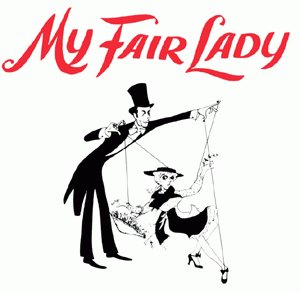
Unfortunately, neither his character nor his name was included in the beautifully printed program for the show. Rather, they appeared on a cheap, blue-ink mimeograph sheet that was folded into every program. At the top of the sheet was the word “OMISSIONS”. Strangely, none of this bothered the young man, who was met with great applause and laughter at each performance and couldn’t WAIT for auditions for the HIGH SCHOOL MUSICAL in his Senior year!
AN UNEXPECTED (AND SHORT) TRIP NORTH
Before Wayne ended his Junior year of high school, he had a conversation with his girlfriend, who politely requested that he take his birthday OFF. When he asked why, she told him, “That’s a Sunday, so there’s no swim meet, no lessons, USUALLY no gigs with the band and I’ve got someplace I wanna take you that will require us to be together all day long. I’ve already talked to your parents and mine about it and they approve of my plan 100 percent! It’s a surprise, so you’ll have to be patient.”
“OK, then.” said Wayne. “I’m all yours on June twenty-first!”
When they talked on June twentieth, the mystery continued. “All set?”, Wayne asked.
“Yup. I’ll be picking you up at 5:30 tomorrow morning! Dress comfortably, but not grubby. Wear comfortable shoes you like walking in. I want you to look good. You won’t regret it!”
“OK. But Five THIRTY?” She had already hung up.
Wayne knew her car a block away. It was so small, the headlights looked like they were a yard apart. Her father had bought her a used 1962 Nash Metropolitan, which was perfect for her, because both were small. And she loved it:

1962 Nash Metropolitan
She pulled up, Wayne hopped in and she headed for the Beltway. It didn’t take Wayne long to figure out where she was going. She was headed downtown. What could be in downtown DC this early in the morning for the two of them? Then she pulled into the parking ramp at Union Station, got out, locked the car and headed toward a specific train, with Wayne hustling at every step to keep up. Then she suddenly stopped, handed Wayne a piece of paper and said, “Here’s your ticket. Don’t lose it. I get bored if I don’t have somebody to talk to.”
Wayne looked at the ticket and hollered, “WORLD’S FAIR?!?! We’re goin’ to the World’s Fair!? IN NEW YORK CITY? COOL!”
“That’s right”, she replied. “Now let’s get a move on. We got a long day ahead of us!”
And a long day it was. The train to New York was operated by the Pennsylvania Railroad, so their train went by way of Baltimore and Philadelphia and took about three hours to get to New York. The Fair didn’t open until 10 am on Sundays, so when they pulled in to New York, they had a little walk from Penn Station to Grand Central Station, then up 42nd Street so Wayne could see all the theatres where the Broadway plays were being performed.
The size of the Fair itself was about 650 acres, on which 139 pavilions, 34 concessions, 66 countries, 350 companies and a wide variety of other entities displayed their wares in one way or another at the Fair, and it soon became evident to the young couple that they were not going to make a sizable dent in seeing much of it during their short visit. But he did see one item he just HAD to have for his dad, something he didn’t mind hauling around all day on this longest of long days.
They decided to split their time between the Fair and the City, having lunch at the Fair and dinner at a little restaurant in Greenwich Village. They took a carriage ride through Central Park and walked through Rockefeller Plaza, where they were stopped by a man in shirtsleeves who asked them if they had a half an hour of time to be part of a studio audience for a taping of a game show that would be aired “next week”. When they looked up over his head they saw ‘NBC Studios’ brightly lit over the doorway. “Just laugh on cue and applaud when they tell you it’s time for a commercial…it’s fun and you can tell all your friends when to tune in. They might even see you on camera! C’mon in!” So they gave the game show a half an hour…what the hell?
The Fair grounds closed at 10 pm and the Pennsylvania Railroad gave passengers to Washington an hour to get back to the departure gate. The young couple had a lot to talk about, but that only lasted for about an hour before they fell asleep in each others’ arms. The train pulled in to DC’s Union Station about 3 am (according to the conductor, the stop in Philadelphia took a little longer than usual).
She drove very carefully across the Potomac back into Northern Virginia and stopped in front of Wayne’s house about 4 am. “I’ll call you when I wake up, which should be about Thursday,” she said. “Don’t forget your gift for your father, m’K? He’s a real sweetheart.” as Wayne stumbled out of his side of the car and made his way around to her side.
Wayne held up his specially packed gift for dad to reassure her. Then he told her, for the hundredth time that day, “Thank you for this special day,” followed by “You sure you don’t wanna crash here?”
“Our ‘partment’s only a few blocks from here, ‘member? Bye…” she said as she let the car slowly roll away from Wayne and toward her parent’s nearby apartment. Wayne waved and watched until her tail lights disappeared, then turned and walked across the lawn up to the front door. He quietly walked into the kitchen and cleared a place at the center of the big breakfast table. Then he unwrapped the package he’d hauled around New York City for at least half a day and put it on the table. No question who this gift was for:
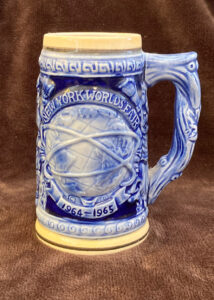
Then he switched off the lights and climbed up the steps to the bedroom he shared with his brother, mentally patting himself on the back for finding a substitute and taking today off from his swimming pool/coaching/swim lesson responsibilities. He never even noticed his mother, fast asleep on the living room sofa.
SENIOR YEAR: CLOSING THE DOOR ON HIGH SCHOOL
As he promised himself, he auditioned for his Senior-year musical, which was Carousel. And the young man once again earned “a comic lead role” as “Enoch Snow”, a character with a round-bottomed boat, a New England dialect, an adoring wife (played by Debbie Twardy), nine children and a production number about his job as a herring fisherman. So performing in high school musicals was where his love for theatre actually began.
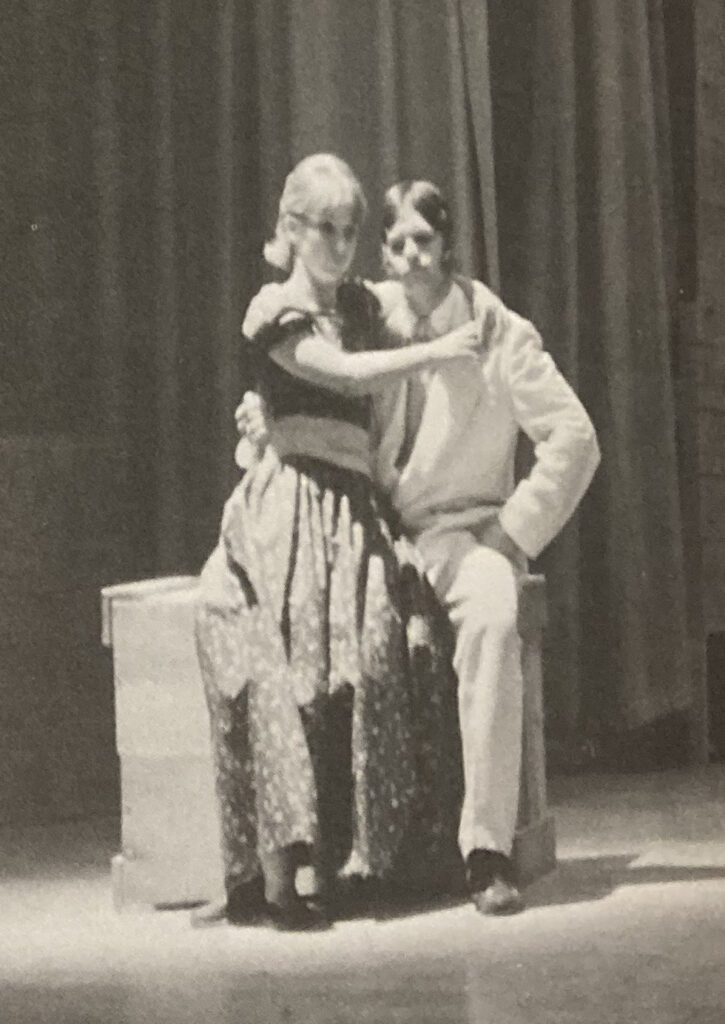
Wayne with Debbie Twardy as Mr. and Mrs. Enoch Snow in Carousel.
As a senior, he also earned a part in the non-musical Senior Class Play, The Girls in 509, won a cash prize for doing something in the school’s talent show, was inducted into the school’s chapter of the National Thespian Society and sang baritone in the school’s choirs.
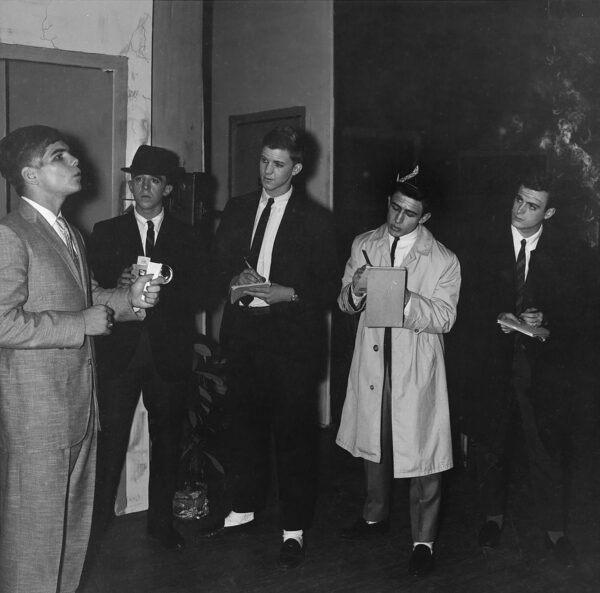
Wayne (L) as Winthrop Allen in The Girls in 509. Other players (L-R) include Jim Tomacelli, Bob Simmons, Mike Albro and Mike Nolan
As an athlete, Wayne competed on the school’s wrestling team for two years and one match. That means he learned as many moves as he could in his sophomore year but never qualified to put on the Junior Varsity or Varsity uniform. In his Junior year, he qualified to wrestle EVERY Junior Varsity match (front row, third from the right) and was UNDEFEATED, winning every match against opposing schools!
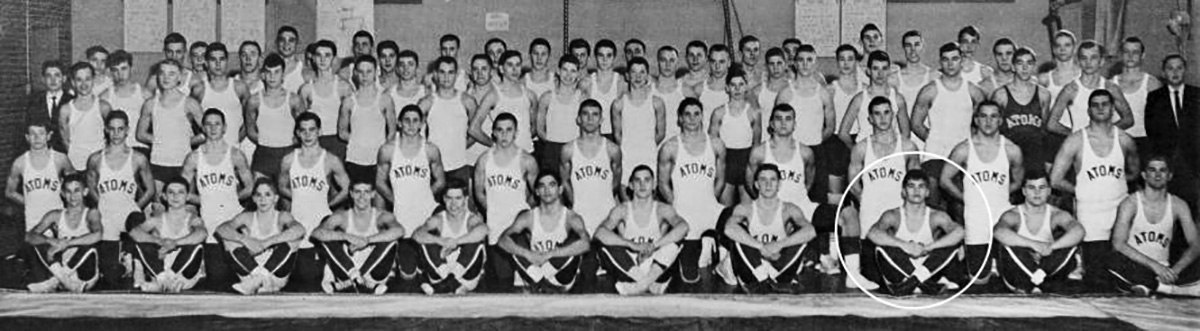
AHS Wrestlers, 63-64 academic year
In his Senior year, he qualified to wrestle Varsity for the first match of the season; however, ahead by one point late in the third period, he felt and heard a POP in his left shoulder, which made his left arm useless. Despite his best efforts, Wayne’s opponent pinned him and Wayne LOST his only Varsity match! It was his ONLY Varsity match because the doctor pronounced Wayne OUT FOR THE SEASON. With all that extracurricular activity, he somehow managed to pass all of his classes and graduate with the other members of his class.
Wayne never understood nor questioned how the parents and/or officials of his high school pulled off what Wayne called “two HUGE honors” for the Class of 1965: somehow, they had the connections or the money or whatever it took for Annandale’s Baccalaureate Service to be held at the NATIONAL CATHEDRAL in Washington, DC! Wayne was a member of a select choir that sang from the chancel at the front of the cathedral that day!
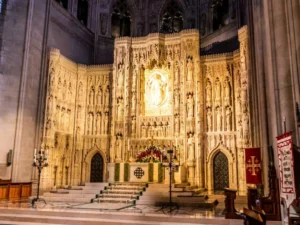
The High Altar at the National Episcopal Cathedral
In addition, the actual Graduation Ceremony also occurred in Washington, at the largest concert hall in the city, CONSTITUTION HALL, with more than 3700 seats, owned and operated by the Daughters of the American Revolution (DAR)! What a sendoff for the members of his class; the memory still brings back pride and gratitude.
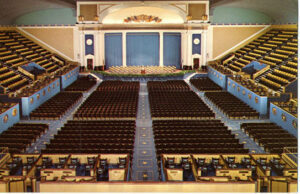
Constitution Hall
COLLEGE AWAITS AND OPPORTUNITIES ABOUND

Wayne was told by counselors at Annandale high school that the smaller the college he chose, the more personal attention he could expect to receive from his professors. The first college that accepted him was twice as far away from home and had 20 times the number of students as the second college, so the choice was easy. He chose the smaller, closer school, Emory & Henry (E&H) College (now University), named for Methodist Bishop John Emory (1789-1835) and Virginia patriot (“Give me liberty or give me death!”) Patrick Henry (1736-1799).
This was the school recommended to him by his coaching friend, Dennis Shaw. Affiliated with the Methodist Church, the school is located in the Appalachian Mountains of Virginia, within sight of the highest geological point in the state, Mount Rogers, just 30 miles from the Tri-Cities (Bristol, Kingsport and Johnson City) area of East Tennessee. At that time, the entire student body numbered less than 800.
It turned out to be the right move. Wayne’s official “Major” was Economics, the equivalent of today’s Business degree. His “Minor” was English. There was no Theatre major. They only had one professor, H. Alan Pickerell, who taught theatre classes (including acting, directing, technical theatre and theatre history), and he only had a budget for producing two plays per year, one of which was typically a musical.
So for the next four years, Wayne took every theatre course offered and was involved in every musical and “straight” play mounted at the college. They included plays like Becket, by Jean Anouilh, The Drunkard, by William Henry Smith, The Fantasticks, a musical with lyrics and book by Tom Jones and music by Harvey Schmidt, and Guys and Dolls, with script by Jo Swerling and Abe Burrows and music and lyrics by Frank Loesser.

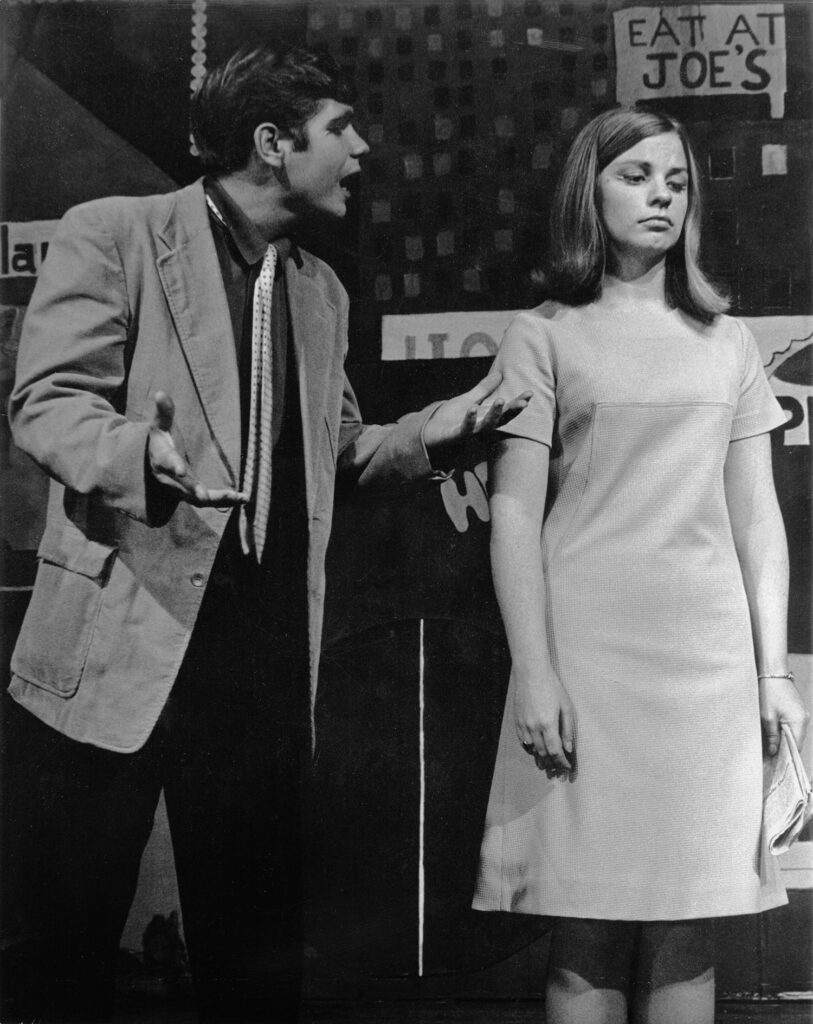
As Nathan Detroit in Guys and Dolls, Wayne Sings “So Sue Me” to Irene Mathieson

Wayne also directed a mainstage production of Picnic, by William Inge, his first opportunity in that position. Pickrell, this same versatile theatre professor, was also the only professor teaching classes in Speech, which proved in later years to be lucrative for Wayne, since Pickrell also gave him a considerable amount of training in Stage Dialects and The International Phonetic Alphabet.
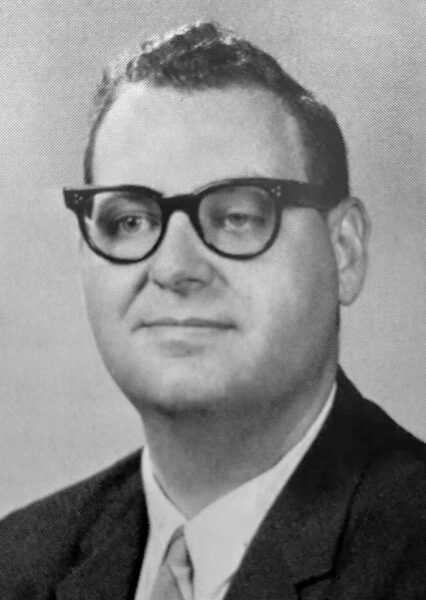
Alan Pickrell
Costuming in small-college theatre was always a challenge, and that was true in Becket. He had to borrow a pair of boots to complete his “Baron” costume. They were too big for him, making it difficult for Wayne to keep his balance and even walk normally. So when the murder scene arrived on opening night, Wayne and the other murderers burst onto the floor of the audience level and rushed to a staircase that led to center stage, where the Archbishop was leading a service. UP the stairs all the murderers ran! Except for Wayne, the last murderer in, who slipped in his too-large boots and fell flat on his ass at the foot of the stairs, right in front of his father and brother in their front-row seats!
The fall was so comical and out of place that the entire audience exploded with uproarious laughter. They KNEW this wasn’t supposed to happen, but they simply couldn’t contain themselves! Wayne scrambled to his feet, saw his family members laughing, HEARD the entire audience laughing and, as he flew up the stairs with his wooden, painted-to-look-like-steel sword, jammed that faux instrument of death into the belly of the “Friar” character he had been directed to “kill”, played by good friend in real life, Bob Rathburn. Then, as directed, Wayne grabbed the tunic of the still laughing, supposed-to-be-dead Rathburn and slammed him, face-first, to the floor of the stage behind a large, painted “stone” (made of plywood), ostensibly where the audience could no longer see him.
Oh, would that it were true. With the murders done, and the carnage evident everywhere, the audience started to settle down, take it all in, and be quiet. But seconds later, the poor “dead” lad simply couldn’t help himself. On his belly, thinking he was out of sight, Bob began to laugh again, which made his sandal-clad feet begin pumping up and down, up and down, faster and faster. The laughter began to rise again, both in the audience and on the stage! Fortunately, the Stage Manager at that instant called for a blackout to end the scene. For days thereafter, Wayne was met with smiles and chuckles as he passed others on the campus sidewalks. He simply kept his head down and kept walking. His friend Bob forgave Wayne for the injuries he inflicted upon him, which included a large bruise near his bellybutton and a bloody nose. For that forgiveness, Wayne was grateful.
Though he was no academic fireball, Wayne was inducted into the college’s Chapter of the Alpha Psi Omega National Dramatic Fraternity as a Sophomore and served as its President during his Senior year. Wayne was also chosen to be a member of the Blue Key National Honor Society, which recognizes college Seniors for all-around excellence in scholarship, leadership and service.
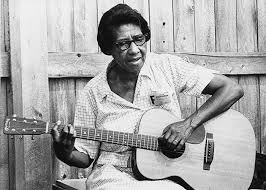
Elizabeth (Libba) Cotten
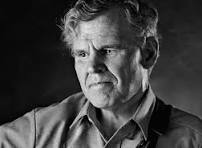
Doc Watson
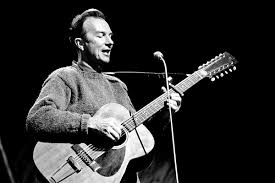
Pete Seeger
Wayne admitted to a bit of hero worship at E&H when he had opportunities to meet and talk with musical favorites like Pete Seeger, Elizabeth Cotten and Doc Watson and modern playwrights like Arthur Kopit, who attended a rehearsal and spoke to the cast about his play Oh Dad, Poor Dad Mamma’s Hung You in the Closet and I’m Feelin’ So Sad, then in production at E&H.

Arthur Kopit
His part in Kopit’s play (Jonathan) was a turning point for Wayne, but only because it was reviewed by a young English professor at E&H named R. Lamarr Smith, who wrote a review of the show for the college newspaper, The White Topper. In part, Smith wrote:
“A great part of the success of the production…is a consequence of the quite brilliant and inspired acting of Wayne Hamilton in the role of Jonathan. From the moment of his appearance on stage…his is a flawless performance. …If I have singled out Mr. Hamilton for special recognition it is because he most perfectly met the ‘sole demand’ I make of an actor; that he permit me to believe in the character he is creating. Each actor in Oh Dad had for me his great moments…for Wayne Hamilton it was first line until last – a remarkable performance.”
Wayne also became a fan of Shakespeare at E&H, thanks to the Chairman of the English Department, Dr. Marius Blesi (pronounced “blay-see”). Before hiring Professor Pickrell a year or two before Wayne’s arrival, Dr. Blesi was the faculty member in charge of teaching most of the theatre courses at E&H and the person who directed all of the live theatrical productions on campus.
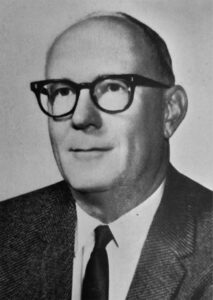
Dr. Marius Blesi
By the time Wayne arrived, Blesi was teaching ALL of the Shakespeare courses, and Wayne took every one he could get. Blesi’s approach was to assign parts to his students in whatever play was under scrutiny and READ THE PLAY OUT LOUD IN CLASS! Blesi would only stop the reading to explain a word or phrase from Elizabethan English, after which reading would recommence, followed by the usual English-class discussion, papers, etc. Borrowing from television’s Johnny Carson, Dr. Blesi called his readers “The Mighty Blesi Art Players”.
Sports-wise, E&H offered no wrestling and no swimming, so Wayne’s extracurricular activities were limited to theatre, choral music and fraternity endeavors. That is, until Wayne decided to put together an R&B band! This was early in 1966, at a time when many small schools, especially in the Southern states, admitted only Caucasian students.
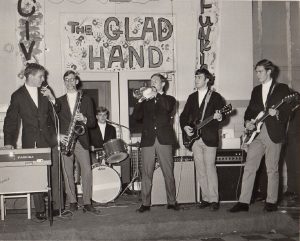
L-R: Jody Huskey, Ken Bondurant, Wayne, Harvey Perkins, Heath Jones, Claus Carr. Not Pictured: Bill Lamb, Harvey Johnson
Wayne’s band, “The Glad Hand”, was eventually kept VERY busy playing gigs throughout Southwest Virginia and East Tennessee at the many high school and college campuses that populated that part of the country. This provided an incomparable source of income while he attended undergraduate school! But the rules of the college complicated “band bookings” during the Spring of 1966 because Freshman students were not allowed to register their cars on campus. Fortunately, the group got help from upper class friends and fellow freshmen who lived locally and “borrowed” family cars. One way or another, the band got help transporting all of its gear to and from its earliest gigs.
The picture above was taken early in the band’s existence. The Farfisa keyboard was replaced by a Hammond B3 organ with a Leslie tone cabinet, the horn players pictured (sax and cornet) also included a trumpet, there were TWO lead singers (the organist and the drummer), and every other player in the band sang backup!
The band members were each good enough musicians to remember all the tunes they had put together for three months during summer vacations, AND good enough scholars to continue performing together until the majority of the band graduated in 1969!
Wayne also auditioned for the choral program at E&H. Each student who was accepted into the college’s choral program was required to sign up for a one-credit course EACH SEMESTER and meet for an hour-long class by section (lyric and mezzo sopranos, alto, contralto, baritone, bass, first and second tenors) each week with the choir director. Freshman students sang at weekly convocations and Sunday church services, rehearsing the music at an additional meeting each week. Wayne’s goal was to get through the first year and then audition for the CONCERT choir, the touring choir, the best choir on campus, where he would perform for the remainder of his college career and tour annually to some far-off destination at some point during the spring semester each year, usually during Spring Break.
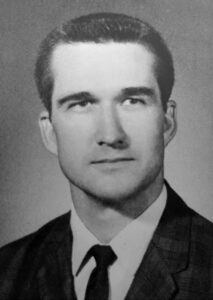
Charles R. “Chick” Davis
Ordinarily, the one choir director on campus, Charles “Chick” Davis, would work with every student enrolled in choral studies. This year (65-66), however, Mr. Davis was completing his doctoral studies in music on the campus of Indiana State University, then and now one of the finest vocal music education programs in America. So, Wayne’s first year would be under the tutelage of a substitute, one of Mr. Davis’ former students, a Mr. Henley Denmead, who, like Davis, had already earned his MMus degree.
Wayne was scheduled to meet with Mr. Denmead one hour per week with other baritones in “Class Voice”, where they would learn not only the finer points of vocal production, but also the Baritone parts of every piece of music the choir was scheduled to sing.
During their initial class meeting, Mr. Denmead had each student sing a vocalise up the scale, matching pitch with the piano in order to determine that student’s “range”; e.g., the lowest and highest notes the student could effectively sing. When it was Wayne’s turn, he started out at a comfortable point with Denmead at the piano and moved up the scale a half step at a time. Eventually, Mr. Denmead stopped and said, “Well, Mr. Hamilton, I don’t know who’s been telling you that you are a baritone, but to MY ear, you have a vocal range that’s more in line with a second tenor! Let’s talk about changing your schedule so you can meet with the tenor voice class.”
As it turned out, this discovery by Mr. Denmead was a distinct advantage to Wayne. Not only was Denmead a tenor, but the director of Wayne’s vocal future, Mr. Davis, was also a tenor. Wayne believed this fact accelerated his vocal development during the next four years and made him a far better singer!
On top of all that, the music “inside” Wayne was limited. Through high school, he had been a drummer and singer. But he felt an increasing urge to create new songs of his own. He had no trouble creating lyrics and melodies, but didn’t play an instrument like guitar or piano that would solidify the melody and “tie” it to the lyric. When he arrived at E&H, he found himself surrounded by young men who played every kind of stringed instrument imaginable. Of the 24 men on his residence hall, (the third floor of Matthews dormitory) he was one of four who did NOT play some kind of stringed instrument. But Wayne concocted a plan to change that.
While he was home during Christmas break of his Freshman year, Wayne drove over to visit one of his old band mates from the TorKays, Mike Dattilio, who had been one of the two sax players. Mike was on his Christmas break as well, from Northern Illinois University. Wayne remembered the six-stringed Harmony guitar Mike had hanging in his room at home, but didn’t remember ever seeing him play it. After comparing notes on their first college semester, Wayne offered his old friend twenty bucks for the old guitar decorating his room. Without a word, Mike pulled the guitar off the wall and Wayne handed him a twenty dollar bill.
The guitar had been made for steel strings, but somebody (maybe Mike?) had used a fingernail file to widen the nut slots so they could accommodate thicker nylon strings. That made learning chords easier for a novice player. Even then, Wayne played the instrument until his fingers ached. Given the talents of the men in his dorm, he had free guitar lessons available to him whenever he wanted them. By 1968, Wayne was writing original songs and to this day, most of his chord progressions have been developed with his twenty-dollar Harmony guitar, which hangs on his office wall, not in a case, ready to “go to work” 24 – 7! Wayne has been a member of ASCAP (the American Society of Composers, Authors and Publishers) for decades and invites readers to visit his MUSIC page on this site.
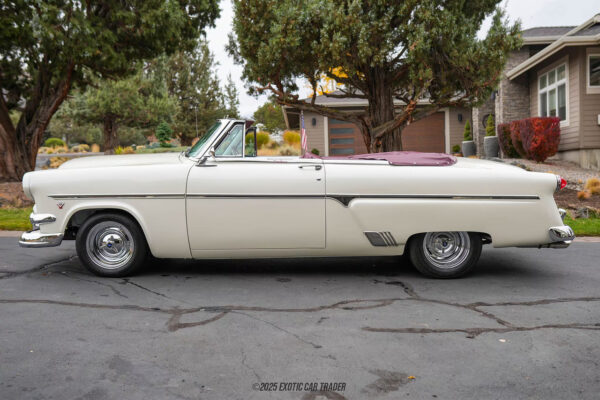
At the beginning of his Sophomore year (1966-67) Wayne’s parents transported his clothes, his drum set and a few books from Northern Virginia back to the E&H campus. He still didn’t have a car of his own, but thanks to the Glad Hand and some of the “extra” money his loving mother put in his bank account, he soon had enough money to buy one. Wayne heard about a 1966 graduate who had a Ford convertible with a V-8 engine in it. And it was for sale. Something about the sound of “a V-8 engine” appealed to Wayne, so he approached the seller and made him an offer. Then the two drove ten miles to Abingdon, transferred the title at the Department of Motor Vehicles office there, and Wayne became the owner of a car that looked something like this:
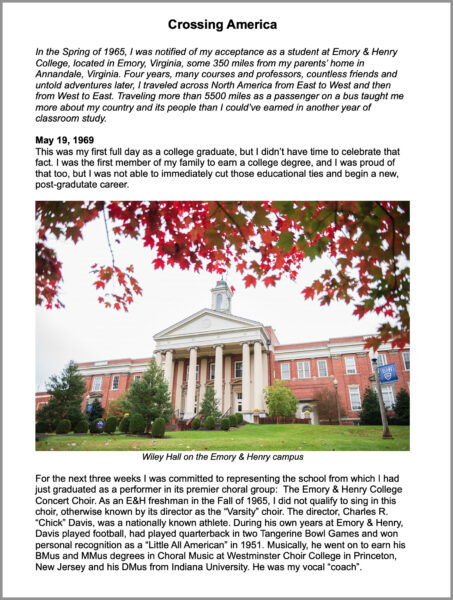
The day after he graduated from Emory & Henry College in May of 1969, Wayne did not immediately rush into a new civil service career in the Washington, DC metro area. Rather, he had made a commitment to Dr. Davis when he started his Senior year for what seemed to be an exciting adventure in music. Throughout Wayne’s Senior year, Dr. Davis had been planning a three-week tour by the Concert Choir from Southwest Virginia to Vancouver, British Columbia and back. This was Wayne’s first trip to another country, a fact worth noting. And not only was Wayne invited to participate after he had graduated, but he was also given a tenor solo to perform in the choir’s program. Click below to hear Wayne’s “big moment” in each performance as the E&H Concert Choir “crossed America”:
On that journey, Wayne brought a “steno pad” and tried to keep a meticulous record of the trip from his perspective. Though his effort is not meticulous, it does contain an acceptable level of detail, is accompanied by pictures and also contains audio files of the choir’s journey. Wayne has often said that those three weeks were like an additional year of study at E&H, in terms of what he learned about America and the wonderful people who live here. In story, photos and audio files, it tells the tale of that three-week trip and some of the adventures that unfolded while the group was on the road. Readers may open (click) the PDF link below and read it from this site OR download the entire PDF document to your device OR save it OR send a link to friends. It’s a true story titled CROSSING AMERICA. It is dedicated to all members of the E&H Concert Choir, past, present and future.
HOME AGAIN TO A DIFFERENT LIFE
High School and College were successfully completed, and Wayne had just returned home from a tour of his country that taught him much about the geography of his nation and the people who populated it. He was grateful for that opportunity and calls those three weeks his “fifth year of college”.
Here was Wayne, fully educated in the late 1960s with a war raging in Southeast Asia and, like most of the males in his generation, facing what they called “the draft”: MANDATORY service in the United States military and possible postings in deadly war zones to “protect America’s interests”. As early as age twelve, Wayne thought he might follow in his father’s footsteps and join some branch of the military as a life path. However, his diagnosis with diabetes disqualified him from service in any branch of the military.
Nevertheless, after he graduated from college, he was “called up” for a physical. This meant that the United States Army ordered him to report to a specific address on a specific day at a specific time. If he passed the physical exam, he would receive a “1A” rating and would be ordered to report for duty in the United States Army, perhaps on the very day he had been declared “1A”!
When Wayne was notified to report, he called his endocrinologist and got an appointment, where he was given a signed statement testifying that Wayne was a Type 1 Diabetic and should be classified as “4F, Ineligible for Service”.
At the Army’s testing station, every man was ordered to “strip to the waist” and was given a sheet of paper that showed a series of “checkpoints” each man was supposed to visit, things like WEIGHT, HEIGHT, etc. When you had visited all the checkpoints, you went into a big room where everyone was gathered, give your sheet of paper to a grizzled old sergeant, put your shirt back on and waited.
The weird part for Wayne was, after he’d been to all the checkpoints, he still had the statement from his doctor in his hip pocket. None of the checkpoints he visited gave him an opportunity to share that information!
Suddenly, the grizzled old sergeant stood up and said, “All right, you grunts! Outside that door (and he raised his right forefinger ominously) are a number of green US Army busses. If I do not call your name, you will exit the building through that door (again with the forefinger) and take a seat on one of those busses. You will be taken to our state capitol of Richmond and inducted into the United States Army TODAY! If I DO call your name, consider yourself ineligible for service in this man’s Army. You are relieved of your obligation to serve.”
At that point, the sergeant spoke about 5 names and finished with: “That is all! Now MOVE!” Wayne’s name was not one of those he spoke. Wayne was stunned. He pulled the note from his pocket as he stumbled toward the sergeant’s table, saying, “I’m sorry, sergeant, there must be some kind of misunderstanding…”
“MISUNDERSTANDING? DO YOU HAVE ANY IDEA HOW MANY TIMES A WEEK I HEAR THAT FROM GRUNTS LIKE YOU? What is your problem, mister?”
“Sir,” Wayne croaked, hoarsely, “I’m a Type 1 diabetic. I have a note here from my doctor…”
“WHAT? Gimme that note!” The sergeant practically ripped the note from Wayne’s hands. He read it, dropped it on the table and tore into the checkpoint sheets until he found Wayne’s. He skimmed the front side, then the back side and stopped about halfway down. “Crap! DUMMY! You never stopped at the doctor’s checkpoint! Number seventeen! Get back there now and pray he’s still here! Git!”
Wayne half ran, half stumbled back into the checkpoint maze, found the doctor and without even explaining himself, handed the doctor the checkpoint sheet and his doctor’s statement. The doctor, first smiling, then chuckling, said, “Don’t feel bad, man. You’re the fifth person this month who’s missed me with some kind of 4F problem.” He scribbled something on the checkoff sheet, stapled the two sheets together and handed them back to Wayne. “Take this back up front. And don’t worry about the Sarge. He’s a pussycat… GO!”
Wayne couldn’t get “back up front” fast enough. There, the sergeant gave Wayne a card that he’d stamped “4F” on and told him he’d get a letter from the draft board within two weeks making his ineligibility official. Then he sat down at his table and ignored Wayne, who quickly left the building and drove home.
A CHAT WITH DAD
Like many men in his father’s generation, Wayne’s dad willingly enlisted for service in 1941, when Japan’s attack on Pearl Harbor dragged America into World War Two (WWII). His parents quickly married, and mom followed dad around to his training stations in places like South Dakota and Texas, living off base with local couples offering free room and board to Army Air Corps wives as dad worked his way toward becoming a Technical Sergeant in B25 bombers.
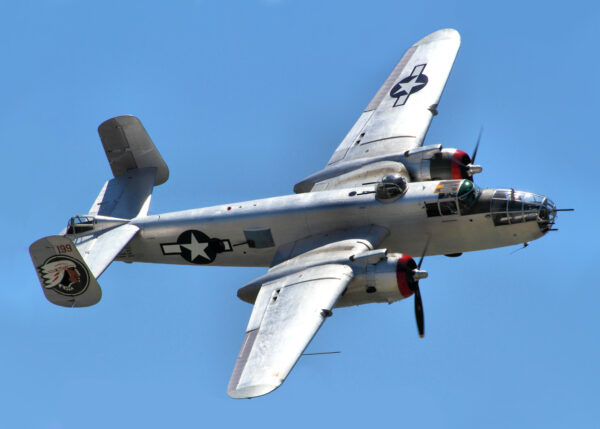
Wayne’s childhood was deeply affected by both his parents: the heroism and traumas of his father in what we now call Post Traumatic Stress Disorder (PTSD) and the positive coping influences of his mother through her love of her husband and popular post-war-era music. After his discharge from service, Dad’s technical expertise earned him a civilian job at the Veteran’s Administration as the first programmer of the first mainframe computer ever purchased by the Federal government (it was a Sperry Univac)!
Today, at age 22, Wayne had some choices to make, and he went to his dad for advice. Wayne knew dad was smart. He once got a peek at dad’s high school report cards…straight A grades. Wayne was good at figuring out problems, but not if they involved numbers or scientific formulas. Wayne was better with personal, human, or organizational problems. Because dad needed to earn an income as soon as he left the military in 1945, he never got a chance to attend college. Therefore, if he “made the grade” in high school, Wayne would become the first member of the Hamilton family to ever attend, let alone graduate from, college!
Dad was not only smart, he was also generous. He told Wayne he would pay for college tuition, room and board; however, he warned Wayne that if he flunked out or dropped out, all resulting expenses would have to be paid by Wayne. This was an excellent incentive to SUCCEED!
Now he faced adulthood in a career that nothing he had studied so far had prepared him for: programming mainframe computers. And for the United States Navy no less! He was trained in COBOL and Autocoder programming languages, and while he was in training, Wayne was investigated by Naval Intelligence and the FBI, who interviewed people at Annandale high school, at E&H College and his friends and neighbors in Annandale. He was given a Top Secret clearance and assisted in the Navy Department’s transition from IBM 7080 class computers to 360 class computers.
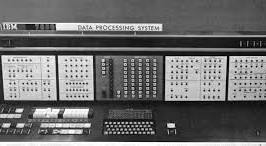
Control console, IBM 7080 mainframe
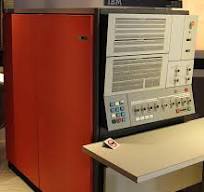
Control console, IBM 360 mainframe
His office was at the Navy Annex on Columbia Pike in Arlington, Virginia, which was originally a warehouse near the back entrance to Arlington National Cemetery, Marine Corps Headquarters at Henderson Hall and Robert E. Lee’s home, the Custis-Lee Mansion. The Annex was on high ground that overlooked the Pentagon, the Potomac River and the city where Wayne was born: Washington, DC.
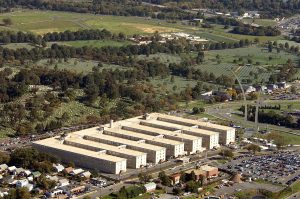
The US Navy Annex in Arlington, Virginia (1941-2013)
Right out of school, Wayne was living with his parents in Annandale. He had met his future wife at E&H. She was an Education major and alto in the Concert Choir. She hadn’t yet finished her degree work, and she wanted to teach. Her father agreed to continue paying for her education as long as she remained single, so she and Wayne agreed to wait until she finished her degree before they married.
Almost 400 miles away, Wayne worked and waited. Since their separation began in mid-1969, the least expensive form of contact was writing letters. Many letters were written, accompanied by infrequent phone calls. When opportunities occurred, he or she would drive, hitch a ride with friends or take a train ride to spend a weekend at the other end of the line.
THE DESIRE TO PERFORM IS CALLING
Alone at home, the music was always there, and the big city was loaded with places to go and listen. Moreover, many of Wayne’s work colleagues were young enlisted men in uniform who were about Wayne’s age. When they found out about Wayne’s experience working in bands, they invited him to go with them to the NCO (non-commissioned officers) clubs the Navy had set up all over DC for them. Wayne’s TorKays band had played at a few NCO clubs and USO (United Service Organization) Clubs when he was in high school.
At some point during those evenings out, a couple or ten of his new buddies would tip the band leader to get him to invite Wayne up to sing a couple of songs with the band. Sometimes “a couple” led to “several”. Naturally, Wayne was only too happy to comply. A few of the band leaders or band managers wanted to hire Wayne on the spot to JOIN the band! But while Wayne was enjoying the limelight being back on stage, he couldn’t afford to be out late every night performing. That was bound to negatively affect his job performance. So he declined such employment offers.
Wayne wanted to “get back in the groove”, but only in a situation he could control, where HE could be the band leader and only book occasional gigs. And that’s what he did. One of his sax players from high school and his B3 player from college were living in the DC area, available and interested. They put an ad in the Washington Post classifieds and quickly found an excellent bass player. In less than a week, Wayne had assembled a cool quartet and given them an appropriate name: FOUR! Living and working in Arlington, Wayne started to hunt for small restaurants and clubs that wanted music. He was lucky to find a well-known Arlington restaurant, Weber’s, that was famous for serving “aged beef”. They only wanted music on Friday and Saturday nights, and they paid handsomely.
Soon FOUR also had an invitation to perform at the Prospect House on Sundays after the Washington Redskins games. The venue was unique. Like Weber’s, it was in Arlington, Virginia, just outside the National Cemetery grounds and right behind the Iwo Jima Memorial and the Tomb of the Unknown Soldier. It was a high-rise building with a glass wall on the north side of the top floor. This top floor housed a restaurant that held an “after party” after every game, win or lose. And FOUR was hired to provide the live music for each party!

The view from the top floor of the Prospect House
Many people are unaware of the fact that the city of Washington, by Federal mandate, restricts the height of buildings within the city limits. Roughly, no building within the District may be higher than 13 floors. THIS building, across the Potomac river in Arlington, was at LEAST that high. And with its glass wall, the view of the city was unparalleled. With the check from the venue owner and the tips from the wealthy clientele, the pain of moving their gear from Weber’s to the Prospect House and back again was well worth the effort.
By the time Wayne’s fiancee graduated, he had found a brick apartment complex with hardwood floors and its own private entrance dating back to the 1930s, located less than half a mile from the Navy Annex. It had been well maintained, was in a secure part of Arlington and was affordable for young working couples. Wayne moved in and a few weeks later the couple was married in her home town of Kingsport, Tennessee. After a brief honeymoon in Montego Bay, Jamaica (Wayne’s second trip outside America), the single-car couple set up housekeeping in the little apartment, she found a job teaching and Wayne walked to work each day, rain or shine. They started buying furniture for their apartment in the form of antique tables, chairs, a brass bed and other items, some of which Wayne restored with much sandpaper and wood stain.
Other items they purchased were the beginnings of a small art collection that began with a graduation gift when they were both at E&H. Elizabeth Korn had been an Artist in Residence during Wayne’s Senior year, so buying her “Study for Nature II” seemed an appropriate way to start a common love for visual arts.
Korn art photo here
The focus quickly moved to print media (Lithographs, Serigraphs, Etchings, even Mezzotints) from galleries, in Alexandria and Georgetown. Often, the cost of framing each item exceeded the cost of the art being framed!
The first year of marriage brought a fair amount of change to the life of Wayne the musician. FOUR broke up when the B3 player quit, and Wayne was recruited into a trio for a brief time that consisted of drums, B3 and tenor sax. But eventually Wayne was not involved in any type of band. Life was simply the job and the marriage – no reason to complain about that, right?
Wayne made a habit of reading the Sunday Entertainment section of the Washington Post. One Sunday he saw an ad for auditions for a new kind of theatre he’d never heard of: DINNER THEATRE. Patrons paid one price for a buffet-style dinner, with or without alcohol, followed by a full-length performance of a Broadway musical! This was AMAZING! Wanted: Experienced singers, dancers, musicians! All would be PAID, but this was a non-Equity production!
Actors Equity is the Professional Union for Actors, founded in 1913, ensuring them a specific level of payment for the roles in which they are cast, along with work rules and other protections. Wayne was not an Equity member, but this production company was not looking for Equity talent. They were simply looking for TALENT! After discussing it with his wife, Wayne decided to audition.
This new entity was called the Longworth Dinner Theatre after the restaurant on the ground floor of an Arlington office building. The upcoming production was going to be Oklahoma! As Wayne chatted with other auditionees, he learned that the new producer was a well-to-do DC advertising agency owner named Lew Resseguie, whose wife Barbara was a talented soprano, who would play Laurey. Mr. Resseguie would play the villain, Jud Fry, and there would be TWO actors playing the hero Curly because they were BOTH in the Army Chorus and might never know when they’d be ordered to perform.
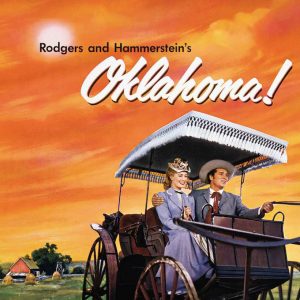
Wayne felt confident and relaxed as he auditioned. He got a call two days later and was offered a part as a cowboy in the chorus. He accepted and was told about the first read-through, where he’d receive the complete rehearsal and performance schedule.
When he arrived at the first read-through, the Assistant Director pulled him aside and quietly told him, “Wayne, we’d like to offer you a few more bucks per performance.”
“Thank you,” Wayne said. “But why?”
“Because we’d like you to be the understudy for Curly.”
“But you already have two Curlys. Why do you need a third one?”
“Well, the Army Chorus has these things called ‘Command Performances’ that require ALL members to appear and perform when somebody like the President holds something like a state dinner. At that point ALL the Army Chorus singers are ordered to report for duty and all, so if that happens, we’d need…well, YOU!”
OK then, thought Wayne. And during the six-week run of the show, he did have several opportunities to perform the role of Curly for his new Army Chorus friends. And, by the way, he crossed paths with both of them in future years, after they left the Army Chorus. Ironically, both of them, like his mentor, Chick Davis, studied Voice as undergrads at the Indiana University School of Music. One, John Stevenson, became a dinner theatre superstar, performing many roles in many different shows (and held down a job at Voice of America as well). The other, Mike Schwartzkopf, returned to Indiana University, earned his Masters and Ph.D. degrees in vocal music and taught voice there for the remainder of his career!
When Oklahoma! closed, most of the cast was simply asked if they would like to stay at “The Longworth” for the next production, How to Succeed in Business Without Really Trying. Most said yes (including Wayne), but new lead players were brought in. “Rosemary” would be played by the beautiful and talented Lonnie Lohfeld, a Maryland beauty queen who was also very nice and easy to work with. “J. Pierrepont Finch”, the male lead character, would be played by popular DC radio personality Johnny Holliday. HE was the person Lew Resseguie was counting on to bring in the audiences. And although Wayne was grateful when Lew asked him to be Johnny’s understudy, Wayne felt the pressure of letting the audience down when they saw “understudy” WAYNE on stage after they had paid to see “celebrity” JOHNNY!
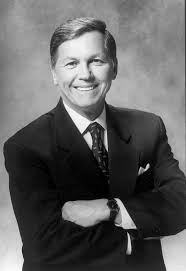
Johnny Holliday
Lew and his wife Barbara introduced Wayne and his wife to numerous Washington theatre folk, which often led actors at the Longworth to parties in Georgetown social circles. Lew called on talent from many past production companies to help him with everything from costumes to lighting to makeup to set construction.
One such individual was Bill Weisel, who helped Lew with lighting for both Oklahoma! and How to Succeed. An ABC-TV unit manager, Bill shared a huge house in Northwest DC (aka “Embassy Row”) with two doctors and a dentist. The house had a beautiful backyard garden that sloped downhill and ended at a black, wrought-iron fence. On the other side of the fence, the landscaping continued downhill to the back patio of an even larger home owned by wealthy socialite Marjorie Merriweather Post, as in “The Washington Post newspaper”.

There was recorded music playing outdoors at Bill’s house, but louder music was coming from Ms. Post’s abode. At first, it sounded like a recording of singer Tom Jones singing “It’s Not Unusual”; however, the more you listened, the more you realized it was actually Tom Jones himself, singing the song with a live band for guests at the Post party! The tuxedo-draped security force, complete with sunglasses (after sundown!), were outside the Post mansion, watching to ensure none of us would try to crash THAT party!
But back to Bill Weisel. Having learned his occupation, Wayne heard a singular story about the man. A few years earlier, Bill and his film crew were walking right behind Presidential Candidate Robert F. Kennedy on June 5, 1968 when Sirhan Sirhan shot and killed RFK at the Ambassador Hotel in Los Angeles. Bill Weisel was standing behind Kennedy and was shot in the abdomen by a second bullet.
Now, years later, at home on a Sunday night, Bill invited all takers to his mother’s oceanfront beach house the next day in Ocean City, Maryland (ONLY 150 miles away) for Labor Day, where there was plenty of room to crash. He passed out postcards with directions to the beach house and it was off to the races the next morning for the DC partygoers!
A BIG DECISION LOOMS
As might be expected, the more time Wayne spent in theatres and being around theatre folk, the more he felt disenchanted with his civil-service employment. Although that was by far the source of most of their income, he knew that only an advanced degree would qualify him for a college or university faculty position, teaching and/or working with undergraduates on performing arts projects. To get that degree, Wayne would have to resign from his secure, well-paying government job.
After discussions with his wife, they decided Wayne would apply for the Master of Fine Arts (MFA) degree program in Theatre at Virginia Commonwealth University (VCU). This was a relatively new (1968) university (at least by name) in Richmond, composed of elements of the Medical College of Virginia (MCV) and the Richmond Professional Institute (RPI). His area of concentration would be Theatrical Direction. Assuming he got accepted, the goal, after acquiring the degree, was to seek employment on the theatre faculty of a small college somewhere in the southeastern United States.
Wayne was accepted into the graduate program at VCU and resigned from government service.
When Wayne told Lew Resseguie about his plans to move to Richmond, Lew tried to talk him out of it. He told Wayne that he had enough talent to be a “regular” in the dinner theatre circuit and eventually to get his Equity membership card and get work in New York City. Wayne thanked Lew, but told him the wheels were already in motion.
Wayne soon got a phone call from Davey Marlin-Jones, the Artistic Director of the Washington Theater Club (WTC). This was a huge surprise to Wayne, who did his best to maintain his composure. Mr. Marlin-Jones asked Wayne if he would come over to the WTC on a Monday afternoon for “a reading.”
“A reading?” asked Wayne.
“Yes”, Davey replied. “It’s a type of tryout. I’ve seen your work at the Longworth, and although I don’t have anything for you at the moment, I’d like to get to know you and make sure you’re included in future casting calls at WTC. Would 2:30 work for you?”
“I’d be honored”, said Wayne. “Two-thirty it is. Thank you.”
It wasn’t until after “the reading” that Wayne woke up to what he’d just been through. It was an attempt by Lew Resseguie to get Wayne to change his mind and NOT leave town! WTC and Davey Marlin-Jones were hot theatrical commodities in Washington, and what could be more flattering than a private “reading” to sway one’s thinking? And it might have worked if the circumstances were different! Wayne WAS flattered, but it was just a bit too contrived, and his plans were simply too far developed.

DC director and critic Davey Marlin-Jones
Although Wayne’s parents, especially his father, were concerned about this career change, they realized that the transportation needs of the young couple were about to radically change. Fortunately, Wayne’s mom worked for Rosenthal Chevrolet in Arlington, Virginia. Somehow, she talked Mr. Rosenthal into selling a new (1970) Chevelle coupe to Wayne at dealer cost: $3,000. Perhaps Mr. Rosenthal agreed because of the car’s color. It had been sitting on his lot for weeks. Whatever the reason, they were now the owners of a brand new car that looked like this (without the black racing stripes on the hood):
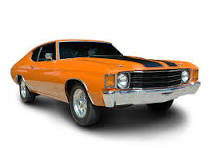
Wayne’s sister made it easy to find a new place to live in Richmond, Virginia. She and her husband, both VCU undergrads, lived in a very affordable town house/apartment development south of the city. There was a two-bedroom vacancy there, so Wayne and his wife put down a deposit in June and began to move South in July. Their town house was on US Highway One, about 200 yards West of the James River and about halfway between Richmond and Petersburg. Wayne’s wife quickly found a 9 to 5 accounting job with a trucking firm near their town house. Wayne was always grateful for her accounting skillset.
Falling Creek Town Homes South of Richmond
Things didn’t always go so well with Wayne. After they settled in, he met with the new Chairman of the Theatre Department, Dr. Kenneth Campbell, in late July, who hit him with two surprises. Most universities that offered the MFA degree in Theatre considered it to be a “terminal” degree; e.g., it is equivalent to the PhD. Both are the highest educational credentials one can achieve in that field. Therefore, one who holds the MFA in Theatre could not be denied rank, tenure or promotion in academe. Moreover, the MFA is, at most universities, a “practicum” degree; e.g., it does not require a thesis, which requires proof of a student’s ability to conduct independent, rigorous research.
However, in their meeting, the Chairman told Wayne that because he came to VCU without an undergraduate MAJOR in Theatre, Wayne would be required to take three Senior-level undergraduate courses in Theatre at VCU to prove his qualification for graduate-school entry. When questioned about whether the VCU MFA was considered a terminal degree, Dr. Campbell responded, “Yes. Without question.” Wayne knew it was fruitless to complain, so he simply walked out of the Chairman’s office frustrated but determined.
At the end of the first semester at VCU (Fall of ’71), Wayne’s grades for each of the three Senior undergraduate courses were A. As a result, Wayne was notified that he would begin the Spring, 1972 semester as a full-fledged MFA graduate student.

STUDYING, TEACHING AND WORKING IN RICHMOND
During the Holiday break, Wayne was surprised by a phone call from the Chairman’s office. Dr. Campbell wanted to schedule a meeting with Wayne and the head of the Speech component of the department. Wayne had forgotten that the OFFICIAL name of the Department he was enrolled in at VCU was the Department of Theatre and SPEECH, just as it was at many other colleges and universities. The chairman’s tone at this meeting was quite different.
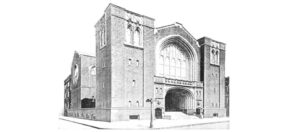
Two renderings of the main theatre building at VCU, a converted Scottish Rite Temple
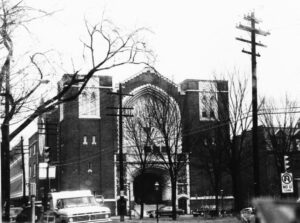
Dr. Campbell made note of Wayne’s extensive experience with Speech courses, enrolling in every available Speech class at Emory and Henry College and earning A grades in each one, also pointing out Wayne’s exposure working with dialects. He explained that one of the speech instructors at VCU had recently resigned his position. There was insufficient time to do a formal search for a new instructor. Decision-makers thought Wayne might make a suitable short-term replacement. Would he be interested? He would be paid not as a “Teaching Assistant”, but at the higher-salaried “Instructor” level.
The decision was an easy one. Wayne returned home that afternoon to report to his wife that the pay rate of his new job as a Speech INSTRUCTOR covered the cost of his graduate school tuition. He was also familiar with preparation for the first class he was assigned to teach: SPEECH FOR BUSINESS MAJORS. He had taken that class himself at E&H. The hardest part of the course was UN-teaching the southern drawl of most of the enrollees before teaching proper American pronunciations!
So Wayne was a Graduate student in the Theatre department and an Instructor in the Speech department. But that “student and teacher” schedule doubled the amount of time he had to be on campus. He needed some inexpensive way to move back and forth from home to campus and back. Six hundred dollars bought him a brand new 175 cc Honda motorcycle.
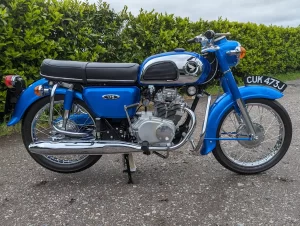
As a faculty member, he requested and was granted the use of an office in the department’s Shafer Court Theatre building. There, he could shed his Nor’easter-type wet gear on rainy days so it could drip dry in time for the ride home.
Meanwhile, among other things during his two years of study at VCU, he performed as “Snout” in A Midsummer Night’s Dream, “Billy Bibbit” in One Flew Over the Cuckoo’s Nest, “Orphan” in Celebration, soloist (“Tomorrow Belongs to Me”) in Cabaret, an Athenian man in Lysistrata, Vocal Coach and “Cardinal” in Hadrian the Seventh, “Amiens” (Shakespeare’s most musical character) in As You Like It, and Vocal Director for his thesis production of The Beggar’s Opera, where he taught a cast of 30 performers, men and women, a variety of dialects, including Irish, Scottish, King’s and Queen’s English and Cockney.
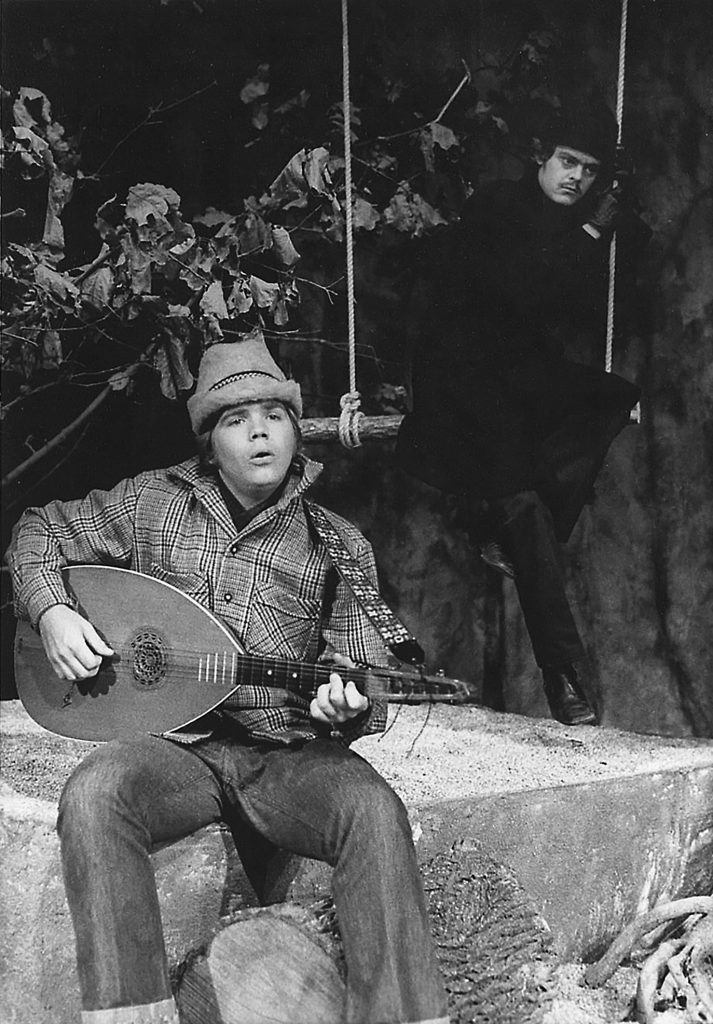
Wayne in As You Like It as “Amiens” with Sam Maupin in the background as “Jacques”
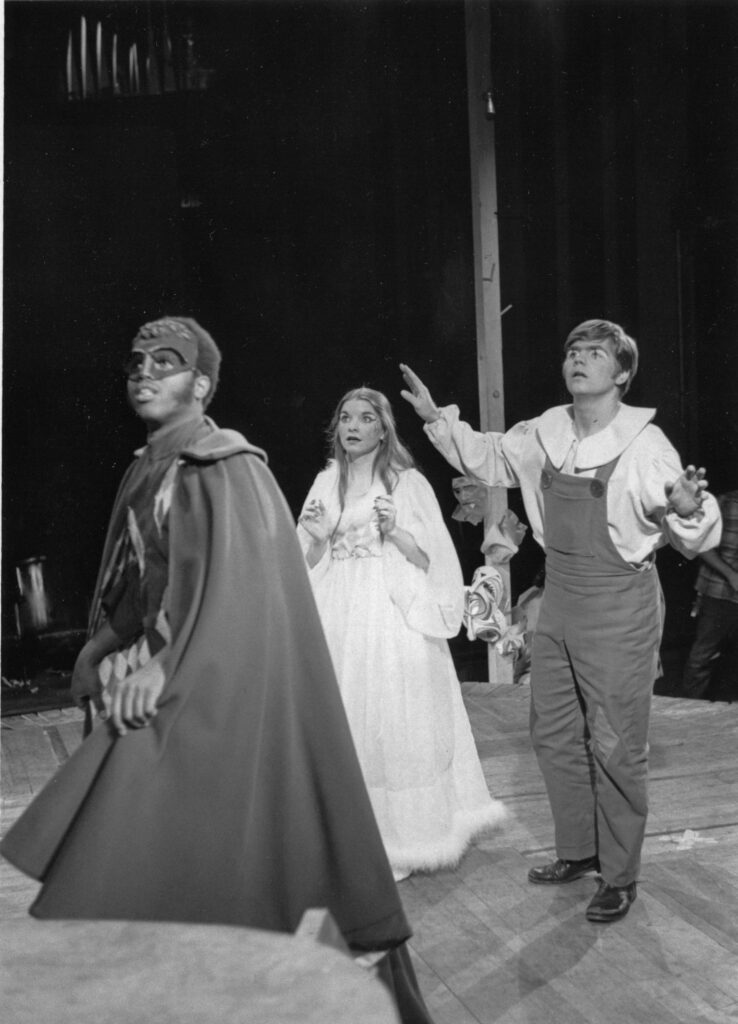
Wayne in Celebration as “Orphan” with Rex Ellis as “Potemkin” and Suzy Smith as “Angel”
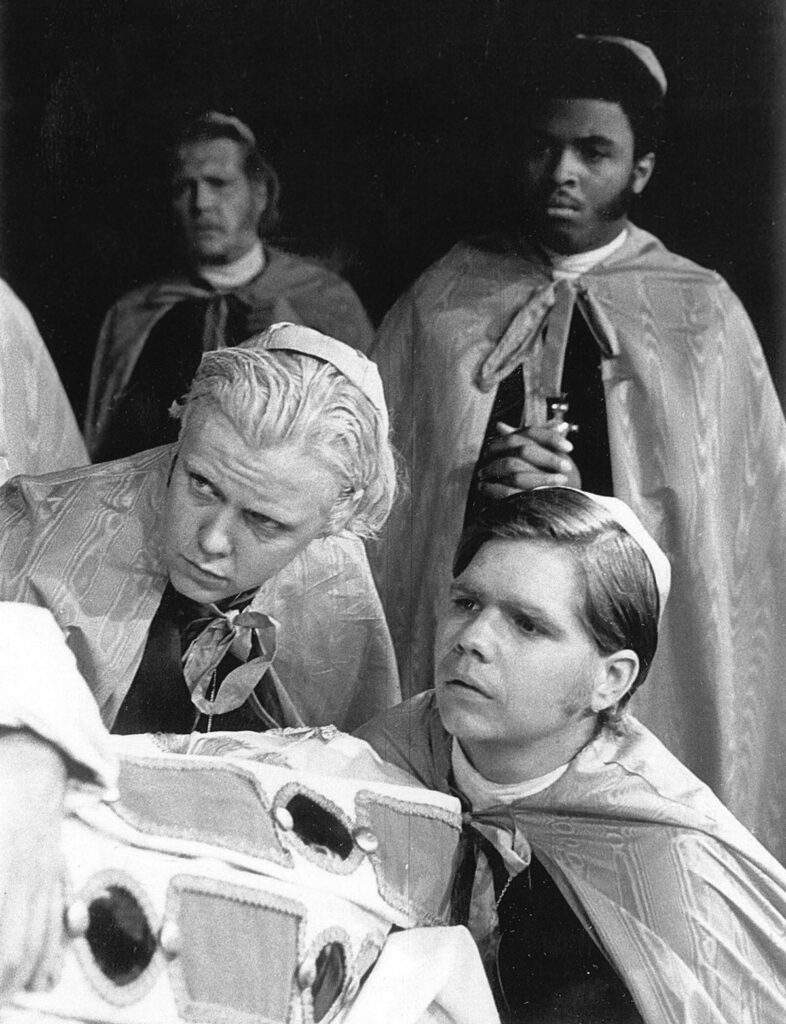
Wayne as a Cardinal in Hadrian VII. On his right is VCU Senior acting student Gil Shaw, who played Wayne’s eldest son in Carousel at Annandale High School!
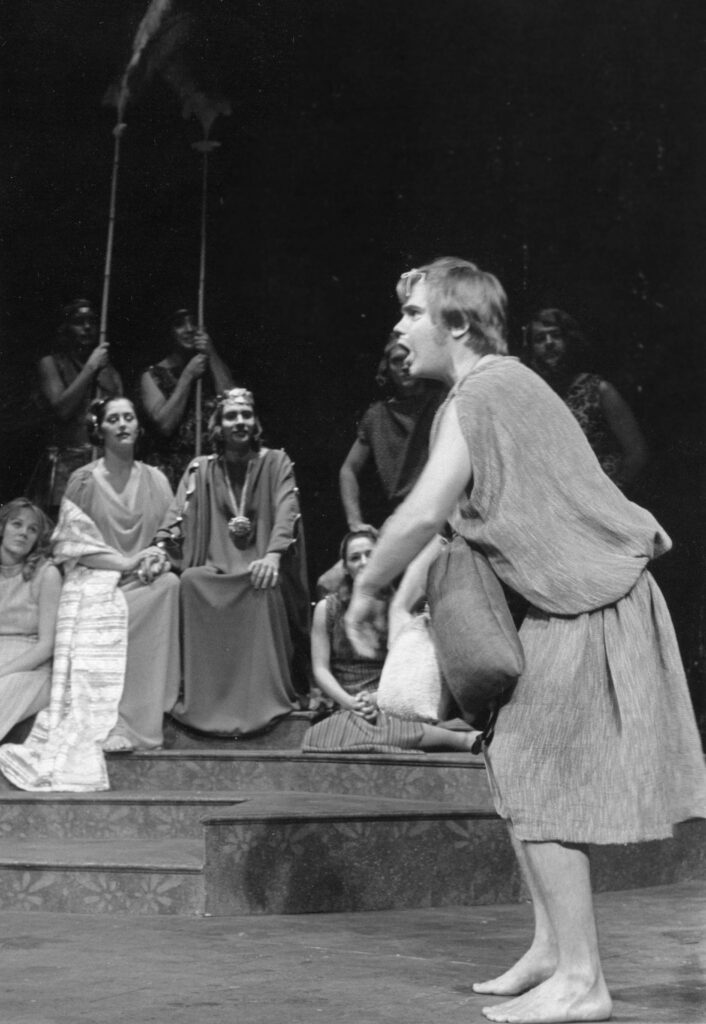
Wayne as “Snout” (one of Shakespeare’s rustics) in A Midsummer Night’s Dream
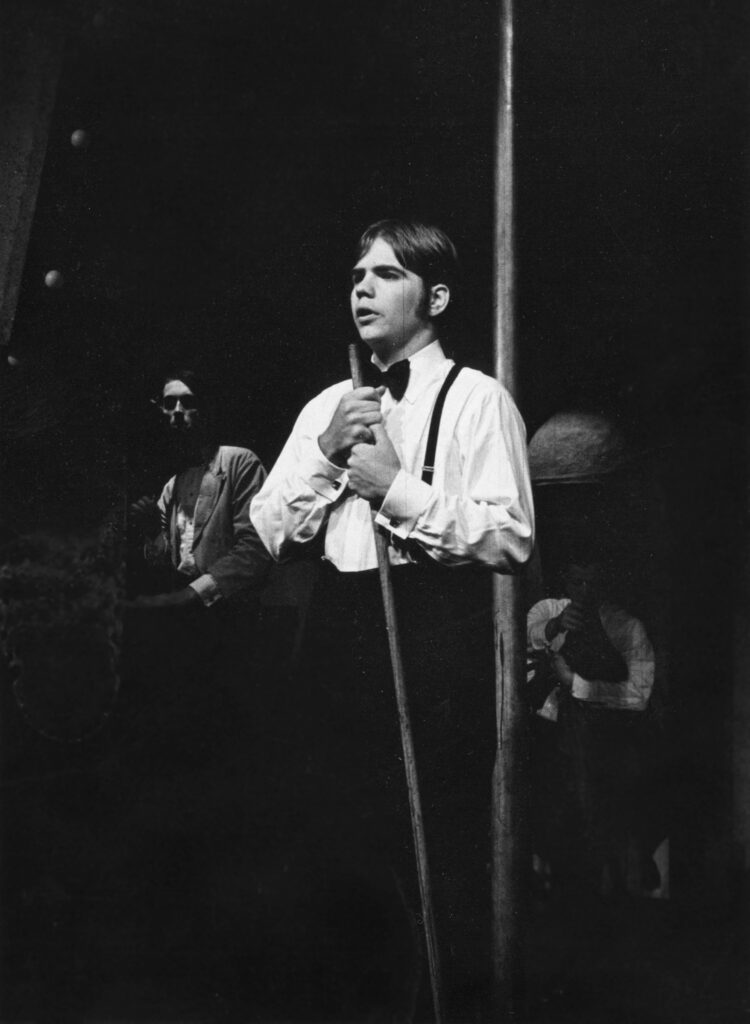
In Cabaret, Wayne leads a crowd of Nazi sympathizers through “Tomorrow Belongs to Me”
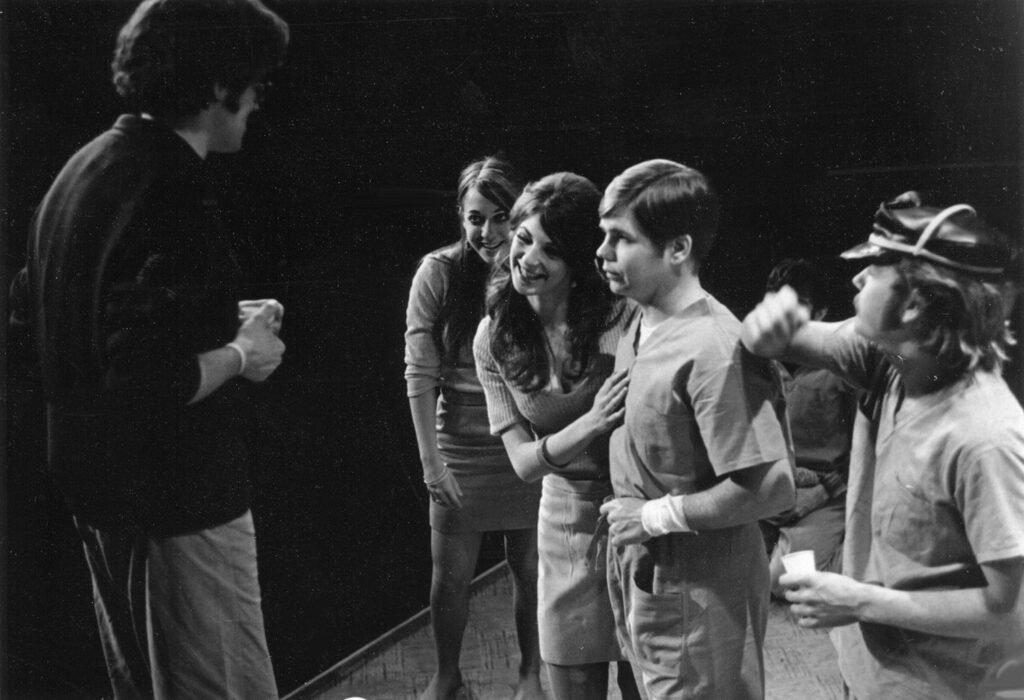
Wayne as “Billy Bibbit” in One Flew Over the Cuckoo’s Nest
Wayne eventually stopped teaching Business majors altogether and taught classes in Voice to Theatre majors at the same Instructor rate of pay. But perhaps his most lucrative “earning” activity while he was at VCU took place completely OFF campus. Two sisters in the theatre department approached him one day and asked him if he would play guitar for them at an off-campus audition. They had planned to audition as a duo, but at rehearsals with Wayne, they decided to add his voice to the mix and audition as a trio.
On the day of the audition, he met the sisters at a place called “Alpha Audio”. It was a recording studio. In fact, he discovered later it was the ONLY 16-track tape recording studio in the state of Virginia! When he arrived, he was impressed with 1) the size of the studio (large enough to seat an entire symphony orchestra) and 2) the professional acoustic treatment given to the space (no external sound penetrated into the room). The trio performed three songs and thanked the studio owners. Then the sisters thanked Wayne and excitedly rushed out of the studio.
Wayne was packing his guitar in its case when the studio owners approached him, thanked him for coming and complimented him on the quality of his voice. They explained, “We’re attempting to build a stable of vocal performers to create radio commercials for businesses all over the East Coast. Not just the music, but the spoken parts as well. If you can act as well as you sing, we want to put you to work. We’ll pay you 20 dollars an hour. Are you interested?”
In 1972, 20 dollars an hour was an excellent wage! Without hesitation, Wayne said, “Yes, sir! I certainly am. Thank you!” Wayne was getting paid to teach classes in voice and speech at the University and was now suddenly getting paid to sing and speak in radio commercials for a professional recording studio with clients all over the Eastern half of America. What fun!
Here are just a few of the commercials to which Wayne contributed while he lived in the Richmond area:
Avis Auto Rentals:
National Central Bank:
Thalheimer’s Department Store:
Old Point National Bank:
The Sound Shop:
Think Green Public Service Announcement:
After returning home with the news of another source of income, Wayne and his wife discussed the possibility of finding him a form of transportation that would keep him dry and warm while traveling to and from home and either classes or the recording studio. They agreed that was fair. So each day, he’d bring home a copy of the Richmond Times-Dispatch and scour the classified ads for “a new set of wheels.”
One day, his eyes fell upon these words: “FOR SALE – 1963 Porsche 356B $1800 firm.” The words were accompanied by a name and a phone number. He called the phone number and spoke to the name and set up an appointment to look at and drive the car. It looked nothing like this:

It was gray, but it had no bumpers and no hood trim. It had a ten-inch-wide, pale purple racing stripe painted on it from front to back and 7.5-inch wide racing tires! The owner confessed that, at ten years old, it had been used as a race car for several years. Though it had never been involved in a crash, there was a “roll bar” installed in the interior. In fact, the interior was completely remodeled, with new seats designed by a chiropractor. The dashboard was not stock, and although it had all the original Porsche dials, gauges and indicators, their layout was definitely “different”.
But in a test drive, it handled like a dream and it had a Blaupunkt radio. Plus, the two back seats folded flat to make space for carrying groceries, and that was enough for Wayne’s wife. Besides, the Porsche had a clutch and a 5-speed manual transmission, which she didn’t know how to operate. So they wrote the owner a check and drove TWO autos back to their little town house. Wayne had a new car. Well, new to him!
Grad-student life was busy. When he wasn’t taking a graduate-level course, he was teaching an undergraduate Speech or Voice or Stage Dialects class or in rehearsal for an upcoming production or attending an afternoon-long seminar with an actor/guest speaker like E.G. Marshall or attending a lecture by Gloria Steinem or recording a new commercial at Alpha Audio for a bank or a roller skating rink or a department store.
Some of the grad students and undergrads he was working with were very talented and became famous for skills they either brought with them to VCU and/or expanded upon while at VCU. Some examples include:
Richard C. Hankins, our set designer for The Beggar’s Opera, who later won two Emmy awards for his design work on TV’s “Guiding Light”, numerous Emmy nominations and won the Lou Dorfsman CBS Outstanding Design award.
Richard C. Hankins
Ralph MacPhail, Jr. served his undergraduate alma mater, Bridgewater College, as Professor of Theatre from 1972-2005. He was also a nationally known author, scholar and speaker on British music theatre creators William S. Gilbert and Arthur Sullivan.
Professor Ralph MacPhail, Jr.
Stephen Feuerstein, an undergrad from Norfolk, Virginia, went to Hollywood, connected with John Belushi and became Stephen Furst, appearing in National Lampoon’s Animal House (remember “Flounder”?), 1941 and other films and TV series. He also worked as a director, producer and writer during his time in Hollywood.
Actor Stephen Furst
Larry Verbit practiced entertainment law in Los Angeles starting in 1987.
Ellen Talles operated a dance studio in downtown Baltimore for many years.
Sam Maupin (pictured above) was a successful stage, screen and TV actor.
Rex M. Ellis achieved success at everything he touched. Multiple advanced degrees, worked in his home town for the Williamsburg Foundation, an award-winning storyteller, a published author, a speaker and decades of service with the Smithsonian, retiring as Associate Director of their National Museum of African American History and Culture; an impressive and truly remarkable man.
In April of 1973, Wayne began work on his last project at VCU. He was Vocal Director (which included dialects and song) for the department’s mainstage production of John Gay’s The Beggar’s Opera. Documentation of his work on this production would meet Dr. Campbell’s requirement for an MFA thesis.
MOVING TO MARYLAND
As Wayne neared completion of his MFA coursework, he began looking around for the kind of college he wanted to work for. Though he hoped he could stay in Virginia, no theatre faculty positions were available. One afternoon he got a call from an actor friend named John Degen, whom he had met at the Longworth Dinner Theatre in Arlington. A year after Wayne enrolled at VCU, John moved to Richmond and enrolled in VCU’s Theatre Department as an undergrad! A true “free spirit”, John had been performing in musical theatre productions at Montgomery Community College in Rockville, Maryland for years and had received his AA degree in theatre there. After visiting Wayne in Richmond to see some VCU productions, John decided to earn a BFA in Acting from VCU!
John knew of Wayne’s search for post-graduate employment, and he sounded excited over the phone. “Hey, Wayne, I’ve got some good news for you. I went home to visit Mom & Dad last weekend and on the way back I stopped off at Montgomery College in Rockville to see Gerry Muller, the Chairman of the Music Department. I probably did more shows with him than I did in the theatre department while I was at MC.”
Wayne knew that John grew up in Tacoma Park, Maryland and was, like Wayne, educated “inside the Beltway”, but on the Maryland side. Montgomery Community College was just OUTSIDE the beltway in the bustling suburb of Rockville, Maryland. “Gerry asked me if I knew any musically inclined Theatre grad students at VCU. I told him about you, how we met at the Longworth and all the stuff you’re doing in Richmond. HE’S GOT A JOB IN THE MUSIC DEPARTMENT AND HE WANTS TO MEET YOU!”
As Wayne listened, it all sounded great except for two words: MUSIC DEPARTMENT. That put Wayne off immediately! He replied to his friend, “Thank you, John. But I’m not really much of a musician in the formal sense. I mean, I sing, play drums and guitar, but I’ve never had any formal training, except in vocal production.”
“Man, don’t get ahead of yourself,” John wisely said. “I’ll tell you a secret. What Gerry really wants is HIS OWN THEATRE PERSON!”
“What does that mean?” said Wayne.
“It means he wants a theatre expert in the Music Department to help him stage Music Department productions the way HE envisions them, not the way the MC theatre department envisions them. Plus, Gerry also works with the college’s Community Services Department, which helps fund production of shows mounted by the Montgomery Light Opera Association, a community theatre organization in Montgomery County that’s been around for years. So Gerry’s one of the most active Musical Directors and conductors in the Baltimore/Washington Metroplex. And he’s looking for a theatrical partner to help him present musicals HIS WAY at MC, funded by his own Music Department and the college’s Community Services Department!”
“Thanks for explaining it to me, my friend. What did you say this guy’s phone number is?”
Wayne called Dr. Gerald Frank Muller, Chairman of the Music Department at Montgomery College in Rockville, Maryland. Because John had his direct number at the college, Wayne’s call went past the switchboard and directly to Dr. Muller’s voicemail. Wayne left a message asking for an appointment on a Saturday afternoon because of his own teaching and rehearsal responsibilities.
When Dr. Muller called back and Wayne actually spoke with him, it was clear Gerry and John had been friends for years. He gave Wayne a date and time, and asked Wayne to mail a copy of his biography. Wayne and his wife drove up to his parent’s home in Northern Virginia the Friday before the interview. Wayne found himself wondering why he felt so nervous as he pulled into the Music Department parking lot the next day. Then he decided it wasn’t nerves at all. He was just excited!
Dr. Gerald F. Muller
Gerry Muller had read Wayne’s bio, knew about his experience with four years of vocal training, his almost-finished MFA in Theatre from VCU, his teaching of voice and speech to undergrads and his acting experience in undergraduate and graduate schools and dinner theatre. Wayne might be just the person he’d been looking for. He simply had to meet the man personally. Gerry and Wayne might have been the only people in the Music building that Saturday afternoon. Wayne, for one, enjoyed every minute of it. Gerry obviously went out of his way to make the job he had in mind as attractive as possible. Gerry described Wayne’s duties as follows:
First, Wayne would be a Music faculty member, teaching one or two sections per week of “Class Voice”, where ten to fifteen undergrads per section would learn, from Wayne, the physical fundamentals of vocal production, including breath control and vowel-tone shaping, while performing songs in several languages that were chosen to assist in developing those fundamental skills. At each class, a professional piano accompanist would be present.
Second, Wayne would hold the position in the Music Department as “Staging Director” for all Music Theatre productions presented by the Music Department. This included everything from small productions, typically presented in the department’s recital hall, such as Puccini’s Il Tabarro (The Cloak) or Kurt Weill’s Down in the Valley, to mainstage productions of classic operas such as Georges Bizet’s Carmen or The Pearlfishers.
Third, Wayne would hold the title of “Administrative Director of the Applied Music Institute”. This was a program supported by the aforementioned Community Services Department, which enabled non-registered music students to use the college’s music facility and faculty to take hour-long, private music lessons in the Music building with Music faculty members for a fee. Wayne would be the official registrar for all such students and assign space in the Music building (usually in the faculty member’s assigned office space) for all such private lessons. He would assign all space and collect all checks or other payment from the students or their family members and be responsible for delivering payment to the Community Services Department before lessons began.
Fourth, Wayne would posses the title of “Staging Director, Montgomery Light Opera Association”. The term “light opera” was new to Wayne, but he grew fond of it over the next three years. Again, the Community Services Department supported, both financially and from a marketing perspective, this large, very active group of both elderly and youthful performers, all of whom enjoyed working on the musical stories told at the turn of the 20th century written by composers like Rudolf Friml, Victor Herbert and Sigmund Romberg.
Collectively, payment for those responsibilities would be less than the equivalent of a full-time Music faculty member. But it was clear that Dr. Muller was doing his best to give Wayne sufficient duties in order to give him TWO checks from Montgomery College: one from the Music Department and another from the Community Services Department.
But Wayne still had to pass one final test. They casually left Gerry’s office and began to stroll around the building, Wayne ostensibly getting a tour of the facility from “the boss.” Eventually they arrived on the first floor and Gerry opened a door, above which was a sign that read: “Recital Hall.” The stage was lit and there were two grand pianos upon it. As Gerry climbed up the stairs, it was clear to Wayne what was coming next: Gerry wanted to hear Wayne sing!
Sure enough, Gerry sat down at one of the pianos and said, “I heard you’ve sung this a few times.” He then started playing the opening chords of “Oh, What A Beautiful Morning” from Oklahoma! Wayne smiled, nodded and began to sing at the appropriate place in the music. It was, after all, sung by Curly as the opening number of that Rodgers and Hammerstein musical. They got about two-thirds of the way through the song before Gerry stopped and said, “OK. Thank you. Very nice. It’s clear you’ve had some excellent training.” Then he stood up and asked Wayne, “Can you be here for the Fall Semester?”
By this time, they’d been talking for about three hours. Early on, Wayne had decided that he liked Gerry Muller, that he could learn from Gerry Muller and that he was glad Gerry Muller offered him a job, even if it was just an adjunct faculty position. “I’d like that very much,” Wayne replied, “assuming my wife doesn’t object. But I think I can persuade her.”
They shook hands and Gerry said, “I’ll consider it done. Welcome to MC. I’ll mail you some forms on Monday.” And it was done. They were moving to Maryland.
MONTGOMERY COLLEGE: A THEATRE GUY IN THE MUSIC DEPARTMENT
Wayne and his wife talked it all out on their way back to Richmond the next day. He notified the VCU theatre department of his job offer and move to another school. He had finished all his course requirements by the end of the Spring semester of 1973 and as long as he continued to pay VCU the tuition fee for “Graduate Study: Thesis”, he would still be considered an MFA “student” who was writing his thesis, which (after it was approved by the VCU Theatre faculty) he had formally bound. Then the VCU Theatre Department placed two copies in the University library system and mailed him his diploma and his copy of his bound thesis in August of 1975.
However, the couple had already left Richmond at the end of the Spring semester of 1973 and moved from Richmond to a beautiful “planned community” known as Montgomery Village in Gaithersburg, Maryland. They rented a two-bedroom apartment on the third floor of the building. There was a mini-mall, gas station and a couple of restaurants two block away, and the apartment was about five miles north of the college where they’d both be working. Yes, they had learned of an opening in Accounts Payable at the Montgomery College Business Office, and her experience qualified her for it nicely. And because of his odd work hours (classes, rehearsals, etc.) vs. her 9 to 5 “office hours”, they were lucky to have two cars to transport themselves to and from work.
Within the mini-mall mentioned above, there were a few “fun” shops and a couple of palatable restaurants. The mall managers were aggressive in staging shows in the common space at the mall to draw local residents “indoors” to sample the retail vendors. One of the indoor attractions was quarterly Art Shows that featured the works of Montgomery County artists. The Hamiltons attended ALL of those shows.
At one, Wayne was surprised to see a familiar name: Joseph Craig English. Wayne had gone to school at Edgar Allen Poe Intermediate School named Joseph Craig English, whom he had known as “Craig”. But when Annandale got too big and had to send some of its students to the NEW W.T. Woodson High School, his friend Craig went THERE. So it was a delightful moment to be able to walk up behind this long-lost friend, tap him on the shoulder and say, “Hey Craig, remember me?”
In the next hour, Wayne learned that Craig DID remember him, Craig attended VCU as an undergraduate art student and Craig had a beautiful home in Washington Grove, Maryland, less than 2 miles from their apartment, where his art studio was also located. Before they parted company that day, Wayne had purchased a JCE diptych (“Gaithersburg Train Station”) and gotten an invitation to tour Craig’s home art studio!
JCE Gaithersburg Train Station diptych art photo here
As far as Wayne’s teaching at Montgomery College was concerned, there were no other voice teachers in either the Music or the Theatre department. He was scheduled to have one class that met for 50 minutes on Mondays, Wednesdays and Fridays and another class that met for 90 minutes on Tuesdays and Thursdays in both the Fall and Spring Semester. He and his delightful and talented accompanist, Mrs. Zvia Sheinman, got along famously, so everything was fine in that area for each of his three years at MC.
The other constant at MC came at the courtesy of the combined auspices of the Community Services department and the Music department. That was his service as Administrative Director of the Applied Music Institute. As described above, it was a strictly clerical position, collecting and turning in forms for each student, assigning teachers and lesson spaces in the Music building, collecting fees, etc. Somebody had to do it, and Wayne was happy to have the pay that came with the duty.
The final sources of income (Staging Director) were more sporadic calendar-wise, but just as important when it came to earning income and MORE important when it came to polishing the theatrical craft he’d learned at VCU. They included:
– Staging Director for three productions of the Montgomery Light Opera Association (MLOA) one each year:
The New Moon by Sigmund Romberg (1887-1951),
Romberg
Naughty Marietta by Victor Herbert (1859-1924), and
Herbert
The Vagabond King by Rudolf Friml (1879-1972);
Friml
These three composers are considered the triumvirate of American light opera creators. The producing group (MLOA) was a spinoff of the now-defunct American Light Opera Company of Washington, DC. The Romberg piece got a full-page spread in the entertainment section of The Washington Post newspaper. Unfortunately, although Wayne was quoted in the article, he was mis-identified as “a student”.
– Libretto Director for a joint production between the Theatre and Music departments of Fiorello! This was the Pulitzer Prize-winning musical story of Fiorello LaGuardia, the Mayor of New York City from 1934-1945. Jerry Bock wrote the music, Sheldon Harnick wrote the lyrics and the book was written by George Abbott and Jerome Weidman.
Mayor Fiorello LaGuardia (1882-1947)
– Vocal Coach for a joint production between the Theatre and Music departments of Guys & Dolls
– Staging Director during two different academic years for MC Music department productions of two Georges Bizet grand operas: Carmen and The Pearlfishers

Georges Bizet (1838-1875)
– Staging Director for two Music department chamber operas: Down In The Valley, composed by Kurt Weill,

Kurt Weill (1900-1950)
and Il Tabarro (The Cloak), composed by Giacomo Puccini.
Giacomo Puccini (1858-1924)
Wayne also earned incidental income as a performer while he was at MC:
– He played the starring role(s) of “Charley Wykeham/Charley’s Aunt from Brazil (where the nuts come from)” in an MC experimental dinner theatre production of Where’s Charley? For Wayne, this was an undeniably great deal of fun. Actually playing TWO roles (Charley AND Charley’s ‘Aunt’), the script required numerous off-stage quick changes, involving at least three student costumers and makeup artists laying in wait for Wayne to exit one scene, whereupon they would rapidly remove one velcro-constructed costume and put on another while either adding or subtracting costume pieces, wigs and/or makeup to turn him into whatever character was called for by the script in the NEXT scene!
One popular hit song came out of Where’s Charley?. It was “Once In Love With Amy”. The way it was staged, “Charley” (Wayne) was directed to choose a female audience member, take her by the hand, lead her onto the stage and DANCE with her during the long instrumental chorus of the song. The show was being performed “in the round”, so Wayne was never far from potential dance partners (though he never knew if the audience member he chose was a good dancer or not). His mother lived just 20 miles from MC and came to at least one performance of every show with which Wayne was involved. She was delighted when Wayne, as Charley Wykeham, led her onto the stage and danced with HER!
– In 1975, a friend Wayne had met at the Longworth Dinner Theatre in Arlington years earlier called and INVITED him to perform the role of “Curly” in Oklahoma! Itzy Friedman, who had been in both Oklahoma! and How to Succeed… for Lew Resseguie, was opening his own dinner theatre, the Saratoga, in Prince Georges County, Maryland. The active Prince George’s County press all praised the production and Wayne’s performance, best summarized in The Bowie Blade, which briefly reported:
“Curly is played by Wayne Hamilton, who turns in a fine performance in the delightful role.”
– During two of his three “Holiday” seasons at MC, Wayne was INVITED by his fellow music faculty members to sing one-night stands with a “pickup band” they assembled for the season. All of the players of the group were members of the Musicians Union except, of course, Wayne. Nonetheless, Wayne was paid “scale” for the few special gigs that were arranged for this band; he never asked and was never told how that was arranged, but he was grateful. Some of the members of the group were also members or first-call substitutes of the National Symphony Orchestra, and another was also a famous jazz pianist: Bill Potts, who was also an arranger, composer and big band conductor. Bill worked, either on stage or in recording studios with people like Paul Anka, Eddie Fisher, Ella Fitzgerald, Stan Getz, Woody Herman, Quincy Jones, Stan Kenton and Buddy Rich, to name but a few. He was a great talent and a great friend who lifted the spirits of everyone near him!
Bill Potts (1928-2005)
Meanwhile, on the home front, there was a guy from California, where they LOVE customized cars, living in the same apartment building as Wayne and his wife. This person made at least one offer a month to Wayne, attempting to purchase his Porsche. The number kept growing until Wayne couldn’t refuse. Wayne sold the Porsche to the young man and used the proceeds to buy a new, 1974 Karmann Ghia convertible. This was the last year Volkswagen sold the Karmann Ghia in America, and Wayne got the only model equipped with a white top. People called it the “poor man’s Porsche”, but Wayne didn’t care. He wasn’t playing drums in a band anymore and he really liked the way the car looked and handled.

1974 Karmann Ghia Convertible
After his first year at MC, the Gaithersburg and Germantown areas of Montgomery County were burgeoning. Both Wayne and his wife were happy with their jobs, and they couldn’t help but notice that a mortgage on a two-bedroom town house would be a sound investment at this point in their lives. They found a Pulte town house development that fit their finances, purchased one and moved the three miles from their apartment. The basement was unfinished, but it was set up to quickly allow improvement of the town house by adding a “half bathroom” (toilet and sink) and a recreation room. That happened during their first summer there, with Wayne playing a new role that he would repeat often in future years: “Harry Homeowner”.

Their first home purchase – in Germantown, Maryland
Wayne installed studs and hung sheet rock to define the laundry and utility room in half of the basement, then put cabinets and bookshelves at one end of the new “recreation room”. Then he paid a contractor for wall-to-wall carpet there and tile floor in the bathroom. He put a toilet, sink and medicine cabinet in the bathroom and ran electrical switches, wiring and plugs from the breaker box through the new living space. Wayne finished the sheet rock and installed baseboard, door frames and doors, then got his wife involved in the painting process. With a bottle of champagne to celebrate completion, they felt like they were going to be in Montgomery County for quite awhile.
Wayne settled in to his teaching schedule, managing the Applied Music Institute paperwork and occasionally directing a theatrical production for MLOA or the Music department at Montgomery College. Whenever he heard of a theatre faculty position availability, he would apply. However, he hadn’t been called for an interview recently. Nevertheless, Wayne kept learning about the historical forms and styles of the musical pieces he was directing for and with Gerry Muller and other Music department staffers throughout the time he worked at MC.
When Wayne’s friend John Degen finished his BFA in Acting at VCU, he came home to Montgomery County and unsurprisingly began getting work in his craft in both theatre AND film. In the middle of 1975 he was working at a theatre that was famous for having started the craze for “Dinner Theatre” in the Baltimore/Washington Metroplex back in 1968: Burn Brae Dinner Theatre. Burn Brae advertised itself as “The Area’s First, The Area’s Finest.” It was so successful that many similar enterprises attempted to cash in on the art form.
Having “been there” himself (at the Longworth), Wayne had already made at least one observation about dinner theatre: it was, at least to Wayne, a peculiarly SUBURBAN art form, at least in the B/W Metroplex. There, no dinner theatre that opened inside the city limits of a town numbering over 100,000 residents could keep its doors open longer than about four months. It was like people who worked in the city didn’t want to go home to the suburbs and then RETURN to the city to be entertained. It just didn’t work!
Burn Brae was located in Burtonsville, at the extreme Eastern reaches of Montgomery County, making it equally accessible to the residents of both Washington and Baltimore suburbs. Perfect placement! And the show John Degen was cast in was perfectly timed for the approach of the American Bicentennial: 1776. The show opened in May of 1975 and closed on December 31, 1976!
The show eventually ran for 430 performances and was seen by 130,000 attendees. That run still holds the national record for the longest-running Tony Award-winning musical production outside New York City! At some unforgotten point during that run, original-cast member John Degen decided to leave the show and enter graduate school (MFA) study in Theatre at George Washington University in Washington, DC. At that point, Wayne got a call from John, who asked him if he’d like to join the cast of 1776 for the reason stated above. John was playing the part of Roger Sherman, Congressional delegate from Connecticut. John invited Wayne to visit Burn Brae to watch a performance and meet one of the owners, Bernie Levin.
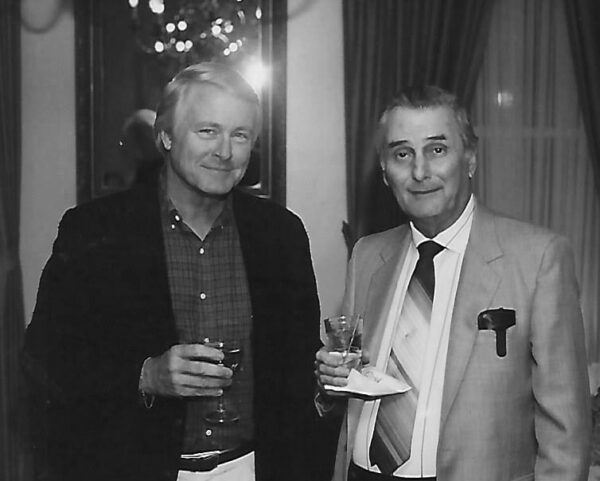
Burn Brae founder John Kinnamon and partner Bernie Levin
Wayne took John up on his offer and watched the show, which was excellent. After sharing his performance resume (directing had no place here) with Bernie, he was offered John’s part, and Wayne happily accepted.
A couple of months later, Wayne was at “work” at Burn Brae as usual and preparing for the evening’s show. Word came down to the dressing room that Bernie wanted Wayne to come “upstairs”. Already in full costume and wig, Wayne went upstairs and made his way over to the bar, where Bernie was waiting.
“Hi, Bernie, what’s up?” said Wayne.
“Hey, Wayne. How are you? Are you still enjoying the show?”
“So far, so good, sir.”
“Great, great. I want you to know that John Stevenson is leaving the show, and JK (meaning founder and co-owner John Kinnamon) and I would like you to take over the role of Rutledge. Would you be interested in that? Of course, it would mean a considerable increase in salary. Are you interested?”
Wayne was stunned. John Stevenson, the former member of the Army Chorus, whom he had met and worked with years earlier at the Longworth Dinner Theatre, and who had become a star in numerous dinner theatre productions since, was “stopping the show” every night in Act Two of 1776 with his solo performance of “Molasses to Rum” as the delegate from South Carolina. As such, his character, Edward Rutledge, historically the youngest member of the Second Continental Congress, threatened to shut down the Declaration of Independence effort unless Adams and Jefferson agreed to remove the “all men are created equal” clause from the document. It had already been agreed amongst the delegates that the final vote MUST be unanimous!
Ironically, Wayne’s father was FROM South Carolina! Unknowingly, his relatives there became a resource to Wayne AFTER Wayne accepted Bernie’s offer to play the Rutledge role. Wayne was frequently on the phone to them afterward, attempting to capture the essence of their dialect as he prepared for the role!
Naturally, Wayne learned the part by watching John Stevenson’s every move during John’s last few performances and promised himself he’d do his best to live up to the level of excellence that John had brought to the Rutledge part thus far. Wayne was amazed at the continuing popularity of the show, with sold-out audiences every night. He wrote to a friend in Richmond:
“…the show never lost its edge or its popularity, and the audiences continued to support it, some by returning often with a new group of friends each time. Undoubtedly, the most special show was the night of July 4th, 1976. The air was electric, the energy high. The audience was standing-room only, and when the overture started and the cast members took their places onstage in the dark, goosebumps proliferated throughout the room. …it was the thrill of a lifetime to play Rutledge in THAT show on THAT night with THAT company in THAT theatre! I will never forget it!”
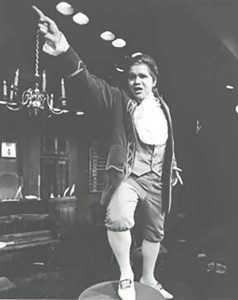
Wayne as Edward Rutledge from South Carolina
Wayne’s time at Burn Brae exceeded all the other dinner theatre work he experienced combined. Although he only participated in one show at Burn Brae, he took a great deal of pride from having been there for months during the Bicentennial. Many years later, after the theatre had closed, he contacted John Kinnamon and offered to create a web site containing a chronology of every production ever mounted at Burn Brae (1968-2001). JK happily agreed, and visitors can visit those wonderful years here: https://burnbraelegacy.com
On a sadder note, Wayne’s only regret about performing the role of Rutledge was that his father never saw him perform it, having died from throat cancer shortly after Wayne assumed the role. Wayne knew that his father was a patriot, a man who loved his country as much as he loved his family. Dad always made sure that the family celebrated July fourth together; it was his favorite holiday. Wayne was sure his Dad would’ve enjoyed a special 200th Independence Day in 1976. But he died in late April of that year.
Wayne felt as though his theatre career was just getting started, but he also felt he was too deep in the “performing” side and not close enough to the “teaching” side of where he wanted to be. At that point, fate stepped in to change his life again.
A few weeks before Independence Day, Wayne had sent credentials to several different small colleges, all within a hundred miles of where their new town house was located. He was, after all, the “product” of a small, private liberal arts college. He thought that might attract the attention of similar schools looking for faculty talent. Indeed, that apparently was a factor at one school that reached out to Wayne and scheduled an interview!

Logo of Mount St. Mary’s College
That school was Mount Saint Mary’s College in Emmitsburg, Maryland. Founded in 1808, “The Mount” is the oldest independent Catholic college in America. The word “independent” is important here; it means that the small group of French priests who founded the school were not affiliated with any specific “order” or Catholic “school of thought”, like Jesuit, Franciscan, Benedictine, etc. In fact, the only Catholic college of ANY kind in America that was older than the Mount was just 70 miles away in Washington, DC. That was the Jesuit-founded college of Georgetown University.
Mount St. Mary’s, AKA “the Mount”, is fraught with history. In addition to its age and religious affiliation, it was located in the Catoctin mountains of Maryland, roughly ten miles north of Camp David and ten miles south of Gettysburg, Pennsylvania. Camp David is the presidential retreat established by Dwight D. Eisenhower, which he named for his first grandson, David. After leaving office, the former general and former president gifted the retreat to the office of the United States President.
Gettysburg is, of course, the site of the epic battle on July first through third, 1863, when Confederate General Robert E. Lee invaded the North in a failed attempt to turn the tide of the American Civil War. Lee’s army marched through Frederick, Maryland and, further north, on “the Emmitsburg road” as it made its way northward. Ironically, Lee attacked Gettysburg from the North and Union troops defended the city from the South! During and after the battle, the college’s buildings served as hospitals for the wounded soldiers of BOTH armies!
The state of Maryland was founded and largely populated in its early years by Catholics. In 1875, the French priests on the mountain in Emmitsburg constructed a replica of the Holy Grotto in Lourdes, France, where outdoor services are still regularly offered. Since then, priests and seminarians have added a tiny chapel and a pathway recounting the Stations of the Cross.
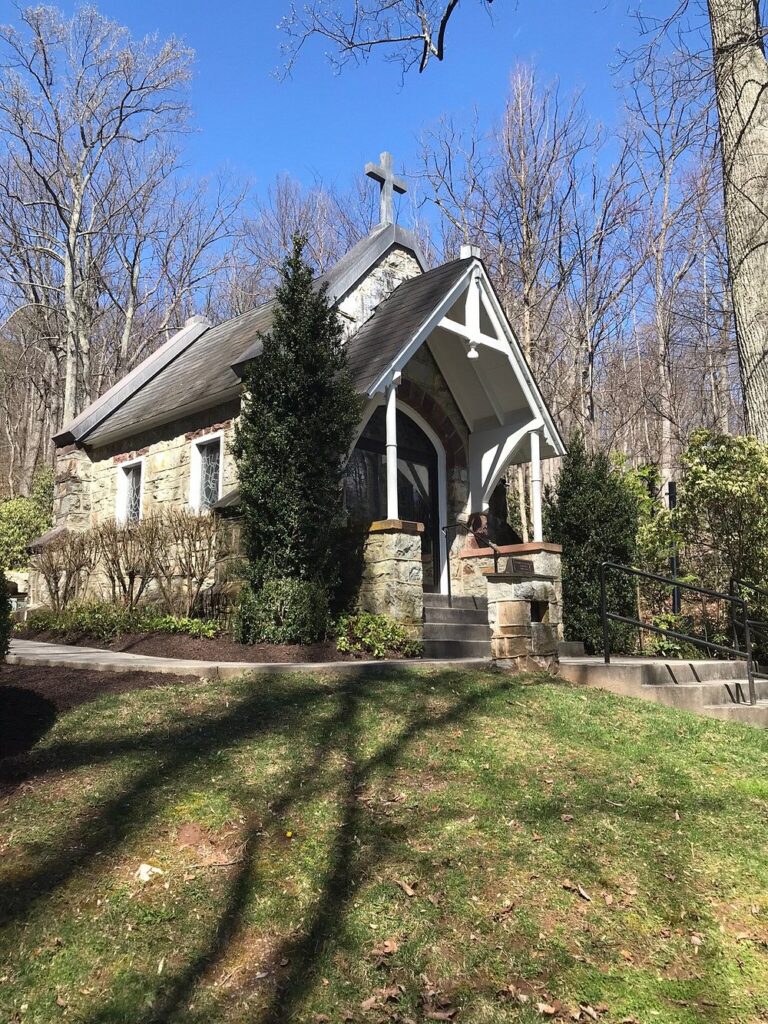
The most commanding feature of the mountainside, however, is a 25-foot, gold-leaf statue of the Madonna standing upon a 95-foot campanile! Travelers on US highway 15 cannot ignore this figure as they drive by, and many are drawn to turn onto the access road and visit this impressive site.
Wayne was invited to the campus of Mount St. Mary’s for an interview with Fine Arts Department Chairman Lewis McAllister. The arts were organized at the Mount in a single department that included two Art professors, two Music professors and one Theatre professor. McAllister taught most of the music courses (theory, history, orchestral). The other music professor was a priest, who taught voice and conducted the college’s SATB choir. Only those two music professors were tenured. Wayne met all of his fellow department members. No one spoke of this, but Wayne quickly observed that, in general, the arts seemed to be siloed, with one exception: Musical Theatre productions, where McAllister and whoever was teaching theatre would work together.
Wayne was relieved to hear that his potential boss, Lew McAllister, loved musical theatre. The reason they were looking for a new theatre professor was the health of their current theatre professor who had, like Wayne, Type I Diabetes (aka T1D). He had decided to resign his position at the Mount, move to New York City and focus his energies on writing plays.
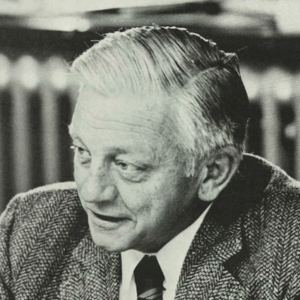
Dr. John J. “Jack” Dillon
Lew introduced Wayne to the President of the College, Jack Dillon, the first-ever lay President of the school. Wayne was also introduced to Bernie Kaliss, the Dean of Students. Those two men sat down with Wayne and Lew for an hour-long, energetic discussion, which both the President and the Dean seemed to thoroughly enjoy.
He learned in this discussion that the Mount had merged with Saint Joseph’s College, a girl’s school only a mile away, in 1973. That merger doubled the number of students enrolled at the Mount and, overnight, made it a co-ed campus. St. Joseph’s had been founded in 1810 by a Baltimore widow, Elizabeth Ann Bayley Seton, who had moved to the mountain, become a nun known as “Mother Seton” and founded an order of nuns known as the “Sisters of Charity”. Moreover, just the previous year (1975), Mother Seton had been canonized as the first native-born American Saint!
Mother Seton (1774-1821), America’s first Catholic Saint
The campus was a virtual chronicle of American Catholic history, and had more than its share of 19th and 20th century famous historic Catholics pass through its gates. One such person was Edward Flynn, the student and eventual priest who founded “Boys Town”, Nebraska’s famous home for orphan boys, who received his BA degree from the College in 1906 and his MA degree from the Seminary in 1908.
Father Edward Flynn (1886-1948)
Another VERY well-known American sports figure was baseball great Babe Ruth. Ruth never attended the Mount, but he was a native Baltimorean and had many friends who attended Mount St. Mary’s, so he was a frequent visitor to the campus, no matter which professional team he was playing on.
Lew gave Wayne a tour of the campus, especially a former gymnasium that was built in 1903: Flynn Hall. This was where virtually all Theatre practicum courses would be taught: set construction, acting, lighting AND where all of the plays and musicals that Wayne would direct would be rehearsed and performed; THIS was, in fact, the theatre building. It was already listed on the National Register of Historic Places, like most of the other buildings on the Mount’s campus (and the entire campus of Emory and Henry).
The second-floor “track” had already been removed from the interior of Flynn Hall, and it was beautifully finished in early 20th century hardwood and fieldstone. The “stage” was a crude collection of 4’x8′ plywood sheets supported by two foot tall two-by-four legs. Wayne tried to imagine a tap dance routine on such risers; it must’ve sounded like a herd of running horses!
Wayne was also to have an office on the third floor of the Administration Building, but it was clear that Flynn Hall would be his “Home Base”, and one that would surely require some work, at least in Wayne’s head.
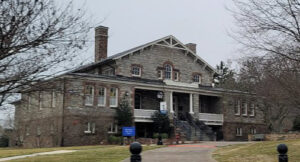
Flynn Hall, built in 1903 as a gymnasium, was a theatre in the 1970s
There was one classroom in Flynn Hall. Lew led Wayne down the steps to this room and opened the door. Inside, there were eight or nine students waiting for their turn to meet the person who MIGHT become the next theatre professor at the Mount. Lew introduced Wayne to them individually in turn and then collectively as “the leaders of the Mount’s Sock and Buskin Dramatic Society” (S&B). Wayne had met with theatre students in previous interviews, but never with quite so many, and never identified as a separate artistic group. He and Lew synchronized their watches. Lew said, “I’ll be back in an hour”, and Wayne’s discussion with S&B began.
For the most part, the questions centered on what one would expect. Q: What’s your favorite theatrical form? A: As a performer, musical theatre. As a director, musical theatre. Q: What kind of stage do you most like to direct on? A: I like them all, but in order of preference, I’d say Arena, Thrust, Proscenium. Sometimes the play demands the type of stage.
Then, from out of the blue, Q: What’s your favorite beer?
Unexpected, but not totally surprising. Wayne had noticed the beer taps in the college cafeteria. Without hesitation, A: “Miller Lite, I suppose. But I was raised around Hamm’s, my dad’s favorite. He bought it by the case and always had a full fridge of it downstairs in our rec room. My brother & I were his ‘beer runners'”, which prompted a collective laugh.
Something changed in the room at that point. Wayne noticed that the students seemed to be more relaxed. More personal questions were asked about what shows he’d done, either as a performer or director, and did he have children. Wayne asked them, “A few minutes ago, when you asked me about my favorite beer, where did that come from?”
The student who asked the question explained, “We asked to see your application when we heard you were invited to be interviewed. We noticed that you went to a Methodist college, so we went to the library and looked it up and noticed it was pretty strict and didn’t allow drinking and stuff like that. So we thought you were gonna be some kind of holy roller or something Sock and Buskin is not. At our strike parties after every show, we order enough pizza for everybody, tap a keg and party down!”
Wayne replied, “A holy roller I’m not. I WILL have rules, but that strike party sounds like fun!” In fact, Wayne thought, it sounded like most of the strike parties at VCU. Wayne went on to ask, “But tell me; I’ve been on a LOT of college campuses. You have what, twenty-five hundred students here and it’s evident that beer is everywhere! Why?
The students told Wayne it wasn’t always like that. “The rule used to be NO ALCOHOL on campus, so students did what they did everywhere else. They would sneak off campus and get trashed, then come back to the dorms to sleep it off. Trouble is, US Highway 15 runs right through campus and kids were getting into terrible car accidents and some had even been killed. So the administration brought the BEER on campus to keep the STUDENTS on campus. And it’s working!”
Only later did Wayne discover that this organization of students was actually co-producers of almost all theatrical productions on campus. The Fine Arts faculty, led by the Theatre professor, worked WITH S&B to select shows, staff, advertise, schedule and pay for all aspects of each show mounted at the school.
When all was said and done, Lew arrived as promised, an hour later. To Wayne, it felt like three hours, because the questions kept on coming. But Wayne survived, parted amicably from Professor Lew and drove the forty miles back to his town house in Germantown. It had been a very long day!
TEACHING IN THE CATOCTIN MOUNTAINS
year one
Wayne and his wife had a lot to talk about later that week. He got a call from Lew McAllister three days after his visit to the Mount. Lew offered Wayne the Theatre faculty position in the Fine Arts Department. It was a full-time, tenure-track faculty position, and while the pay was not high, Wayne felt it was the kind of environment he had been looking for – a gateway to the future. He would officially be an “Assistant Professor”! Therefore, he accepted it. The most difficult part of leaving MC was losing his working relationship with Gerry Muller, an honest man he truly respected and one he felt would be a friend for life. And that’s what he told Gerry when he announced his decision.
While he was teaching at MC and working with Community Services and performing in dinner theatre shows, his wife quit her position in MC’s accounting department and took a position as Director at a large after-school childcare center at a Silver Spring church. She was happy, and that made Wayne happy, so all was well. The move to the Mount was something of a Homecoming for both Wayne and his wife, since they had studied for four years in the Blue Ridge Mountains of Virginia. Geographically, the Catoctin Mountains of Maryland formed the Easternmost ridge of the Appalachian mountain range.
Though they shared the same home address, their work lives kept them separated by about fifty miles. They had just bought a house and invested several thousand dollars into finishing the basement at that house. Her job was about twelve miles South of where they lived and his job was forty-plus miles North of where they lived. She would be home by 6:30, fix dinner and be in bed by 10 pm, while Wayne ate dinner in the college cafeteria Monday through Thursday evenings, conducted rehearsals until 10, THEN drove 40 miles home. Fortunately, his new friend Bernie Kaliss ensured that none of Wayne’s classes began before 11 am, a gift which Wayne had never even requested!
That’s how life went for Wayne’s first year at Mount Saint Mary’s College. His office on the third floor of Bradley Hall was small, but it was big enough to accommodate a desk, a bookshelf, an office chair, a visitor’s chair and a fold-out sofa where Wayne could sleep in case the mountain roads were so bad with snowstorms that he couldn’t get home! Some of his colleagues joked about the new Theatre professor having a “casting couch” installed in his office, a joke Wayne was too new to think was funny. So he simply ignored it.
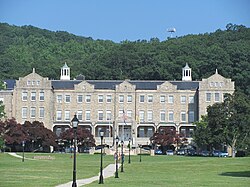
Bradley Hall, the Mount’s Administration Center
Lew had already determined which Theatre courses Wayne would be teaching that first semester in the Fall of 1976. Before he started teaching, Wayne spoke with Lew about the play selection process at the Mount and learned that multiple parties were involved. Since his first semester was scheduled for a non-musical show, Wayne made a short list of straight plays and shared it with Lew. If he approved it, Wayne took it to S&B, answered their questions about it. If THEY approved, Lew ordered scripts from the play service. Wayne was grateful not to be personally involved in withdrawing money from departmental funds.
Wayne announced audition dates when the play had been selected. He usually had the play cast before scripts arrived, and they met, worked together as a theatrical “company” as quickly as possible. When scripts arrived, Wayne hounded them to memorize their lines ASAP. With Plaza Suite, Wayne was actually directing three one-act plays on the same set, Suite 719 of the Plaza Hotel. He trusted Neil Simon’s genius with the words and helped the young actors with appropriate timing and expression when delivering them.
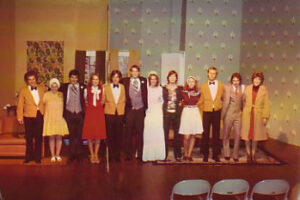
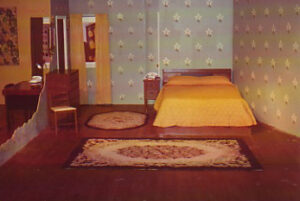
The school newspaper, The Mountain Echo, did a preliminary article about a month before the show opened. It recounted the success of Plaza Suite on Broadway, the success of Neil Simon in general, and laid out the plot for potential purchasers of tickets. After the five-performance run closed, The Mountain Echo gave the show its stamp of approval in a headline that included the words “A Smashing Success”. Good news travels fast on a small-college campus, so every performance was a SRO sellout.
Meanwhile, the daily commute was starting to take its toll on the Karmann Ghia. The value of the car was dropping as the odometer approached the hundred thousand mile mark. Wayne decided to take advantage of the car’s current value and trade it in. Therefore, he took another step down in the VW brand hierarchy and traded his green convertible in for a used, 1974 SuperBeetle. It had plenty of power, good gas mileage and an automatic transmission. It wasn’t pretty, but it was tough.

For Wayne, one of the things that excited him every day was going to work in a building that was on the National Register of Historic Places. That meant he could not request changes to any part of the building’s exterior. He COULD, however, request changes to the INSIDE of the structure. At Wayne’s request, the college agreed to paint the interior of the building and re-finish the hardwood floor. They also installed reverse window shades that would darken the interior of two-foot wide by twelve foot tall windows without the use of a ladder. Wayne personally framed show posters and hung them in the Green room after every show to boost Sock and Buskin and Fine Arts Department pride.
One of the wonderful things about Flynn Hall was that it could accommodate any kind of staging: proscenium, arena, thrust, whatever. Plaza Suite was staged as a proscenium set on what was once the floor of a basketball court, facing the rear of the theatre, with audience members walking past the set and sitting on risers facing the FRONT of the building. Modern lighting batons and electrical wiring had been added to the gigantic wooden crossbeams that supported the roof of the building.
The same set/audience positions were used for the Spring musical. However, Wayne wanted the audience seating to start on the floor and rise toward the back of the building. The floor of the entire stage would be two feet above the “basketball” floor and the orchestra would be placed BETWEEN the front of the stage and the front rows of the audience.
The Fine Arts Department did not have the budget to build what Wayne envisioned. But he had learned of an off-campus organization, the Mount St. Mary’s Parents Guild, that awarded funds to worthy student-oriented projects on campus. Wayne applied for and received a grant to build a dozen boxes (4′ wide x 8′ long x 2′ high). To absorb sound, the interior of each box was filled with fiberglass insulation before closing the bottom and all four sides with fiberboard panels. To ensure ease of movement, 12 carpet patches were applied to the bottom of each box, allowing them to easily slide into position whenever the boxes had to be moved.
These boxes, though heavy, could be stacked and used for audience seating in arena, thrust or proscenium configurations. They could also be used to create stage segments for performances. When placed in final position for performances, the boxes were typically “topped off” with 1/8″ thick tempered masonite that covered the entire stage, including the small gaps between boxes, providing a single, smooth performance surface.
The “performance boxes” described above that Wayne invented served audiences and performers for the next six years for every performance offered at Mount St. Mary’s. Future applications to the Parents Guild also enabled the purchase of newer, more powerful lighting control boards, spotlights and lighting instruments.
First show, first year, successful. Second show, first year, a little heavier fare in the form of a social statement. The Threepenny Opera by Bertolt Brecht and Kurt Weill was a musical, but one that was written in 1928 Germany.
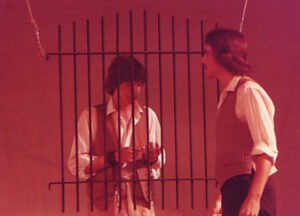
It was a biting satire of capitalism populated by low-life characters and featured music based on John Gay’s 1728 melodies and themes. When it came to choosing which musicals would be produced for public performance, Wayne learned very quickly that Lew wanted to be deeply involved in that process. And much to Wayne’s delight, Lew had a penchant for selecting musicals that were NOT the big-cast, big-name shows everybody knew by heart.
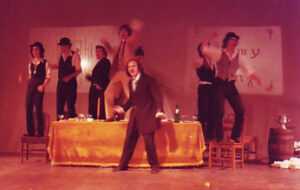
Such was the case with Threepenny Opera. Obviously, this was material with which Wayne was extremely comfortable, since he’d spent so much time with the 200 year-old root work (The Beggar’s Opera) during his MFA studies. This was his first work with his new boss, Professor Lew. He quickly learned that Lew was very popular with the students, who referred to him as “Uncle Mac”.

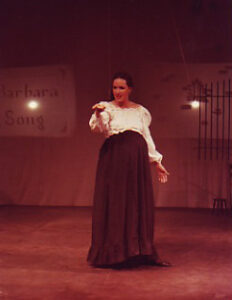
Wayne chose to use “the boxes” as the stage for the first time with Threepenny, and presented the show in the thrust style. Lots of set pieces were lowered from the crossbeams by ropes. The show ran for five performances and The Mountain Echo called it “Sensational”.
The fact that Wayne and “Uncle Mac” got along so well was augmented by the fact that THEIR WIVES also got along. One reason for this was the fact that both women were from the state of Tennessee!
So the relationship of the couples extended beyond the professional to the social. At one early point early in Wayne’s time at the Mount, the Hamiltons invited the McAllisters to drive South to Rockville to see a dinner theatre show at the Harlequin Dinner Theatre, a venue that was practically across the street from Montgomery College. When they arrived at the theatre, they were escorted to their table by the “maitre’d”, who said, “Your waitress tonight will be Michelle, and she’ll…well, here she is now!”
The waitress stepped up and began her “welcome to Harlequin” patter: “Hello and welcome to Harlequin. My name is Michelle and I’ll be your waitress tonite and…OH MY GOD…” she stopped in mid-sentence and stared wide-eyed at Wayne.
Lew asked her, “Are you all right?”
Michelle broke out of her frozen stare and said, “I’m so sorry, it’s just that…” and turning to Wayne, said, “do you have any idea who you look like?”
Mystified, Wayne replied, “No, who is it you think I look like?”
“Well, to me you look exactly like WAYNE HAMILTON!”
There is a moment of stunned silence as the Hamiltons and the McAllisters, jaws dropped, exchange looks, waiting for Wayne’s reply: “Perhaps that’s because I AM Wayne Hamilton.”
Red faced, Michelle said, “Oh, Mr. Hamilton, I am so sorry. I was one of your voice students in the Music Department at Montgomery College. I took your Voice 101 and Voice 201 classes and it has changed my life. Oh please sit down. I’m not getting lead roles yet, but I’m appearing regularly here at Harlequin and with Montgomery Light Opera Company and my voice keeps getting better all the time…”
And for the rest of the evening you’d think Wayne was something approaching the Prince of Wales. The Maitre’d sent an ice bucket and a free bottle of champagne to their table with a note that read “Complements of the House.” The two couples chuckled about the incident for weeks.
One classroom item of note should be made here, only because it was so unusual. Once every academic year, typically in the Spring Semester, the Fine Arts Department offered a 12-week course titled “Introduction to the Fine Arts” to a maximum of 120 students, which required that an additional fee be paid by each registrant. This was a required course for Fine Arts Majors. Each time it was taught, there were three sections, and each section met at the same time and place and on the same day of the week.
Section 1 might start out with a Music professor, section 2 with an Art professor and section 3 with the Theatre professor. After four weeks, the three PROFESSORS each moved to another section to teach the same material to that section. Four weeks later the three professors would move to the section with which they had not yet met and teach the same four-weeks of introductory material to the last of the three sections.
FINALLY, after all three sections had met with all three professors for four weeks, the college rented buses and invited the remaining Fine Arts faculty members, their wives/husbands and certain select members of the Administration to join the three professors and the students on a 70-mile “day trip” on a Saturday to either Baltimore, Maryland or Washington, DC (the Mount was almost equally distant from both).
The goal was to take all 120 students to an art gallery to view a special exhibit, a concert hall to hear a musical group in performance and a theatre to see a performance of a specific, professionally produced play or musical before returning by bus to the college campus, usually after the hour of midnight.
Students FLOCKED to get into this class, and it was great fun for everyone involved. Oh, there were rules, but few tried to break them, because 1. it was too much fun and 2. we were their ride back to campus. This course was a fabulous part of every academic year Wayne spent on the faculty of Mount St. Mary’s College! Naturally, the three professors included the presence of their spouses during each of these “special days” that wrapped up the Intro to the Fine Arts course.
Just a few weeks after the event at the Harlequin Dinner Theatre in Rockville, it was time for the students and faculty members to take the busses, this time to Washington, to the National Gallery of Art in the morning, a series of string quartet performances in the Kennedy Center Concert Hall in the afternoon and a performance of A Chorus Line at the Kennedy Center Theatre in the evening.
The National Gallery offered several guides, so the three professors could be assured that all students would get the same information. The performance experiences offered different perspectives on the music and the actors, based on where people were seated, but it was never possible to get such a large number of tickets in a single block of seats. Our “party” of 130+ were seated in locations all over the Concert Hall and Theatre.
By chance, the Hamiltons and McAllisters were seated together with a large block of empty seats directly in front of them. Wayne and his party, including the invited “special guests”, arrived early for the evening show and were studying their programs when Wayne heard a familiar voice say, “Hey pal, I think YOU are sittin’ in the wrong seats!” Wayne looked up to see the handsome face of John Kinnamon, owner of Burn Brae Dinner Theatre, smiling down at him! He had brought a large entourage of theatre people “downtown” to see this show about theatre people!
After much laughter and introductions and “Howya doin’?” exchanges, everyone settled into their seats. Uncle Mac reached over and thumped Wayne’s knee and said, “Can’t we go ANYWHERE without running into your theatre friends, Hamilton?”
That summer of 1977, Wayne got a call from an actor friend named David Harper. David was a regular understudy for the John Adams role at Burn Brae in 1776 during the Bicentennial. He told Wayne he was both directing and performing the title role in Man of La Mancha at yet another dinner theatre in Jessup, Maryland, called Colony 7. David INVITED Wayne to perform the role of “The Padre” in a six-week, summertime run of that show. Wayne agreed, mostly because his character would sing a solo called “To Each His Dulcinea” in each performance. Needless to say, he informed everyone he’d met at the Mount and at MC about the show’s location, dates and times as quickly as possible.
While all this was happening, Wayne was approached by the college about his living arrangements. During WWII, the college hosted a US Navy flight training program on its campus that was designed to train select members of its (at that time) all-male student body how to fly and, after graduation, induct them as Second Lieutenants and pilots in the Navy. To that end, the Navy built a large aerodrome to house and service the planes (probably biplanes) on the college side of US Highway 15, where there was a huge field for planes to take off and land.
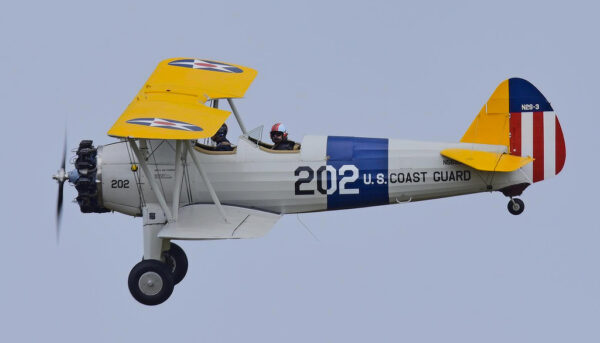
The Boeing Stearman Kaydet biplane, developed by the US Navy to train its WWII pilots
After the war, the on-campus flight-training program ended and the Navy flew all of its aircraft away to nearby Naval air fields. All of the buildings constructed by the Navy were given to the college as “gifts.” The college closed the two open ends of the aerodrome with fieldstone walls, put in bleachers, a hardwood floor, two locker rooms and two baskets and had a fine basketball arena.
It was in that airplane-hangar-turned-basketball-court that Wayne met the first of two small-college coaches in that sport who set examples for him in terms of goal setting, excellence and work ethic that Wayne admired and held throughout his working life. The head basketball coach at Mount St. Mary’s was Jim Phelan, who served in that position from 1954 to 2003, winning 830 games and, in 1962, the Division II National Championship.
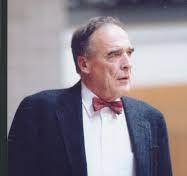
Coach Jim Phelan
On the OTHER side of Highway 15 and parallel to that road, the Navy also built a row of five, one-story cottages for the officers of this flight training enterprise, each of which included two bedrooms, one bathroom, a living room, and a large kitchen/dining room. Each cottage had a full unfinished basement, ostensibly for workouts and/or laundry. After the war, those houses, also gifted to the college, became homes for college faculty members.
When Wayne arrived on campus, the middle cottage was raised off its foundation, enabling a new foundation and concrete basement floor to be laid. Now, in the Summer of 1977, that cottage stood empty on its new foundation. Knowing Wayne’s residential situation in relation to the college, Professor McAllister convinced the administration to rent that “middle cottage” to Wayne and his wife for $150 per month.
After lengthy discussions with his wife, and after consideration of the increase of value of their town house resulting from their finishing of the basement level, they decided to sell their Germantown property for a considerable profit. Wayne’s wife quit her job at the child care center in Silver Spring and she and Wayne moved into the middle of the five cottages on the campus at the Mount before the 1977-78 academic year began.
At that point in time, the college also quietly planted, at the southern end of that row of cottages, about thirty acres of vegetables of all kinds just for its faculty members to harvest and consume. There was corn, cucumbers, tomatoes, melons, potatoes, strawberries, green beans and more, all there for the picking, and it was about 75 yards from Wayne’s back door. There were also fully grown chestnut trees between each of the cottages and a cluster of half a dozen apple trees fifty yards to the east side of the house. College employees were welcome to harvest what they wanted from all these sources of nutrition. Emmitsburg was in farm country, surrounded by fruit and dairy farms for miles around.
Much turmoil and change was happening at the Mount at this point in time. College President Jack Dillon was diagnosed with cancer and had to resign. The college’s Board of Trustees found a new, young President (only five years older than Wayne) by July 1. History tells us that their choice was actually the youngest college president in America at that time. Wayne was sad to see Jack Dillon leave the campus he loved so much.
Dillon’s replacement was a young man who had never had an academic rank higher than Wayne’s current rank (Assistant Professor) and who brought in two former colleagues from the Big Ten University where he earned his PhD in English, a male to be his personal assistant and a female to be the Mount’s new Dean of Women. Both would be Wayne’s neighbors, as each took occupancy of one of the five cottages across US Highway 15. This new President also hired a popular former Mountie basketball star to replace Bernie Kaliss as Academic Dean.
year two
The first half of the 1977-78 academic year, at least from a theatre directing perspective, drew on Wayne’s experience with the Montgomery Light Opera Association. In November, for the Fall production, Wayne and Lew selected a 1959 Off-Broadway musical called Little Mary Sunshine, which was actually a PARODY of the operettas of Romberg, Friml, and Herbert! The show also poked fun at the films of Jeanette MacDonald and Nelson Eddy. The plot featured mounted police, Indian chiefs and tough, smart women who are oh, so sweet! All this, Book, Music and Lyrics, were from the pen of one man: Rick Besoyan, who followed the form of those turn-of-the-century composers hilariously!
Once again, the new boxes served as the stage (this time a proscenium type) and the orchestra pit was on the floor between the front of the stage and the audience. Lew and Wayne had as much fun mounting this production as the students did. Sunshine was another sellout.
Another academic phenomenon provided an option for the Fine Arts department to offer a third performance opportunity each year to its students and its on and off-campus audience base. It was called “The J-term”. The name stems from the end of the Fall semester occurring BEFORE the start of the Christmas break, with some (not all) students returning on January 2 and taking a single, practicum course ALL DAY LONG, FIVE DAYS PER WEEK in JANUARY to earn three Fine Arts credits. The Spring semester would then start later than usual, in early February, and would end in June rather than May.
Expecting lower enrollments for this performance opportunity, we chose small-cast productions, the first of which was a musical version of Oscar Wilde’s The Importance of Being Earnest entitled Ernest in Love. Enrolled students completed all the work required to mount this J-term show, set in the late 1800s: build and paint the set, assist with costume construction, design and implement the lighting requirements, learn the lines, the music and perform the show and finally, set Flynn Hall up as an ARENA theatre, four entrances onto the performance space, surrounded by audience members.
Ernest in Love set, obviously arena style, looking toward the rear of Flynn Hall.
The Mountain Echo sent its most experienced theatre critic, Pete Horton, to review Ernest in Love. He wrote, in part:
“Director Wayne Hamilton has woven a tapestry of professionalism and art in this musical production as he has brought the best talents together tor a tightly-knit job. Under his competent direction, the production never lagged, but rather gained momentum as it went along, each scene better than the one preceding. His blocking of characters and movement was superb, utilizing the ‘theatre-in-the-round’ technique to its fullest capacity. His casting was uniformly perfect, and he was rewarded with the best his performers could give, the fullness of their talent, making Ernest in Love a labor of love as well as one of the finest productions this company has ever done.”
Horton closed his review with this paragraph:
“Ernest in Love was indeed an evening of theatrical magic, an evening the audience hoped would never end. Those of you who missed Ernest in Love missed a warm and funny experience. Those who were fortunate enough to catch this performance will know what I mean. If Sock and Buskin continues to present plays of this high caliber in the future, our little town of Emmitsburg will become the home of one of the finest collegiate acting companies on the Eastern Seaboard.”
High praise indeed. But Wayne could not keep from smiling as he read these words. He had proven himself four times over and was happy to have found a musical partner who apparently enjoyed working with him and who was an excellent teammate. And to top it all off, Lew and Wayne had the good luck to find two excellent costume mistresses. All of the late-19th century women’s costumes for Ernest were designed and created from scratch by their two spouses!
During the early days of 1978, while he was working on the J-term show, Wayne was visited by a faculty colleague, a faculty member in the Business Department, who wanted to talk to Wayne about a business proposition. His colleague owned a campground near Thurmont and wanted to offer his customers some theatrical entertainment while they were camped at his establishment. Could Wayne think of a way to help make that happen?
As it turned out, Wayne could. He quickly consulted with college officials for permission, borrowed a couple of pickup trucks from the college to haul the necessary set pieces, lights, control boards and other gear and recruited students to get involved FOR PAID POSITIONS in the enterprise. All this effort would take place in the summer of 1978, when Wayne’s little company of players would re-stage a mobile version of Neil Simon’s hilarious third act from Plaza Suite, “Visitor from Forest Hills”. In this act, a bride gets cold feet at her own wedding and locks herself in the bathroom of the suite, creating panic among the members of two families, especially the bride’s, whose father, in keeping with tradition, was bearing the EXPENSE. Wayne made arrangements with Dramatists Play Service for licensing and began to search for the right people to make this happen.
Wayne identified members of Sock & Buskin who chose to stay near (not on) the Mount campus to keep jobs they held down while getting their education. Other students were already commuting from nearby homes to attend the Mount. In short, Wayne had all the on- and off-stage talent he needed to re-create this part of Simon’s play. As for a set, Wayne and his tech students developed a wire frame to define the room, with a door at either end. Stage right was the entry from the hotel hallway into the suite. Stage left was the locked bathroom door. Curtains were hung on the wire frame for walls and light, easy-to-move furniture pieces furnished the room. The whole set with lights and controls fit in two pickup trucks and could be assembled or disassembled in forty minutes.
Wayne’s faculty colleague/campground owner agreed to hire Wayne’s OUTDOOR COMEDY company twice. Once in June and once in August. He was also President of a regional Association of Campground Owners and agreed to promote OUTDOOR COMEDY to other members of that organization. They did about 10 performances of “Visitor from Forest Hills” that summer, and charged $800 per performance. Each of the ten company members got an equal share of the earnings. “Earnings”, in this case, included TIPS from campground attendees, most of whom seemed to enjoy the performances tremendously.
Shortly after the Spring semester began and students returned to campus in 1978, Wayne and his wife were informed by her doctor that they should expect to become parents at some point in October. She began to shop for clothes to accommodate her changing shape and took a job as secretary to the Mount’s archivist to help pay for them. She also pointed out to Wayne that getting an infant and his (or her) necessities in and out of a two-door car would be, at best, inconvenient. He dared not disagree, and introduced her to his new friends at the Nissan dealership in Gettysburg. After looking at all the different models offered, she naturally chose the top of the line, 5-door, fully automatic, six-cylinder station wagon, the all new Datsun 810!
She also had a choice about WHERE she would give birth. A large, modern hospital existed in Frederick, Maryland twenty-five miles South of their cottage. But only ten miles North of the cottage was a small but “adequate” hospital in Gettysburg, Pennsylvania. She liked her obstetrician in Gettysburg and he was fifteen miles closer, so to her, the choice was easy, her child would be born there. With that choice, their child would become the first from either family bloodline to EVER be born North of the Mason-Dixon line! So be it.
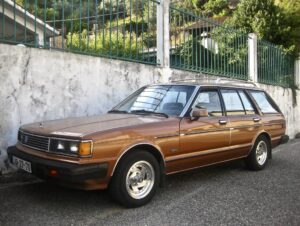
The Datsun 810, soon to be renamed “The Maxima”
Her 1970 Chevelle had zero trade-in value, but a recent Mountie theatre graduate, Bobby Golibart, asked if Wayne and his wife would sell the old Chevy to him. He had just landed a job as an on-stage host/narrator for a Pepsi-Cola-sponsored Skateboard Show that was traveling up and down the Eastern seaboard. Bobby said he needed “personal transportation” to travel with the show and had “always admired” that car. Wayne never asked what happened to the car, but he and Bobby stayed in touch throughout Bobby’s career.
As for the next show at the Mount, Wayne had considered, for no specific reason, making a subtle statement about alcohol. Not to chide the student body; rather, to point out that it was, to one degree or another, a problem that had been around for a very long time. He started with an 1868 temperance play called 10 Nights in a Bar Room. Then he mixed in elements of dialogue from an earlier 1844 melodrama called The Drunkard. The result was a non-musical comic melodrama with 19th-century characters and costumes and staged in the proscenium style. The audience was seated at round tables, like an old-time saloon, and beer and wine were available at additional cost. Finally, Wayne took the central role as the “Snidely Whiplash” villain. The show had a five-performance run in mid March (before Spring break) and a three-performance run in early April (after Spring break).
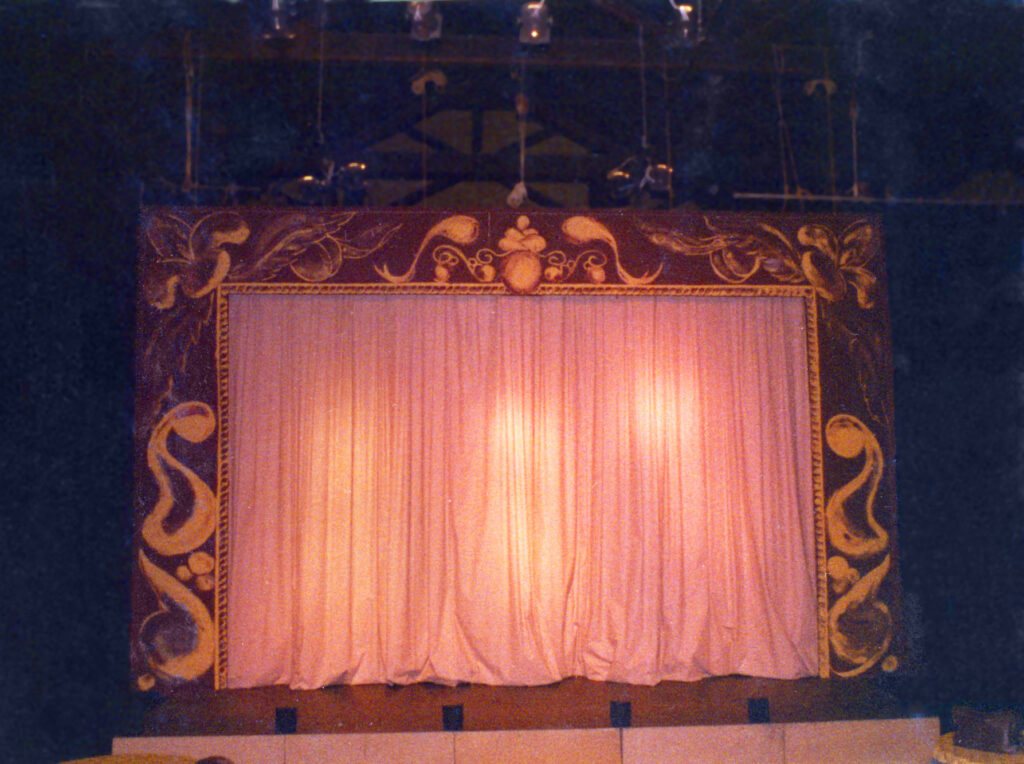
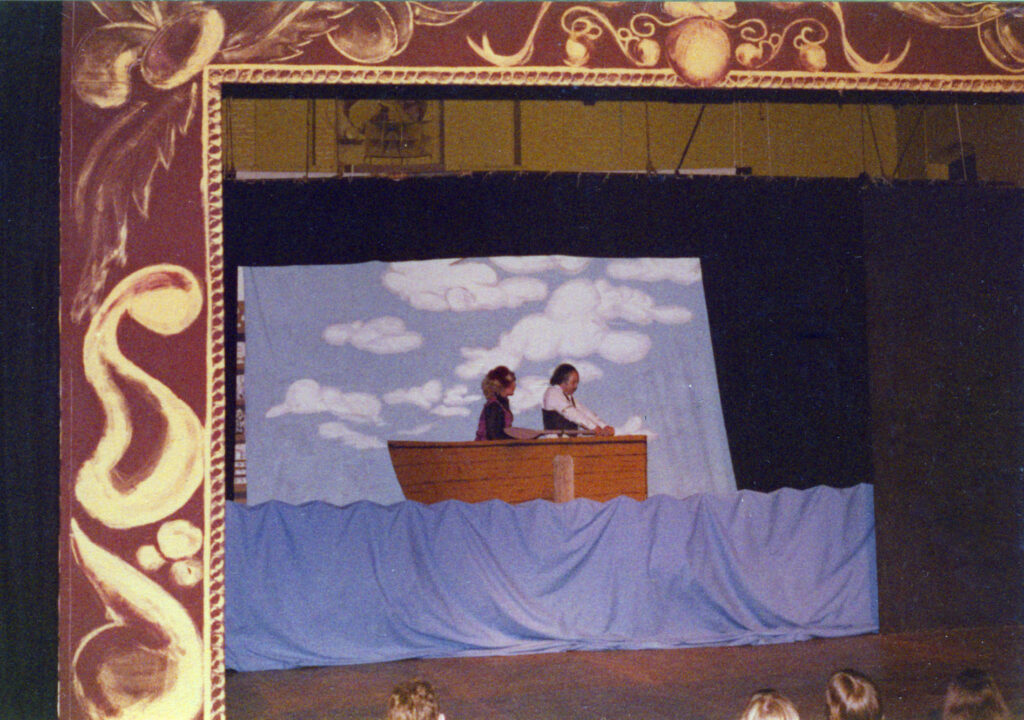
The proscenium stage was taken to a new level for this production. Placed at the back of the space and facing the front door, Wayne created a “hallway” of black curtains between the Green Room and stage along the complete length of the theatre, thus masking any movement of offstage actors from the audience. The proscenium arch actually had a curtain that opened and closed at the center, and in one scene, a rowboat was mounted on wheels with a blue curtain, representing “water”, masked the crew members behind the curtain pushing the boat across the stage. It was “hokey”, by modern standards, but it was also very “nineteenth century” theatrically!
year three
International history visited the Emmitsburg area for thirteen days in September (5-17) of 1978. In an effort to broker a peace agreement, America’s President, Jimmy Carter, hosted two heads of state whose countries had been at war for centuries: Anwar Sadat of Egypt and Menachem Begin of Israel. Those three men met at the Camp David presidential retreat from September 5th through 17th. The negotiations took place just a few miles from where Wayne’s family lived, but Wayne was personally involved in some associated activities.
First, Wayne was at Flynn Hall in the late afternoon cleaning up after a “tech class” on a Thursday (September 7th). The big glass entry doors were propped open (Flynn was not air conditioned), so Wayne could clearly hear the sound of a helicopter flying low over the campus. He ran to the front porch, down the steps and around to the back of the building to watch a large black helicopter set down on the baseball field directly behind Flynn. A man with a headset and a walkie-talkie hopped out and ran up the rise to where Wayne was standing and asked, “Can you tell me where the turnoff is to the Madonna and Grotto road?” He nodded and pointed to a very long limousine on the access road parallel to US Highway 15.
Wayne knew the road he wanted was narrow and went up the mountain and through a small forest to those religious shrines. The road would be invisible from the air. “Sure,” Wayne said. “Tell him it’s the second left from where he’s sitting right now. Why?”
“We’re Secret Service. The President and his guests would like to visit the shrines. It’s our job to do some advance work to see how safe the site is.” Then he radioed Wayne’s directions to the limo team. Wayne watched the car head up the mountain road to the shrines. A few seconds later, the agent put his free hand up to the earpod on his headset and said, “10-4.” Then he turned to Wayne and said, “Thanks” and started to leave.
Wayne said, “Wait. Are they going to visit us or not?”
“No way” said the agent. “Not safe. Road’s too narrow. If the limo was attacked, there’s no way we could turn it around and get it out of there. Nope. Not safe. Thanks for your help.” Wayne watched him jump into the chopper and strap himself in, then watched it and the limo disappear South, toward Camp David.
During the next few days, the newspapers announced that the three heads of state would visit the famous Civil War battlefield in Gettysburg, Pennsylvania, on Sunday, September 10th. Wayne was pretty sure they’d have a large entourage going with them on the 20-mile, one-way trip to the battlefield, so they’d be likely to drive straight up US Highway 15 RIGHT THROUGH THE MOUNT CAMPUS AND RIGHT PAST WAYNE’S HOUSE. Therefore, Wayne encouraged his students to make up some non-political welcome signs for the event and come to his house that day to wave at them as they drove by. He even invited his neighbors and mowed his lawn!
Sure enough, that Sunday the network TV “Camp David watchers” showed the caravan of automobiles leaving Camp David with those big, black helicopters escorting above, all heading North toward Gettysburg on US 15. Wayne and his wife had about 25 students, most with signs that read “WELCOME TO THE MOUNT” and “STOP AND VISIT” and “COME SEE US” standing on their property by the roadside. Wayne’s “crowd” was not more than twenty feet from the highway, and it was easy to see, in the lead limousine, in the back seat, plain as day, left to right, Sadat, Carter and Begin. Everybody standing in Wayne’s yard cheered, yelled and madly waved their signs. The entire caravan numbered 27 vehicles! Even Carter’s daughter Amy went along for the ride. It was quite a day!
Sadat, Carter (with Amy) and Begin listen attentively to the Park Services Guide Israeli General Moshe Dayan (right foreground) seems unimpressed
The NEXT day, Wayne got a call from the College’s Athletic Director with a surprise request. It seems that the White House press corps, who were all staying at motels and B & Bs in Thurmont, waiting on the latest word from the Accord negotiations, were spending their daytime hours at the VFW bar. They were getting bored and decided to challenge the Mount faculty to a softball game. Wayne was asked to help coordinate the affair, and he happily agreed to do so.
The A.D. reached out to faculty members to solicit players and donated softball equipment (balls, gloves, bats, even bases). Wayne bought three large, styrofoam coolers and drove around Emmitsburg soliciting free beer (in cans only) and ice donations from bar owners around town, not hesitating to point out the historical importance of their donations. Wayne promised the bar proprietors he would give each reporter a list of every bar that donated beer to the players. And he did!
The game took place the next day in the afternoon, a Tuesday (September 12th). While “Uncle Walter” (Cronkite) was not present, journalists for major news outlets like the New York Times, The Washington Post and major TV networks (ABC, CBS, NBC) showed up to play. Everybody there had a great time, with both teams laughing and shouting insults at each other with every error. They would play a couple of innings, then stop playing for a “beer break” at home plate, accompanied by joke swapping, then go back to playing. Soon, no one could remember the score and it was obvious no one cared. This field had no lights, so the only thing that stopped the game was darkness. In short, a good time was had by all and it was an afternoon to remember!
A month later, on October 12, 1978, Wayne’s wife gave them a beautiful baby boy. Wayne was delighted and happy that his now three-person family was all together in the same house. However, pressures still surrounded Wayne, despite his teaching and artistic successes at the Mount. Perhaps it was being the only one of the three artistic disciplines in the Fine Arts department with only one person (Wayne) to manage everything having to do with that discipline and having the most public face in the department, but Wayne sat down with Lew during the early summer of 1978 to ask for some help. Lew suggested that, while he began negotiations for funding with the new Administration, Wayne should visit small colleges in that area with small theatre programs like the one offered at the Mount and interview graduating Seniors about a part-time theatre “assistant” position. In short, both professors were successful, and in October of 1978, EVERYONE, including Wayne’s new assistant, went to work on Bye Bye Birdie.
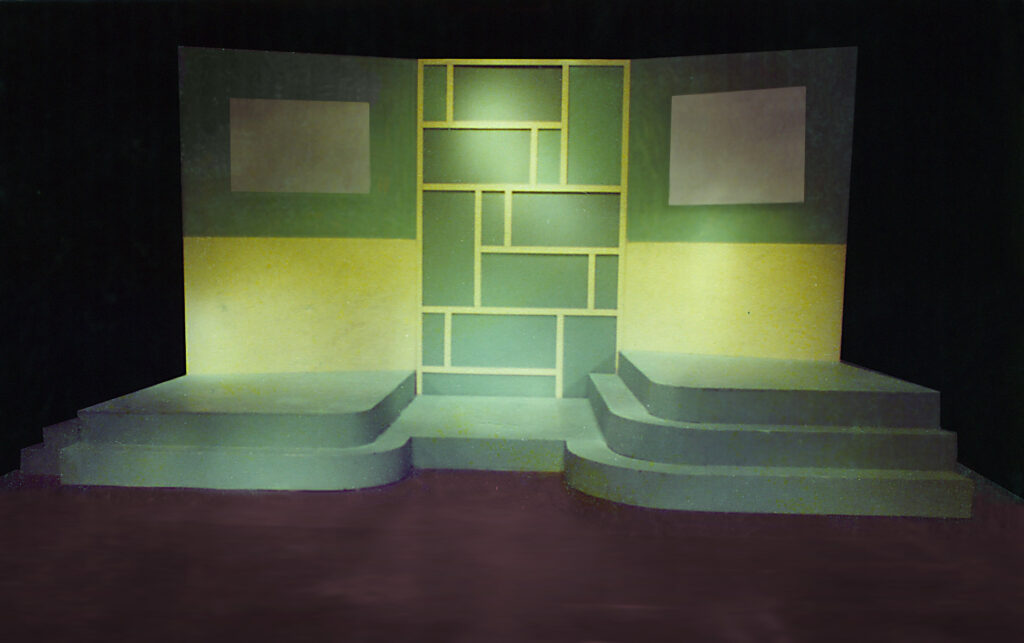
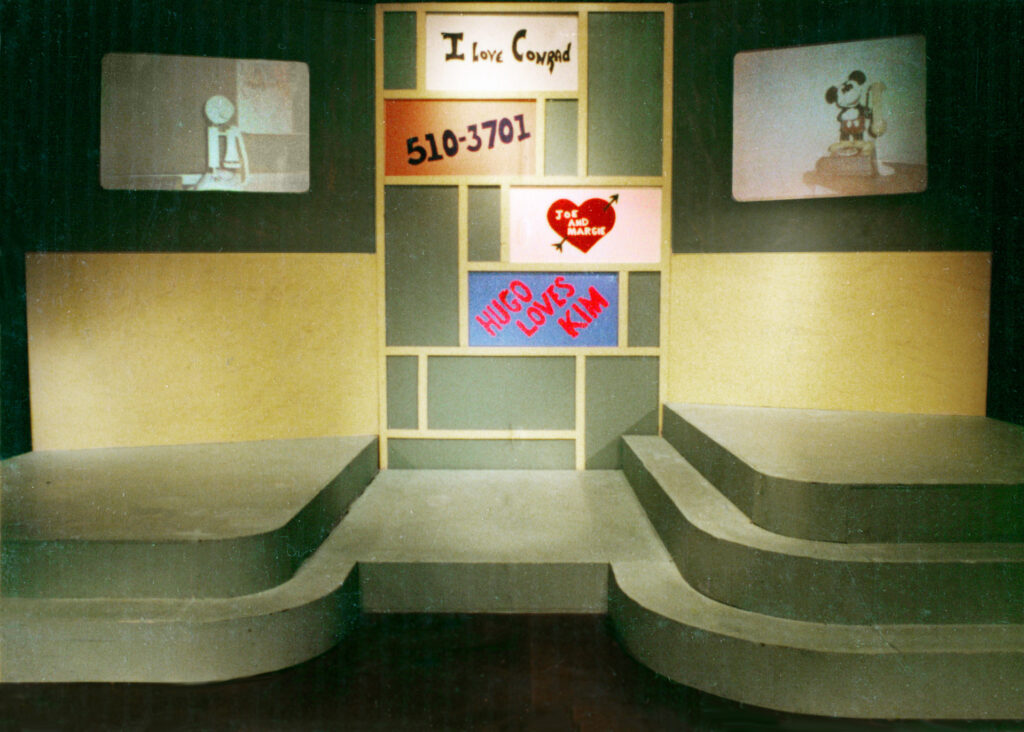
The stage set was unusual, but it had what most directors love: LEVELS! Part of the director’s job is to create interesting pictures on stage. That’s easier to do when you have multiple levels on which to place actors! Counting the floor it stood on, actors could be placed on five different levels. In addition, it utilized quick-change, replaceable panels and translucent screens onto which images were projected from backstage cameras. The stage itself allowed very fast scene changes, which were quickly performed by company members in full costume and in low-light conditions. Minimal three-dimensional set pieces were placed on different parts of the set, but the projections and panels made scene locations very clear to audience members. All of that added up to a fast-paced show, which was important in 1963 when the show first appeared in New York. Birdie had its own, somewhat odd, historical place in musical theatre as well. Some critics claimed it was, at least thematically, Broadway’s first “rock musical”. However, many others took issue with that opinion. The version offered at Mount Saint Mary’s at that time was popular and, as such, successful.
For some long-forgotten reason, the Fine Arts department at the Mount chose NOT to offer a J-Term production in January of 1979. Nevertheless, there were other opportunities for the extensive talent pool there to find other nearby places to perform. After the four-day Thanksgiving break at the Mount, Wayne got a call from a popular Gettysburg restaurateur, inviting Wayne and his students to audition for a new dinner theatre at his establishment, named Stonehenge, where he planned to stage two small-cast comedies: Plaza Suite and Absurd Person Singular.
Having already done the former show, Wayne auditioned for and was cast in the latter, Absurd Person Singular, a British comedy by playwright Alan Ayckbourne. He was very proud that one of his theatre majors, Roberta Rooney, was cast in Plaza Suite and another, Florinda Reid, was also cast in Absurd Person Singular! Wayne played the part of Sidney and was delighted to use his best British dialect in the part. The play was set during the Christmas holidays, so (with the director’s permission), Wayne deconstructed an old clip-on bow tie and rebuilt it with green felt “holly leaves” and red plastic “berries” that usually got a laugh at his first entrance.
Absurd photo here
The Gettysburg newspaper did little more than announce the two plays, the names of the cast members for both shows, what nearby towns they lived in and the dates the two shows would be performed. For Wayne, it was a trip back in time to collect a check for performing a comic role in a non-musical show.
By February, however, Wayne was back to his teaching responsibilities and preparations for offering the Mount campus a serious drama in April: Look Homeward, Angel. This was the stage-ready version of Thomas Wolfe’s highly autobiographical novel by Ketti Frings. Wayne knew he had excellent material to present to his community. Ms. Frings had won the Pulitzer Prize in 1958 for her work in transmogrifying Thomas Wolfe’s novel into a stage play. Wayne’s set-construction students did a beautiful job of ingeniously combining the EXTERIOR scenes of Wolfe’s North Carolina childhood home with scenes that took place INSIDE behind a back-lit screen. In addition, his students who were more bent toward the acting arts surpassed themselves and managed their serious roles with excellence! Still, every seat was filled for every performance. The play ran from April 3-7, 1979.
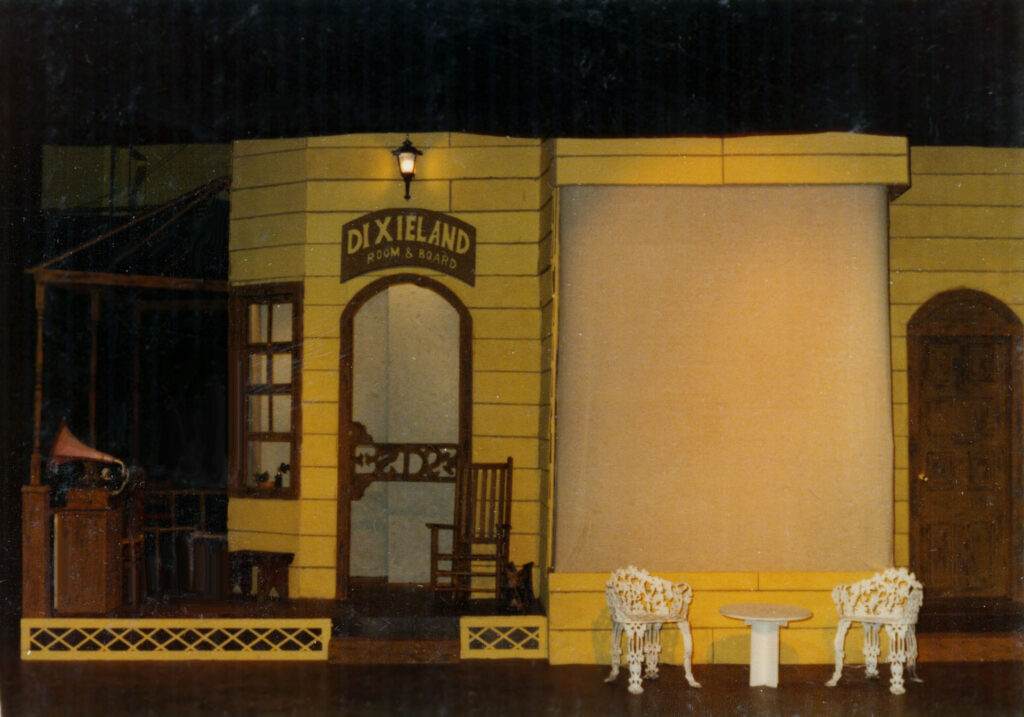
The set for Look Homeward, Angel. Interior scenes occurred behind the scrim, when that part of the set was “back lit”.
As the opening of this play approached, everyone on the campus at Mount Saint Mary’s and in the town of Emmitsburg faced a man-made disaster that might have forced the evacuation of that entire area. On March 28, the cooling unit of the number two reactor at the Three Mile Island nuclear plant failed, just 60 miles north near Harrisburg, Pennsylvania. This caused a partial meltdown and the threat of a nuclear explosion. It took four days to stabilize the reactor, and the Federal Nuclear Regulatory Commission closed operations there immediately and permanently. However, the cleanup, defueling and decommissioning processes continue today.

Three Mile Island nuclear power plant
year four
There was no summer production in 1979, which was something of a relief to the Hamilton family of Emmitsburg. Wayne and his wife were feeling increasingly fond of the Emmitsburg community and began to think of it as “home”. Wayne was invited to join the local Lions club, his wife changed jobs on campus from being on the staff of the Archivist to being secretary to the Chief of Campus Security, and their son was enrolled in a child care facility operated by Mother Seton’s Sisters of Charity. Wayne and his wife felt very confident about Wayne’s chances of advancement to tenured status on the college faculty, so much so that they began to scout the local real estate market for a different, larger house.
And as fate would have it, they found one. It was on St. Joseph Street, a corner property one block away from the St. Joseph Catholic Church. The elderly gentleman owner had just passed away, and his daughter was looking for a quick sale of her inheritance, a half-acre lot with a three-story, three-bedroom house that had been built in 1928. After two visits to the house, the Hamiltons decided that it needed too much improvement for her asking price. They made a lower offer and she accepted it immediately.
The Hamiltons said goodbye to the cottage built by the Navy and moved into town. Wayne purchased a used International Harvester “lawn tractor” to mow the lawn. The property was fenced in except across the front, which had an ancient, double-wide driveway leading to a wooden, barn-shaped, one-car garage with an attached lean-to that was wide enough to accommodate a small, second car (like Wayne’s B210). All Wayne had to do was cut out the front wall of the lean-to, re-attach it with strap hinges on the left side and farm gate latch on the right side. Then he ordered a dump truck load of gray gravel, bought a steel rake and spread the gravel by hand across the interior of the garage and across the space between the front of the garage and the street. Et voila! A new, wider driveway and a two-car garage!
The house only had a tiny bathroom on the second floor, so they took a 12 foot by 12 foot room with two windows at the front corner of the FIRST floor and made it a LARGE bathroom! Upon completion, the room had ALL the fixtures and a double-wide linen closet. They re-painted the entire interior of the house and hung a double-wide wooden swing on the front porch.
Wayne loved his work in the classroom and in the theatre, but after nearly a decade, he thought it might be time to add to his skillset, whether or not it led to another degree. Early in 1979, he’d gotten a letter from the main campus of the University of Maryland in College Park. The letter announced a new interdisciplinary PhD program in Public Communication, in which students would select courses in Radio, Television, Film, Speech, Theatre and Journalism. The new program would begin in the Fall of 1979. It sounded complicated and challenging, but Wayne applied for the program and was accepted.
He quickly learned that Mount faculty members could also apply to the Dean of the College (the former basketball star) for funding advanced-degree study. So Wayne’s involvement in at least the first semester of this Public Communication degree program was pretty much paid for. That made Wayne smile inside.
When students returned to the college campus in the Fall of 1979 and Wayne began his normal routine of teaching, advising and working on the next production with Sock & Buskin, he felt like his work load had been cut in half. Then Lew McAllister suggested they produce their most ambitious musical ever: a little-known show titled Something’s Afoot. Wayne was unfamiliar with this show, but when Lew finished describing it, the challenge was clear, because the SET kills off the entire cast! It was first performed in 1972 and played all over America with DIFFERENT CASTS before opening in New York City in late May of 1976 and closing there after only 61 performances.
This musical spoofed the detective stories of Agatha Christie, in particular her Ten Little Indians tale. Staircases explode, giant vases swallow people whole, telephones gas some guests, light switches electrocute others. Clever, funny lyrics kept the audience laughing at the songs and no one felt threatened, despite blackouts, lightning storms and loud noises, including gunshots. It was a two-story set that had audience members wondering which set piece would be the next to claim the life of a character!
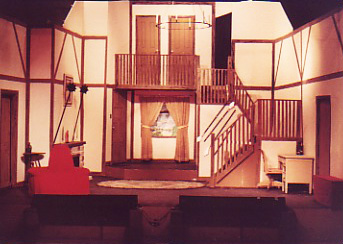
An impressive two-story set with many moving parts, the eleventh “character” ready to murder the ten live actors in this comic drama.
Wayne took the pictures, filled out the paperwork and submitted them to the American College Theatre Festival (ACTF) officials in Washington, which resulted in a visit to Flynn Hall by ACTF adjudicators. Students and faculty who worked on Something’s Afoot were both happy and proud when ACTF sent its first-ever Commendation Award to the Fine Arts Department and Sock & Buskin Dramatic Society, dated January 11, 1980, recognition that was well-deserved. Performances at the Mount occurred November 1, 2, 3, 5 and 6, 1979.
Despite Wayne’s busy schedule, with teaching, doctoral study, introducing new courses, helping out with a toddler, and counseling students, he was always looking for ways to make the PhD program work FOR him, not AGAINST him. He had already arranged his teaching schedule to enable teaching in Emmitsburg early on the same day as taking a course later in College Park.
One day, while driving south on two-lane US highway 15 to the University of Maryland, a full-sized yellow Ford station wagon suddenly turned left in front of Wayne. Wayne T-boned the Ford at 55 miles per hour, totaling both autos. Wayne was not wearing his seat belt, so he went head-first through the windshield of the VW. At that time, his right knee hit the dashboard and drove his thigh bone backwards, shattering his right hip bone. The recoil from the impact threw Wayne back through the windshield opening onto the passenger seat. On the return flight, the back of Wayne’s head struck the rear-view mirror, causing a three-inch bleeding cut in his scalp, the only place on his body where blood was externally evident.
Wayne never lost consciouness, but he could not move. With the engine behind him in the Super Beetle, there was no fire, no smoke and only bumps and bruises on the two 8 and 12 year old children on the back seat of the Ford. Wayne waited for the Fire and Rescue crews to arrive and evacuate the Ford driver and her two passengers, then watched with calm interest as the “jaws of life” ripped the passenger door off the VW, carefully lift Wayne onto a wide board of some kind and slide him into an ambulance. The closest hospital was in Gettysburg, so off they went.
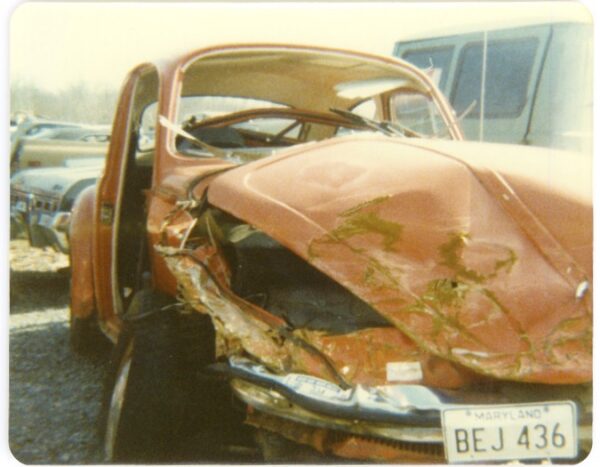
The SuperBeetle
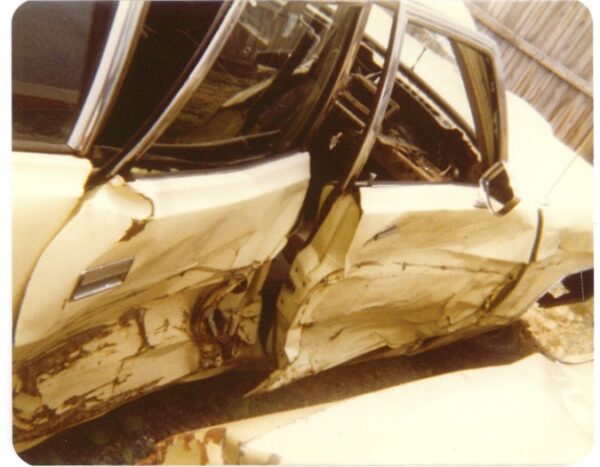
The Ford Station Wagon
This was a time when hip replacements had not yet been invented, but they must have had a pretty good orthopedic staff. After they X-rayed Wayne to a fare-thee-well and his wife signed off on the paperwork, they opened Wayne up on the right side at the hip, found all the pieces, used four screws to put his hip back together and, after a week in the hospital, sent him home with a pair of crutches and a bandage on his head.
Thanks to his wife, his friend John Degen, the College Dean, his students at the Mount (some of whom found an old wheelchair in the prop room) and the professors at the University of Maryland, Wayne caught up, then got back into the swing of his formerly very busy schedule that semester. Since the day of the accident, he has never traveled anywhere by automobile WITHOUT wearing his seat belt! Unfortunately, that was a “too little, too late” decision.
The police report laid the blame for the accident squarely in the lap of the Ford driver, and Wayne received a large settlement from her insurance company. With those funds, Wayne purchased a 1977 Datsun B210 hatchback, which turned out to be one of the most functional and friendly car he’d ever owned.
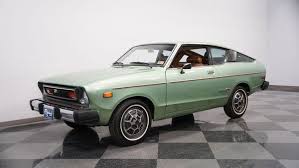
Wayne’s Datsun (now Nissan) B210 hatchback
Oddly, the course Wayne LEAST enjoyed teaching was Acting. His friend John Degen had long since finished his MFA in that field at George Washington University. Wayne and his wife had driven to DC one weekend to see a performance of his last production before graduation and to congratulate him. After checking with Lew, who approved the idea, Wayne called John to see if he wanted to teach Acting at the Mount. Fortunately, he was interested. John drove up from DC on Tuesdays and Thursdays to teach Acting 101 and Acting 201 on those days. And for no extra compensation, John “coached” performers at rehearsals who had earned parts in productions under way on campus. It was a big help to Wayne, who was grateful for John’s presence.
From time to time during Wayne’s six years of service at the Mount, he invited other theatrical friends from DC and Baltimore to the campus to conduct additional workshops (makeup, dance, lighting) with his classes. He also gave his Music Department colleagues at Montgomery College another “off-campus” performance venue for groups like the Big Band and the Jazz Band. Such visits by his old MC colleagues and their students provided off-campus performance opportunities at no cost to his current employer, Mount Saint Mary’s.
January of 1980 brought forth another J-term production, an old musical favorite for almost everyone: How to Succeed in Business Without Really Trying. Because of the reduced number of registered students for J-term shows, Wayne chose to present this one in the arena style on the floor of Flynn Hall with “the boxes” stacking the audience around all four sides. This meant the set pieces were light, free-standing and simple and the costumes were likewise uncomplicated: modern business attire for everyone.
The Men’s Room set pieces
The Board Room set pieces
Ticket prices were higher at the Mount for this production, because Sock & Buskin ambitiously negotiated with campus food services a modest buffet and wine meal before the opening “curtain” to make this a Dinner Theatre outing for patrons. Non-performing students serving as “waiters” and “waitresses” reported receiving many requests for “More like this, please”. The show ran January 31 and February 1, 2, 4 and 5.
The Spring, 1980 production was a straight play, recommended months earlier by Professor Ed Ryan, an avid theatre fan. One day, while Wayne was keeping his required office hours in Bradley Hall, Ed stopped by and asked, “Have you chosen the Spring play yet?”
“No, sir.” replied Wayne, taking note of a script Ed had in his hand. “Got any suggestions?”
Both men smiled as Ed extended the hand containing the play script to Wayne. “As a matter of fact…”
“Thanks, Ed,” said Wayne. “I’ll get this back to you ASAP.”
“No hurry,” said Ed. “Just don’t lose it. It’s one of my favorites.”
And with that, he was on his way home. That last sentence spoke volumes to Wayne. It was an endorsement for the play, suggesting that Ed thought it would work well on the Mount campus.
Wayne looked again at the cover. The Warrior’s Husband. With a title like that, it HAD to be a comedy. As he discovered, it was a 1932 play by Julian F. Thompson (and a 1933 film) about a fictional land of Amazons where women are the warriors and men are domestic. The plot follows the arrival of Greek soldiers, led by Theseus, who have come to capture the Amazon’s sacred girdle, and the humorous clash of cultures as the men are baffled by the reversed gender roles and a romance begins to blossom between Antiope and Theseus. Skimpy Greek-style costumes were constructed for all cast members, and to heighten the illusion of the Amazons as warriors, the purchased female sandals were “built up” with glued-on-and-painted plywood layers, making each actress up to FOUR INCHES taller than her normal height!
The play was presented in the thrust style. No critic offered an opinion in print about the piece, but each performance was met with copious laughter from the audience. Most important to Wayne was Ed Ryan’s comment afterward, which was: “Well done!”
year five
The Summer of 1980 was a pivotal time for Wayne at Mount Saint Mary’s. That summer, his colleague, creative partner and friend Lew McAllister fell ill. Wayne hadn’t spent much time with Lew during the Spring semester, since the show at that time was a non-musical. But suddenly, although he’d have the summer to recover, Lew had decided to give up his chairmanship. As mentioned earlier, the only other tenured faculty member in the department was a priest, and that priest declined the responsibility of department leadership.
So what did the College’s Administration do? It appointed a tenured priest as Chairman of the Fine Arts department. And what did this priest know about the Fine Arts? Wayne had no idea. All he knew was that the courses the priest taught PRIOR to his ascension to the Fine Arts Chair were in the field of Theology. The first act of the new chairperson was to fire the two untenured ART faculty members in the department. No one knew why they were fired, but they were on the cusp of being considered for tenure. The new chairman quickly found qualified local Art faculty to replace them, however, and was apparently quite happy to welcome them to the Mount Fine Arts department.
Wayne had no doubt that he had earned the recommendation for tenure. But he was far less certain that this stranger, who had no apparent connection to or expertise in ANY of the Fine Arts, and whom Wayne had never seen attending a theatrical performance at the Mount, would support him. In fact, most attempts to engage him in conversation were quickly brushed off. It was as though he wanted to surround himself with faculty he could consider “his own”.
But for the sake of his family and his own professional future, Wayne simply decided to ask his new boss the question. Wayne walked into the man’s office one day, closed the door, sat down and said, “As you well know, my time in service here qualifies me to begin the tenure application process next year. And as you also know, any effort to acquire the rank of associate professor and tenure almost completely relies on the positive recommendation of my department chair, namely you. However, at this point in time, your attitude toward me is anything but positive. Do you intend to support my application for tenure next year?”
The priest put down his pen, folded his fingers together on his desktop, looked at Wayne and said, “I do not intend to recommend you.”
Wayne left the priest’s office, went home and told his wife: “We have work to do.”
As much as he loved his friend Lew McAllister, Wayne decided he would simply “soldier on”. Knowing his future at Mount Saint Mary’s College would be over at the end of the 1981-82 academic year, he began his search for an academic position at another college elsewhere. Also, not knowing where his next academic position might be, he decided to continue with his studies in Public Communication at the University of Maryland, but not be obsessive about completing the Ph.D. program there. After all, he already had a terminal degree. Finally, he resolved to attend as many academic and professional gatherings as possible in the next 18 months; e.g., places where he might have opportunities to speak with organizations which might be in “hiring” mode.
The next show that was offered by Sock & Buskin and the Fine Arts Department in the Fall of 1980 was a musical comedy based on the story of “The Princess and the Pea”, Once Upon A Mattress. On Broadway, it made a star out of an hilarious comedienne named Carol Burnett. S&B and the Fine Arts Department were fortunate to have the assistance of a wonderful set painter from the Mount’s Seminary. The set was BEAUTIFUL and the costumes were outstanding!
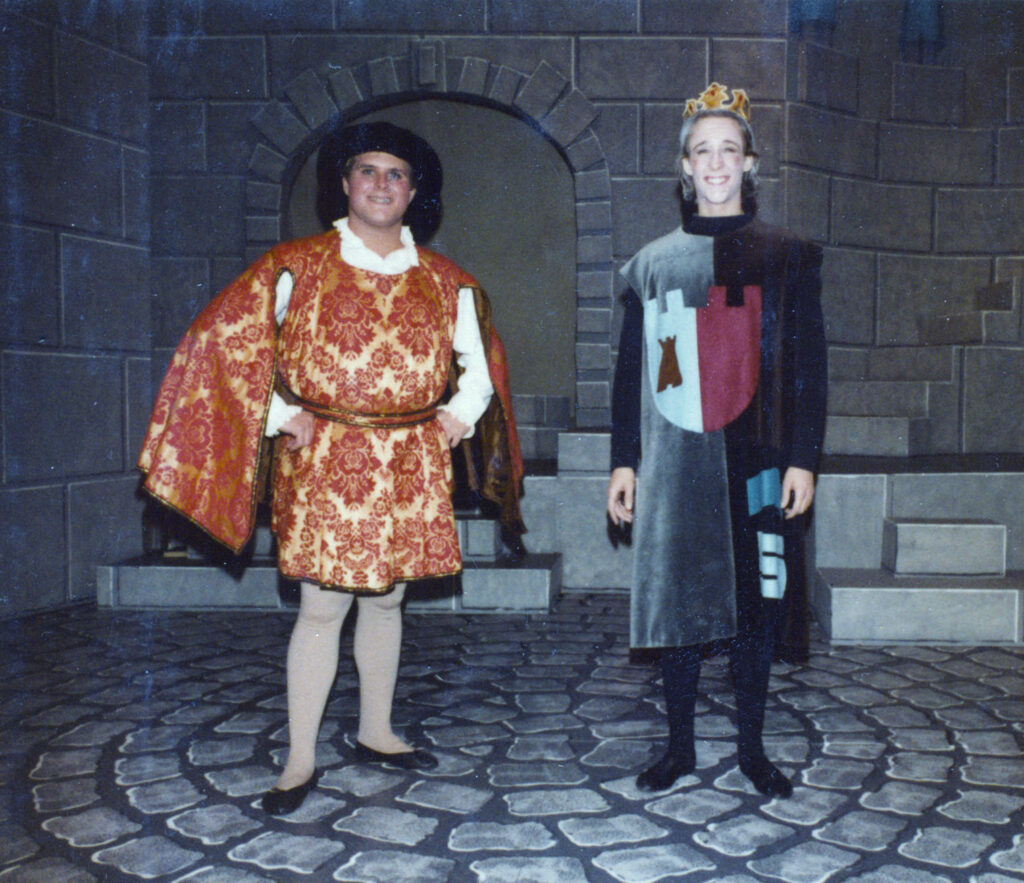
Pat Alocco and Frank Barnes
The producers signed this show up as a participant in the American College Theatre Festival (ACTF), held annually at the Kennedy Center in Washington, DC. Wayne filled out all the forms and sent pictures of the set and costumes. Partially because of his trips to College Park for doctoral classes and partially because it was simply the right thing to do, Wayne shared directing credits in the program with his actor friend John Degen. ACTF representatives visited the Mount campus, took pictures and interviewed several people before returning to DC. The result was another Commendation award from ACTF for “Excellence in Set Design”.
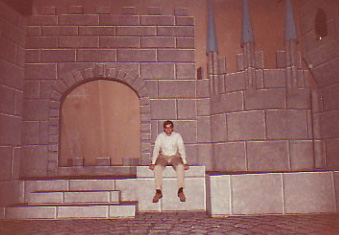
Co-director Hamilton on what seems like an impossibly massive set on the tiny Flynn Hall stage, worthy of commendation from ACTF!
At the same time, Wayne was enjoying the professors he had met and the coursework he had undertaken at the University of Maryland. He studied with Roger Meersman in the Theatre Department, who was his “official advisor” in this interdisciplinary program, and Tom Aylward, a tech-savvy leader from the Television and Radio Department, with whom he had many enlightening conversations about future trends in those two delivery media. But his favorite professor was a woman who was only a year older than Wayne from the Speech Department. Kathleen Hall Jamieson was already famous because of her skill at analyzing and writing about PRESIDENTIAL RHETORIC, past, present and future. She conducted classes in her living room and was generous with her time and her talent. At one point, she proposed that several of her students, including Wayne, would each contribute a chapter to a book on rhetoric, which she would edit and for which she would would write an introduction and a summary. She had it all lined up with her publisher!
Kathleen Hall Jamieson
Alas, before that book came together, Kathleen left Maryland for a position at the University of Texas at Austin before being appointed Director of the Annenberg Public Policy Center at the University of Pennsylvania in Philadelphia. Kathleen has written or edited more than 30 books, co-founded FACTCHECK.ORG and received countless awards for her excellence in writing and teaching. She is one of the most interesting and admirable people Wayne has ever met.
Fortunately, the University of Maryland also had a J-Term in its academic calendar, so when Wayne was approached by a professional performance company in Frederick about appearing in one of their shows, Wayne was available. The Octorian Theatre Company cast Wayne, along with one of his students, John O’Brien, and Frederick area residents Bob Baker, Debra Pond and Vanessa McCambridge as performers in their musical revue of Side by Side by Sondheim. Wayne was thrilled at the prospect of performing Sondheim’s songs, since he had never performed in or directed a single Sondheim musical; yet here he was, being asked to sing the best songs from the great composer’s BEST musicals! Every performance was accompanied by two grand pianos onstage with the singers. The irony of this cast was that often, the wrong gender was singing the great man’s songs.
For example, Sondheim’s “You Gotta Have a Gimmick”, from Gypsy, in which three strippers seek to teach Gypsy Rose Lee how to succeed in the world of burlesque, the strippers were played by the three MEN in our cast. This might have seemed odd, but it brought terrific laughter in this production. In other words, it worked!
The Octorians performed this revue all over Frederick County, but it was never better received than the performance that Wayne arranged and had videotaped at Flynn Hall on the Mount Saint Mary’s campus in January of 1981. Below are links to selected songs preserved on Wayne’s YouTube site for your enjoyment:
“Anyone Can Whistle” https://youtu.be/2LPhSwsfe2k
“We’re Gonna Be Alright” https://youtu.be/x1yYh_jLOlg
“The Little Things” https://youtu.be/qua6xngHFtE
“You Gotta Have A Gimmick” https://youtu.be/k5GkvCt8VMw
“Pretty Lady” https://youtu.be/px4OPDIisR0
“Everybody Says Don’t” https://youtu.be/OG-WUmQQGtA
year six
This last year at Mount Saint Mary’s was a hodgepodge of activity for Wayne. He was writing to colleges and universities across America where his talents might fit faculty openings. This was a waiting game, often taking weeks for responses, if and when responses arrived at all. Wayne was fortunate to have had interviews at gatherings of theatre folk, like the American College Theatre Festival. But the schools that were most serious about employing Wayne actually invited him to visit their campus, typically for at least two days.
For example, early in 1982, Wayne was invited to State College, Pennsylvania, just 136 miles North of Emmitsburg, to visit the chairman of the theatre department at Penn State University. He was a guest at the Nittany Lion Inn. The theatre chairman explained that Wayne would lead a staff of three faculty members at the Penn State, New Kensington campus near Pittsburg. That campus, which Wayne also visited, was 200 miles West of Emmitsburg.
The University of Wisconsin Theatre Department invited Wayne and two other potential candidates to Madison and then took all of them to four different two-year, community college campuses all over the state. From there, theatre students finished their BA or BFA work at the central university facility in Madison. This was too much like the one-person theatre department he was leaving at the Mount to be of interest to Wayne.
After leaving Wisconsin, Wayne did not fly home to Maryland. He made a much shorter flight Westward to Minneapolis, where he had been invited to interview with the Theatre department at the University of Minnesota’s Twin Cities campus. The chairman of the search committee, Lee Adey, told him he was the third of three candidates being considered. They had a modern, multi-theatre, multi-story facility on the West bank of the Mississippi river that included black box, arena, thrust and proscenium stages. The Twin Cities had over 100 theatre-producing companies in the 7-county metro area, including the world-famous Guthrie Theatre, founded in the early 1960s. So it was an exciting theatre environment, with much opportunity. On the the other hand, it was also a long, long way from home. Wayne was competing for one position on the Directing faculty. He interviewed first with the search committee, consisting of students and faculty members, and then with the entire faculty.
Then they gave Wayne twenty minutes to study a three-page scene of an unfamiliar play, took him into a theatre half-full of theatre faculty and students, allowed him to select two students from that crowd who identified themselves as acting majors and asked him to direct them through the scene.
Wayne must have done something right. Two days after he got back home, he got a phone call from Professor Lee Adey, who offered him the position. Adey told Wayne that the search committee recommendation to the faculty was unanimous, as was the final vote of the faculty. Wayne was expected to be on campus by August 1, 1982.
In 1981 (back in Maryland), Wayne was invited by the Fredericktowne Players to serve as their “Critic in Residence” for their 1981-82 season. He would attend dress rehearsals, usually within a week of a play’s opening, watch dress rehearsals and take notes to provide comments for EVERYONE. That included actors, director, designers, lighting techs, everyone. He was very careful to be politically correct, even gentle, and he could tell that everyone listening seemed grateful that he approached their work in such a professional manner. In short, everyone seemed to WANT at least ONE comment and everyone seemed happy that part of the comment they received included a compliment. Wayne tried to make sure of that, even though it was often like walking a high wire.
Learning that Wayne would be leaving the Mount and Frederick County in coming weeks, the Fredericktowne Players decided to say goodbye with a farewell banquet. In June of 1982, they catered a modest meal onto the Players’ stage, rattled off a list of “thank yous” from various members of their Board of Directors and finally presented Wayne with a beautifully framed etching by famous Frederick artist Joseph Osmann titled “Spires” (Osmann referencing John Greenleaf Whittier’s clustered spires in his poem “Barbara Frietchie”). The brass plate affixed to the glass reads:
“Wayne Hamilton
From Fredericktowne Players
1982″
The words and art speak of the many church and civic building towers bursting through the old growth trees in this 19th century Maryland town. This was a moving gift for Wayne, who had been collecting print-media art for years.
Back on campus at Mount Saint Mary’s, Wayne continued his teaching and directing responsibilities before leaving to report to the University of Minnesota campus in Minneapolis. Wayne chose to do both of his last two plays at the Mount in the proscenium style.
In the Fall semester (late October/early November), he and Lew McAllister planned for their last musical together, She Loves Me. Set in a parfumerie in Budapest, Hungary during the late 1930s, it is a love story of mistaken identity. The set and costumes were designed to fit the time period, and the set was built upon a remarkable pair of turntables to accommodate scenes inside and outside the shop.
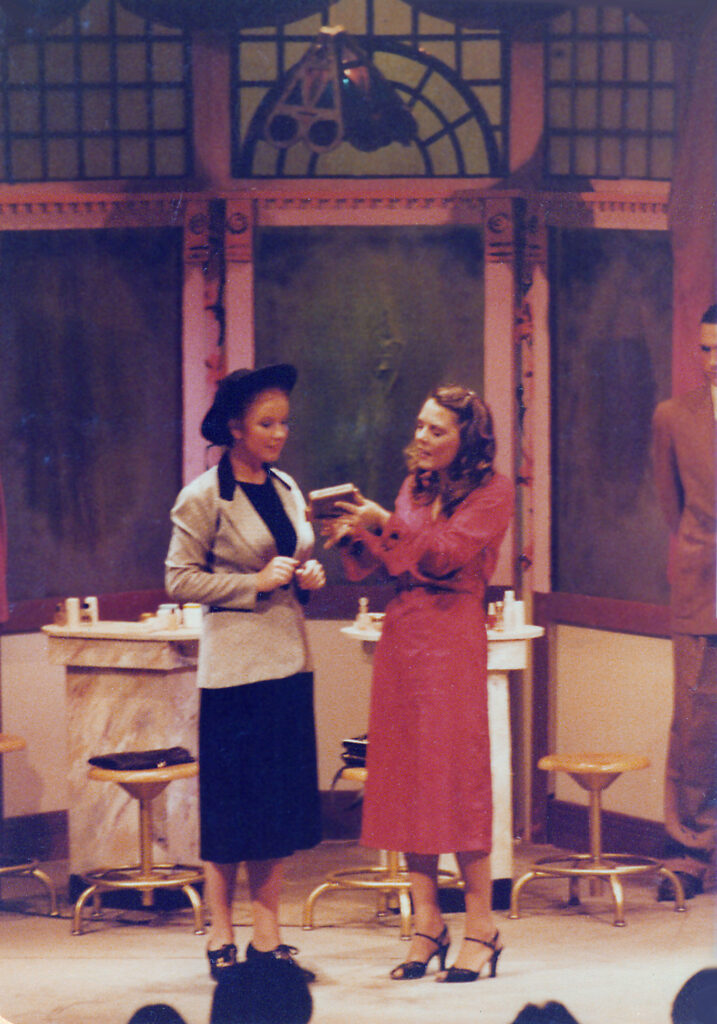
Inside the shop
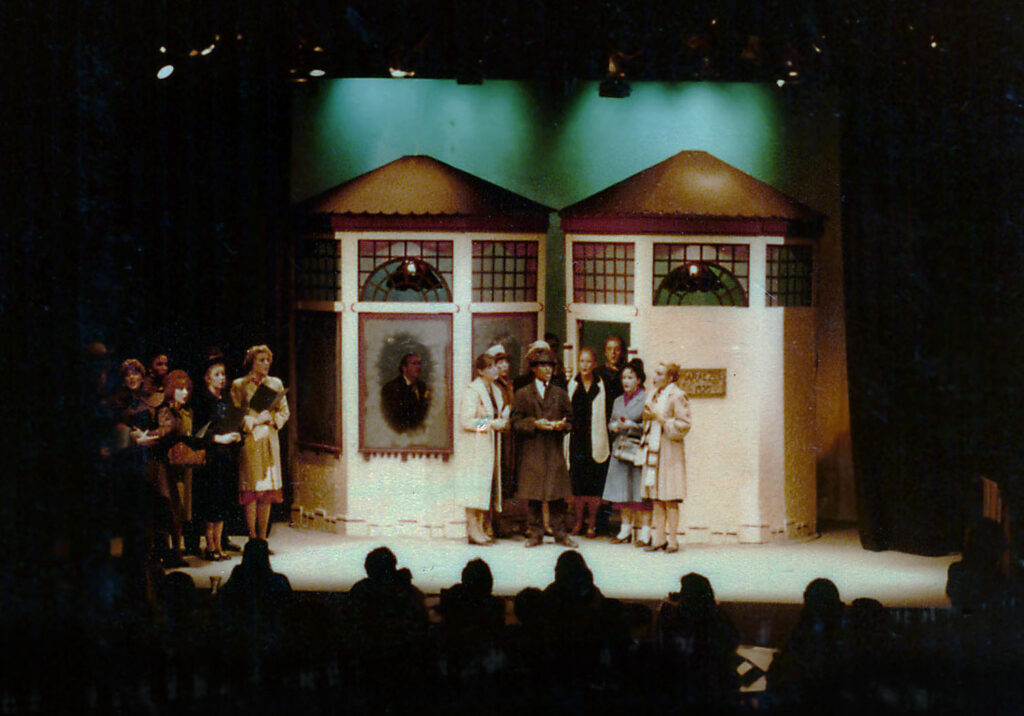
Outside the shop
At the last minute, one of the cast members had to drop out of the cast and return home because he was stricken with what was then called “the kissing disease”: mononucleosis. Wayne stepped into the role of a 15 year old messenger boy, rode an ancient bicycle onstage and sang a duet with one of his students, who was made up to look like an old man.
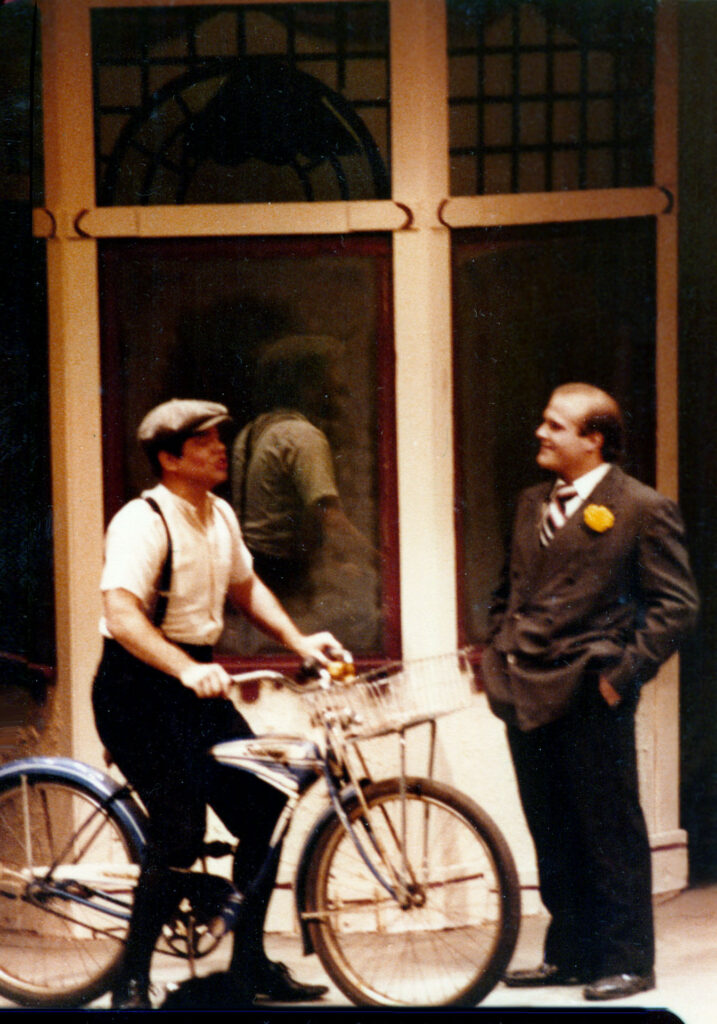
In the Spring semester, Wayne agreed to direct a small-cast play that was based on a 1970 movie directed by Otto Preminger: Tell Me That You Love Me, Junie Moon. A trio of outcasts who meet in a hospital decide to pool their resources, move into a small house and face a series of adventures together.
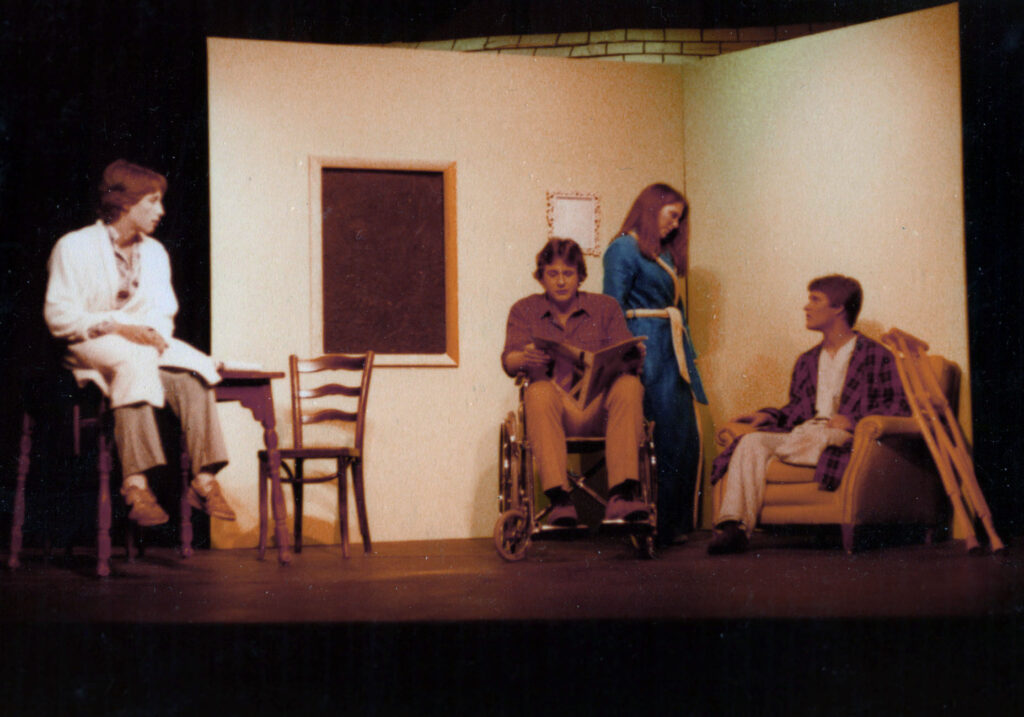
Inside the house
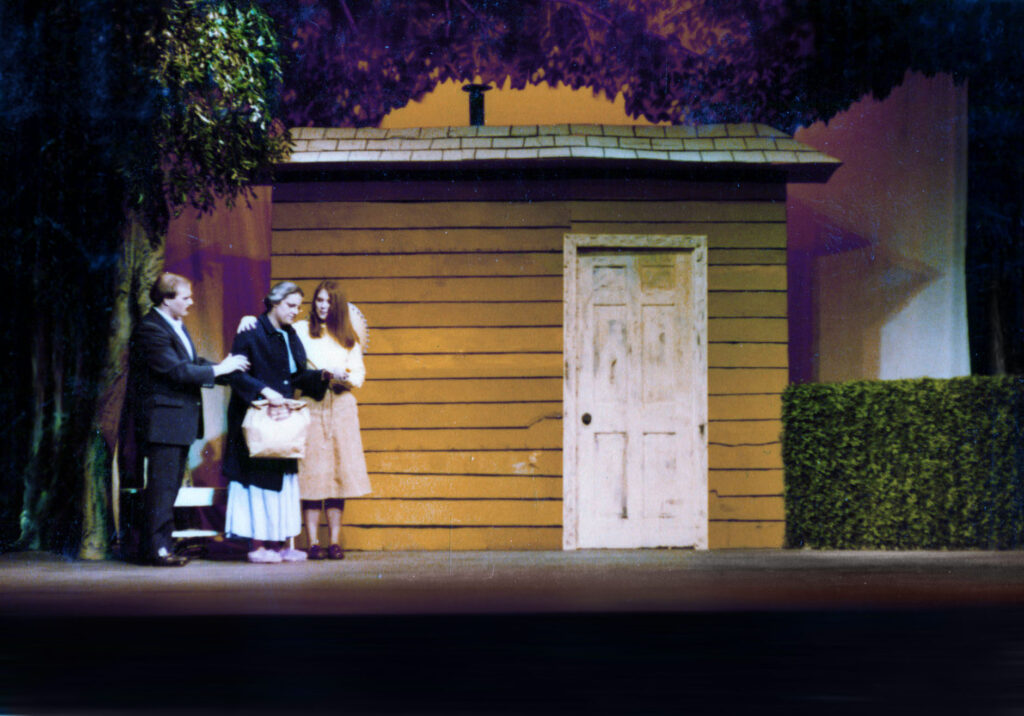
Outside the house
And thus endeth Wayne’s six-year “experience” with America’s oldest independent Catholic college.
Well, not really. No explanation came from the chairman/priest as to his lack of support for Wayne’s tenure bid, but Wayne knew, as a matter of course, that the President would not intervene and/or override the priest’s decision. Wayne was also aware that the Mount’s President had attended and received his PhD degree from the University of Minnesota, and that his fondest wish was to return there as an Associate Professor. Wayne couldn’t help stopping by the President’s office on the day he picked up his last paycheck from the Mount.
Noting that the President was sitting at his desk in his otherwise unoccupied office, Wayne knocked on his door and, not waiting for permission to enter, simply opened the door enough to initiate the following conversation:
“Hi, Bob. Just wanted to stop in, say goodbye and wish you well!”
“Well, thanks, Wayne. Any news on your next position?”
“As a matter of fact, yes. Thanks for asking. Interviewed at Penn State and Wisconsin. No word from them yet, but got a solid offer and will be starting at another Big 10 school this Fall.”
“Really? Where is that?”
“I’ll be at your alma mater. Minnesota, Twin Cities! Wish me luck, Bob!”
TRANSITION: MARYLAND TO MINNESOTA

Wayne and his wife were ready to leave Maryland and move to Minnesota. Unfortunately, the house they had purchased in the little town of Emmitsburg was not quite ready to let go of them. They hired a realtor and put the “For Sale” sign in the front yard, but Wayne was forced to put a trailer hitch on his B210, rent a small U-haul trailer and fill it with enough clothing and books to get him through his first semester at the University of Minnesota, Twin Cities.
In late July of 1982, after a tearful goodbye from his wife and four-year-old son, Wayne drove for two days to reach Minneapolis. Job one was finding a room to rent. Wayne found one on the second floor of a house on Columbus Avenue in South Minneapolis.
Wayne showed up at Rarig Center, home of UNIVERSITY THEATRE and the Department of Theatre Arts on the West Bank of the Mississippi River. He was looking for Lee Adey, but he was surprised when the department chairman told him that Professor Adey was on sabbatical for the entire first year of Wayne’s two-year contract with the U of MN Theatre Department. Since there were only two Directing faculty in the department (Lee and Wayne) Wayne would be “on his own” in making his way through the ins and outs of America’s largest single campus, numbering sixty THOUSAND (60,000) students. Disappointment number one.
The department not only housed theatre as a major discipline, but also speech and dance. So faculty meetings numbered well over 20 attendees. The chairman of the department when Wayne arrived was an old-school Scandinavian gentleman in his early 60s from North Dakota named Wendell Josal, whose specialty was set design. Wayne immediately respected and admired him as a leader and as an individual who could be an unbiased resource, a person who could provide information without bias. On the downside, Wayne was quickly impressed with the deep-seated “belief” among his new colleagues in doing theatre “the U of MN way” and none other. Over time, Wayne became aware of the fact that only he and two other theatre faculty members did not earn ANY of their academic credentials from the department in which they were now teaching (academic inbreeding?). Disappointment number two.
In late October, Wayne got a call from his wife that their house in Emmitsburg had been sold. She had also managed to make the sale final AFTER Wayne could fly home for the Christmas break. He would help pack a 17-foot rental truck and drive it from Maryland to Minnesota with the whole family in the truck cab and her car in tow. Until then, it was Wayne’s job to find and rent a house in Minneapolis to put their possessions in when they got there.
That drive in the truck to Minneapolis was actually a little more of an adventure than Wayne had bargained for. On day three, temperatures dropped and the skies were overcast as they moved Westward through Wisconsin. Then snow began, and by the time they got to “Metro Minnesota”, the local radio told them they were arriving at the end of a three-day, seventeen-inch accumulation of snow. Wayne managed to get the truck and car-in-tow into their neighborhood, but it was impossible to see where they could legally park their rig AND unload at least SOME of it.
The blocks in Minneapolis are mostly rectangular in shape, and eventually a parking space only three SHORT blocks to the West of their rental house opened up. Little Andy, then only 4, had a full backpack with a bedroll attached and was protected from the elements as well as possible. As if he cared. He couldn’t WAIT to get chest deep into that snow, squealing with glee every inch of the way. He’d never seen so much snow! Wayne’s wife carried as much as she could of whatever she believed she needed to get through the night. It was getting dark by this time, and Wayne had no doubt he would be making at least one, if not more, trips on foot between the truck and the house. But this first one was a challenge: a “full” sized mattress balanced on his head and carried the three blocks and up fifteen steps from the street level to the front-door level of their rented house. The next morning, Wayne’s little family got bundled up and walked two blocks to a hardware store to make their first family purchase in Minnesota: a small and totally inadequate little snowblower! Welcome to Minneapolis!
Wayne was grateful that someone at U of MN Theatre had the foresight to NOT schedule Wayne as director for a production during his first semester on the faculty. And although Wayne had no say in which show he would direct during year one, he was grateful for what he called a “softball assignment”: You’re A Good Man, Charlie Brown.
This show can be called a “softball” because its characters are well-known and well-loved by people all over the world. Moreover, for Minnesota audiences, the creator of these characters, Charles Schulz, was born and raised across the Mississippi River in Saint Paul and gave life to them from an imagination based in reality! The CHALLENGE was this: Wayne would be directing TWO separate casts in TWO separate productions, one right after the other!
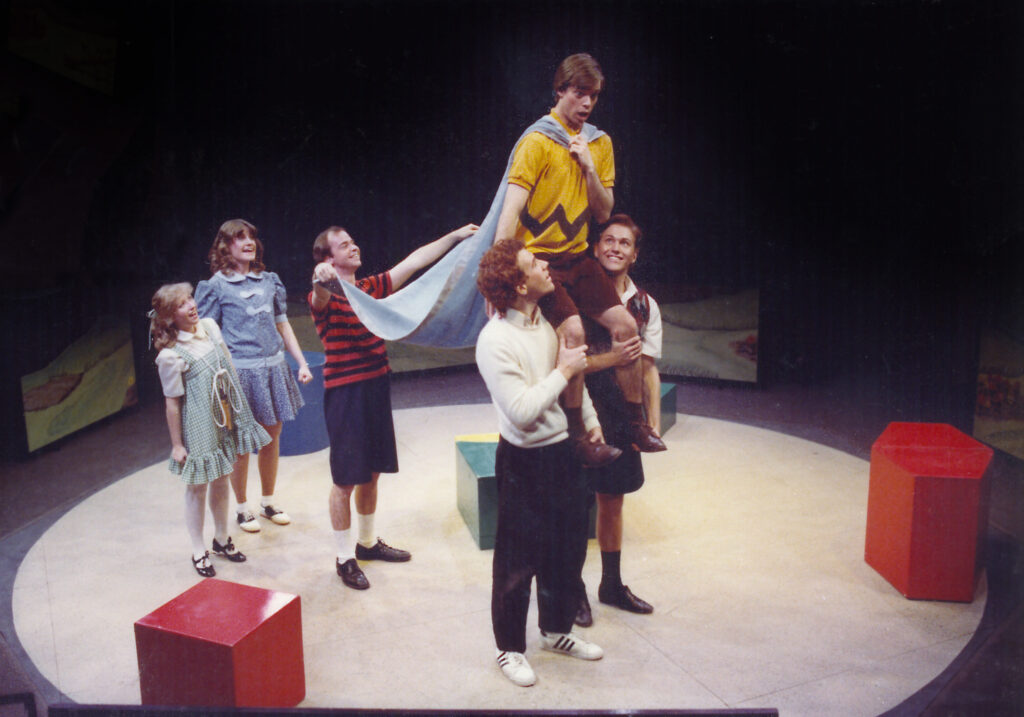
The Arena version
The first, or Mainstage, production would be staged in the smallest of Rarig’s venues, its 200-seat Kilburn arena setting, and would not be cut back in any way. The Mainstage show would open in late January of 1983 for a two-week run. The second production would be a truncated (by Wayne), 45-minute “Young Peoples University Theatre” (YPUT) offering, presented in Rarig’s largest venue, its 460-seat Stoll thrust theatre. The YPUT show brought elementary school students to Rarig Center during their regular school day by the tightly scheduled busload. Those performances were not open to the general public.
This first directing assignment at the University of Minnesota shed some light on another aspect of “the way things were”. Wayne cast the Mainstage show just as he always had: the best talent got the part. That’s what he’d always done. But he had undergraduates tell him (away from rehearsals): “Thank you so much for giving me this Mainstage opportunity. Typically only graduate students get roles in these shows…undergrads rarely get a chance to perform in Mainstage shows.” Disappointment number three.
You’re A Good Man, Charlie Brown received positive writeups from on and off-campus media. Staff Writer Mike Steele at the Minneapolis Star and Tribune (then the Minneapolis daily newspaper) wrote:
“The University of Minnesota Theatre, under the direction of its newest faculty member, Wayne Hamilton, has taken the piece on and done a routinely nice job of it. Hamilton, like Schulz, shows some respect for kids and seldom falls into the trap of making them overly precious. Kids, let it be said, never think of other kids as ‘cute’ or ‘darling.’ Adults often do and that condescending attitude drowns a show like ‘Charlie Brown’ in a sea of smirks. Hamilton manages to meld the cast into a nice ensemble overall and the group as a whole is likeable, which wins half the battle.”
In the campus newspaper, the Minnesota Daily, Lisa A. Brock wrote:
“…Director Wayne Hamilton has put together an admirable production. What the show lacks in content he makes up for in tempo, color and razzle-dazzle showmanship. Each vignette slides swiftly into the next, never letting the audience’s attention lag. Moreover, Hamilton has a clear conception of Charles Schulz’s ironic, understated humor, and presents each scene with a careful shading of mood and tone. A basic, direct approach has made this production of You’re A Good Man, Charlie Brown a success. With Hamilton emphasizing the sharp, clean lines of Schulz’s humor without ever condescending to the material, this juvenile musical is given a very professional treatment.”
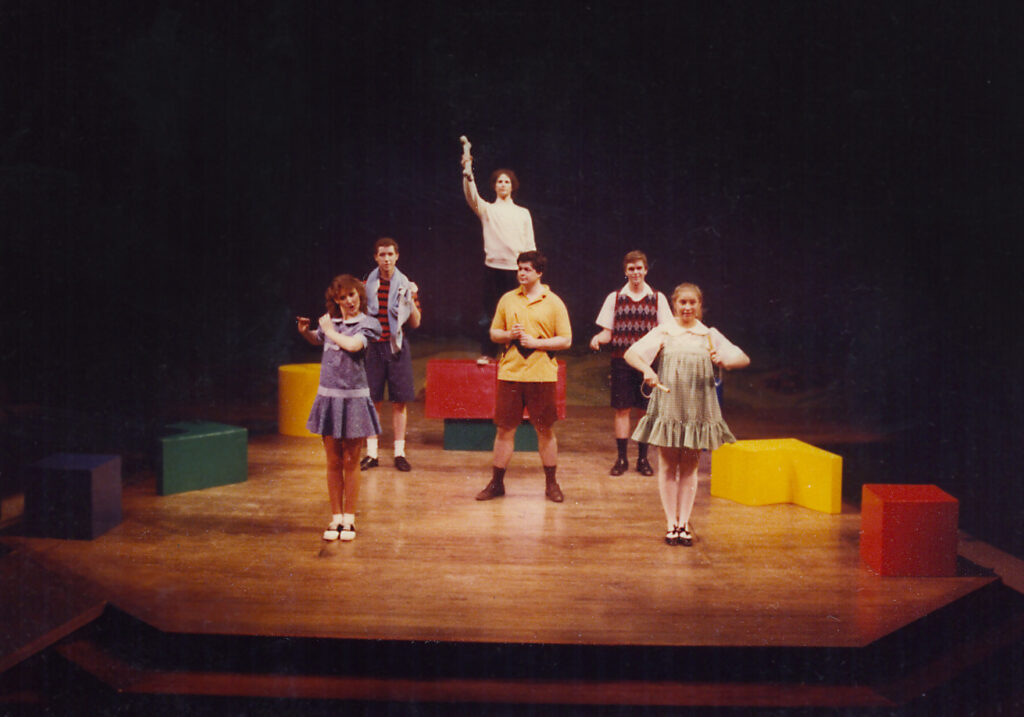
The Proscenium version
In addition to teaching undergraduate classes, teaching at the University of Minnesota also meant teaching graduate classes. That was understood from the beginning. Along with that came the responsibility of ADVISING both undergraduates and graduates. On top of that, graduate students had graduate PROJECTS, which faculty were expected to supervise and suggest improvements. Furthermore, as a NEW faculty member, Wayne was “made aware” that it would work in his favor to take on directing projects IN THE COMMUNITY!
To that end, while he was employed at the University of Minnesota, he directed additional plays and musicals for community theatres and other academic entities in the Twin Cities area, including:
The Sound of Music, by Rodgers and Hammerstein, for the Masquers Theatre Company in Forest Lake, Minnesota. This production auditioned in mid-May of 1983, and received extensive support from the entire community. The Chisago County Press in Lindstrom, Minnesota published an extensive article about Wayne in an article that put his entire theatre resume, complete with photograph, in their May 12 issue, designed to pump up excitement about the popular musical. The county high school in Forest Lake was the site of the production, and the show had an eight-performance run in late June and early July (June 22-25, 29 & 30, July 1 & 2). After the first week of performances, the same local newspaper ran a two-column article on June 30 with a half dozen pictures about how wonderful the show was, encouraging readers to “get their tickets” so they wouldn’t miss the remaining shows!
Chapter Two, by Neil Simon, at the new Phipps Center in Hudson, Wisconsin. Hudson was a small town on the banks of the St. Croix River with large, pretty houses and a busy, commercial “main street” with lots of bars and restaurants. Many of the large houses were built by executives of the 3M Corporation, who decided that residence in a quiet little town just ten miles from their large corporate campus might give them some privacy. Now, in 1983, city fathers had allocated the funds, assisted by a gift from the local and wealthy Phipps family, to build a modern “Phipps Center for the Arts”.
The new building housed a local children’s theatre, a community theatre, a dance school and an art school and gallery, It was in its final months of construction in the early summer of 1983 under the tutelage of the man who chaired the search committee that brought Wayne to the University of Minnesota: Lee Adey. Lee, who was working with the Phipps during his sabbatical to establish appropriate systems and equipment for the new facility, invited Wayne to visit “the Phipps” and introduced him to the Phipps board of directors. They all spoke of community theatre there, and Wayne was invited to direct their next production, to be presented July 22-24 and July 29-31 of 1983.
And the pattern was repeated. The Hudson Star-Observer published an article that recounted Wayne’s directing experience, announced the audition dates for Chapter Two and cited his excitement about his upcoming work with the citizens of Hudson and surrounding communities. After the first weekend of performances, the Star-Observer‘s theatre critic, Linda Bleskachek’s headline was “Chapter 2 Incredibly Good”. Her comments about Wayne read as follows:
“Wayne Hamilton is to be congratulated for a fine directing job. He has brought four complex personalities to life. With so few characters, it is a challenging job to find balance and believability. Wayne gives us two supporting players who have distinct comic personalities yet do not dominate the major characters. He gives us two major characters who dominate the action in spite of their quieter personalities. The balance is there and it is skillful. Special praise should be given for the handling of a play which has distinctly different moods in each act.”
Candida, by George Bernard Shaw, at Lakeshore Players in White Bear Lake, Minnesota was Wayne’s next non-University production. This was the opening show of the Lakeshore Players’ 1983-84 season, running September 9-11, 15-18 and 22-25 of 1983. The company had been founded in 1953 in an old wooden church they purchased and quickly converted to theatrical purposes. The six-character cast included, ironically, Wayne’s fellow directing faculty member at the U of M, Lee Adey, back from his sabbatical, which was a positive “get re-acquainted” experience! Candida was fun for Wayne, who had an opportunity to coach his entire cast in one or another British dialect.
Marlys Oliver, editor of the White Bear Press local paper, wrote six terse paragraphs after viewing one of the performances of the first weekend. Overall, she called the show “a fine production”; she went on to say “In less skillful hands, this play could have been a disaster. Director Wayne Hamilton pulled the right strings in this case.” The caption of the picture below was more informative. It read, in part: “This Bernard Shaw ‘Pleasant Play’ is a witty look at traditional marriage vows, and at men in their relationship with an emancipated woman. A pleasant comedy from the pen of one of the theater’s great playwrights…”
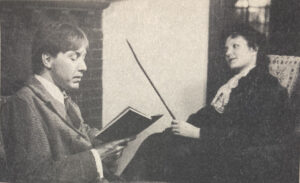
Craig Johnson as Marchbanks and Janice Hoffmeister as Candida
Fifth of July, by Lanford Wilson, at Hamline University in St. Paul, Minnesota. Wayne was invited by Hamline’s Theatre department to conduct a workshop titled “What the director looks for when casting a play”. The workshop resulted in an invitation to direct the Wilson play, which Wayne happily accepted. It was not a musical. Rather, it was about a group of friends who came of age in the sixties having a reunion in an old Missouri farmhouse, where their reminiscences reveal shattered hopes, buried resentments, lost dreams, and the unhealed trauma of the Vietnam War.
The second year of Wayne’s two-year contract with the University of Minnesota (the 83-84 academic year) gave Wayne a hint about where his future lay. The teaching part would be the same, working with both undergraduate and graduate classes and advising. This year also gave Wayne some additional input about what HE would like to direct, and he was not surprised when the added stipulation came: “…as long as it’s a musical.” From day one, Wayne saw the hints that an aging, dance-oriented, very popular faculty member who was “Mr. Music Man” for the department was looking hard at retirement and Wayne was going to be the person to step into his Capezios.
Also from day one, Wayne had been impressed with the extensive technical capabilities of the department and its tech faculty members, all of whom were about his age. Perhaps it was because of their age similarity that they were a little social at first, inviting him to THEIR outings, mostly weekend pizza parties at favorite clubs or at each others’ homes. But along with those invitations were constant probing questions that Wayne felt uncomfortable responding to: “Where do you want to be in five years?” “Do you plan to apply for a chance to direct at the Guthrie?” “How do you feel about tenure?” His avoidance of answering such question seemed to annoy his colleagues, but that was OK with Wayne. For cryin’ out loud, I just GOT here! Couldn’t we talk about sports or hobbies or our kids? Apparently not.
It was OK because Wayne was growing more unhappy almost daily. He was still making about the same money as he had made at the Mount, and the expenses of living in Minneapolis were far higher than living in rural Maryland.
However, Wayne was not willing to quit yet. He took a risk that he questioned later, more than once. in his second year at Minnesota, he decided to ask if he could direct a musical he had directed just a few years ago: Something’s Afoot. That was the most challenging technical project Wayne had ever undertaken, and he wanted to see how the advanced tech capabilities of THIS department would handle it. He did not do so to make the department look bad; rather, he hoped, even expected, that the department would conquer the challenge and have fun solving the tech problems the show would present.
The department agreed and assigned Wayne as director of Something’s Afoot. Wayne recalls that the set construction team were especially excited about the challenge of having the set serve as a “character” designed to dispose of every live actor in the play. And he recalls that they did a great job of it as well. They had a 40-foot proscenium to work in. He kept some pictures of their work, but kept no record of any published critical commentary. Perhaps that’s because he had decided that, at the end of the 1983-84 academic year, he would resign from the Theatre faculty and seek employment in a corporate position.
In Mid-March of 1984, Lee Adey told Wayne that the tenured members of the Theatre department had a meeting to discuss Wayne’s “fit” within the department. Some faculty members liked Wayne, some members disliked Wayne and some members were indifferent about whether or not he should be invited to return for another two-year contract. According to Lee, Dr. Josal pointed out that it was too late in the academic year to start a search for someone to replace Wayne. Therefore, he was offered another contract and was told that at the end of that contract he would either be granted tenure or dismissed. Wayne was given a copy of the contract covering the Fall, 1984 to Spring, 1986 timeframe and asked to return it by June first.
Throughout the Spring semester of 1984, Wayne reconfigured his resume to reflect his skills in “Communication”. At this time, companies were using “communication” instead of marketing or sales to attract new personnel. Wayne’s Doctoral studies at the University of Maryland had made him an excellent writer, and he hoped that would interest corporate employers.
Fortunately, it worked. He got an offer to join a small advertising agency as their VP and principal writer. And the compensation was $5,000 above his U of MN salary. In mid May, after informing Lee Adey of his decision, he visited Wendell Josal’s office and told him he would not be returning in the Fall. The remainder of the conversation went something like this:
Dr. Josal: Really?
Wayne: Yes. You sound surprised.
Dr. Josal: I am, a little. We’ve fired people before, but we’ve never had anyone quit on us.
Wayne: I appreciate everything the Department has done for me, and I wish you well. I just think it’s time for me to explore other opportunities. Thank you.
Wayne shook Dr. Josal’s hand and left his office. He had already been slowly emptying out his office on the second floor of Middlebrook Hall, a 12-story dormitory near Rarig (Rarig had plenty of theatre and production space, but theatre faculty offices didn’t make it into the theatre building’s design). With that, Wayne began his second and most lucrative career change, one that took him in many different directions.
KISSING ACADEME GOODBYE
The next ten years was a decade of change in the life of Wayne Hamilton. He moved from working in ad agencies to working for companies related in some way to mainframe computers. Mainframe manufacturer Control Data Corporation (CDC), which had been founded in the 1960s, was headquartered in Minneapolis. Throughout the late 80s and early 90s, CDC re-formed or re-structured or re-branded itself as its place in the industry diminished. At one point in time, the corporation was selling entire departments to its managers wholesale. The managers became CEOs, who took the technology they purchased into the market under a different name.
One such entity was Blueline Software, which provided replacement software for IBM mainframe computers. The CEO at Blueline was interested in Wayne’s background in programming mainframes and his time as an educator. He once told Wayne: “Hamilton, you have an uncanny ability to write about highly technical concepts in language that the person on the street can understand.” As a writer, Wayne created ads for national magazines, edited articles by subject matter experts (SMEs) for publication and presentation at technology conferences and wrote training manuals for software and hardware operation.
The downside of working in technology was that tech operated on an 18-month cycle. A new advancement would be introduced that everyone would adopt and build into their tech product or service. Everyone would have an “UPside” period, during which they could sell and prosper. That UPside, however, was typically followed by a “DOWNside” period, during which companies had to be more frugal with budgets and often reduce personnel. When a tech-oriented CEO had to make a choice between releasing a “here’s how it works” writer like Wayne and a technology developer, Wayne almost always lost.
Nevertheless, Wayne worked for large and small tech companies like Blueline, FSI International (computer chip manufacturing and cleaning equipment), United Healthcare, MicroLANs, Tricord Systems and CPT Corporation (word processor manufacturing) and others.



In some cases, Wayne would have an opportunity to move from a small tech company to a large one and improve his income. Also, Wayne might be working for a small tech company that was purchased by a larger tech company, which also improved his income. As Wayne moved from one tech company to another, his income grew with each job change. In the ten years after leaving the University, Wayne tripled his best academic salary. Wayne and his wife had bought a beautiful Southeast Minneapolis home built in 1928 with an unfinished attic. Wayne quickly designed and expanded that upstairs space into a large bedroom, a huge walk-in closet, a small study, a full bathroom, two storage spaces and two skylights. Meanwhile, Wayne was coaching his son’s little league baseball team in summer months and transporting him back and forth to ice skating lessons. Her father was paying for Andy’s private school education.
However, Wayne’s “job hopping” employment was not a lifestyle his wife could manage. They divorced in 1988.
Wayne remained single for six years. He moved into a West-side Minneapolis two-bedroom apartment on Lyndale at Minnehaha Creek (on the South side of the creek from Tangletown). Andy moved between parents for a week at a time to stay close to the schools his granddad was financing. Wayne was grateful for the private-school education his ex-father-in-law was providing to his grandson, which is the only reason Wayne didn’t immediately move back to his home in the South.
During the summer months, Wayne took a week of vacation from whatever company he was working for so he and Andy could have what Wayne called an “Adventure Week”. The first year, Wayne drove West to the Black Hills of South Dakota. The drive across the plains was boring for Andy, especially because Wayne (ever the history buff) insisted on stopping to read EVERY “historical marker” on the way! Andy would start moaning the moment he saw a sign that read “HISTORICAL MARKER AHEAD”. He’d say, “Dad, do we HAVE to stop?” or “We’re not gonna stop, are we, Dad?” Most of the time, Wayne parked the car so close to the sign he could read it without even getting out of the car, and most of the time, Andy pretended he was asleep until the car was moving again. But both of them generally had a good time.
Less boring was their week at the Grand Canyon, via Las Vegas, Hoover Dam, and a long day on the Colorado River with the Hualapai Indians. Their craft that day was a 12-foot welded steel box with padded seats forward, starboard and port. The box was welded between two 15×3-foot steel “torpedo” floats. Aft were THREE 500 horsepower outboard motors and fuel containers, along with the crew (three Hualapai tribal members). The craft could accommodate 20 passengers, and it was designed to manage Class III and IV rapids. That day, they were on the Hualapai Reservation, so they had a pre-determined location on the North bank of the river where they could beach both rafts for lunch. Fires were already blazing and Hualapai chefs had garden-grown vegetables and game birds cooking upon arrival. There was so much food, tribe members invited other river canoeists, rafters and kayakers to join us. They were eagerly accepted, saying things like “…nothing but beans for three days.” (It’s possible to spend MONTHS at a time paddling on that river) After a delicious lunch, there were friendly Indian games and wrestling matches on the beach before continuing downstream to Lake Mead, where the rafts docked and passengers were escorted to school buses and driven back to their cars at the trip’s starting point. The bus ride was the least exciting (and least comfortable) part of the day’s journey!
That first year, Wayne could honestly tell Andy that this was his second trip to the Black Hills, and he would talk about the time he and Andy’s mom traveled through this part of the country on their three-week choir tour. Andy enjoyed seeing the Badlands, Wall Drug and Mount Rushmore. They drove down to Jackson Hole, Wyoming, had lunch at the base of the Grand Tetons, then took the cable car up to the top of the ski run. It was July, so Andy was amazed to see four feet of snow at that elevation. One road sign Andy saw that did not bore him was one that read “You are now crossing the CONTINENTAL DIVIDE”. He’d learned about that in school and delighted in telling Wayne all about it! A similar trip took the pair further West to “see the Rockies”. Wayne’s cousin Bruce had a son, Mike, who worked for the US Forestry Service in Boise, Idaho. Andy and Wayne flew out to visit them. As tourists, they saw the remnants of the wagon wheel tracks carved into the prairie by pioneers who created the Oregon Trail in the nineteenth century. They also visited Craters of the Moon National Monument & Preserve, a unique location formed by volcanic activity; it was like being on another planet!
Other Adventure Weeks took the pair to the East coast to visit Wayne’s mother. Andy got the Grand Tour of Washington, DC, including the monuments, the Smithsonian Museums, the Chesapeake Bay and the Atlantic Ocean. Andy especially enjoyed the art galleries and the works of Pablo Picasso. Another Adventure Week found Andy and Wayne at Disney World, and another was an International trip North to Thunder Bay, Ontario. Wayne made sure their fishing poles were in the trunk of his car on that trip. They made random stops at lakesides in both countries for some catch-and-release fun. Other stops back in Minnesota included visits to taconite mining and forestry harvesting operations.
MAKING CONNECTIONS AT “HOME”
Wayne looked forward to all of these trips; they were important to him in developing a strong bond with his son. But they were only a week long. Wayne didn’t feel that Minnesota was his “home”. He was there to support his son’s education and his own job-rich opportunities for employment. However, Wayne had too many empty hours and felt the urge to exercise his creative talents. He was surprised to find a number of organizations that could “feed his creative need.” The first was the Minnesota Bluegrass and Old Time Music Association, also known as MBOTMA (pronounced “muh-BOT-mah”). Wayne’s initial attraction to this large group (close to 1,000 members at the time) was their monthly magazine, which published a list of locations that welcomed local Bluegrass bands and/or groups of fiddlers, or banjo players or guitarists or some other acoustic instrument to gather and practice playing their instrument together.
Another activity from Wayne’s past returned to play an important role in his future: SONGWRITING. He had tried his hand at that back in his college days when he was learning to play guitar. Rhyming had always been easy for him, and melodies simply “happened”. The more he wrote, the more his guitar playing improved. Many Twin Cities coffeehouses hosted “open mics” that invited guitar-playing singers and singer/songwriters to share small stages with each other and take turns covering popular hit folk songs or performing one or more original tunes.
Wayne visited a few of these open mics; he knew he could hold his own in the singing department, but he did not want to appear on any stage with the only guitar he’d ever owned: his twenty-dollar nylon strung Harmony. But FATE intervened to change his path. A young couple he’d met while he was still married called him up and invited him over for dinner. They had a small house in Richfield, a southern suburb of Minneapolis, and they were thinking about finishing their attic to add a guest room and perhaps a bathroom in that space. They’d heard that Wayne had experience with “Harry Homeowner” remodeling projects and wanted to ask his opinion about their ideas. Flattered, Wayne accepted.
During dinner, they chatted about the project and their excitement about “making more space” for themselves. Then the three of them walked up the steps to the area in question. The young couple led the way, with Wayne following behind them. They were talking away as they went up the steps, but Wayne stopped and looked down at the floor as soon as he got to the top. Laying flat on the floor was a guitar case with the name GUILD on it. All Wayne could think about was the temperature in this attic. It was early June, about 6 pm. It felt like at least ninety degrees. In the middle of the day, Wayne had no doubt that the temperature in the space exceeded 100 degrees.
Wayne swallowed hard and said, “I didn’t know either of you played guitar.”
HE said, “She does. That’s her guitar.”
SHE said, “My guitar was broken at a campground I worked at one summer years ago. That’s the guitar the campground owners gave me to replace it. I think I’ve only played it once or twice. Would you like to see it?”
Wayne quickly said, “No, no, no. What I’d really like to do is take it downstairs to a cooler environment if you don’t mind. It’s way too hot for it up here. May I do that? I’ll be right back!” Without waiting for permission, Wayne gently picked up the guitar and held it in front of him like a golden chalice down the narrow staircase and into the living room. He gingerly set it on the floor, then rushed back upstairs to re-join the young couple. The trio discussed their ideas for the attic transformation and Wayne offered suggestions he thought would be helpful. They went back downstairs, ostensibly for dessert, but Wayne could hardly wait to see what was in the case marked “GUILD”.
While she was preparing the strawberry shortcake dessert, she invited Wayne to open the case and take a look at her guitar. Wayne knelt next to the case and opened the latches that kept the lid closed. What he saw when the lid was open made him hold his breath. It was a dark, shiny, beautiful six-string Guild guitar. He carefully lifted it from its case and looked into the sound hole. He was amazed to see that there was absolutely NO cross bracing inside the instrument! He immediately turned the instrument over and saw what he expected: the wood on the back was arched outward, which gave it the strength to hold it together and provide a rich, sonorous sound at the same time. One of the strings was broken and the other five were out of tune, but it was hopeless. Wayne had immediately fallen in love with this guitar. Knowing it was not his, he gently placed it back in its case, secured all the latches and said, “This is a beautiful guitar. Please promise me that you will find a place to keep it on the main floor that will protect it from the heat of the attic and the moisture of the basement, OK?”
The couple silently nodded and they all sat down to the strawberry shortcake. They chatted their way through the dessert, and within the hour, Wayne wished them well on their home improvement project and drove quietly back to his apartment.
Although Wayne cannot remember exactly when he saw the young couple again, but he does recall that it was within the next couple of weeks. She pulled him away from a crowd of people, perhaps a church service, a choir performance or a children’s play. She said, “We just KNEW you’d be here, and we’re so glad to see you! I want you to have my guitar! I never play it, and I think it will be better off with you. We brought it with us, and we’d LOVE for you to take it home with you!”
Needless to say, Wayne was flabbergasted. He said, “I appreciate your offer. I’ll tell you what I’ll do. I will take care of YOUR guitar for you, OK? And I will play it for YOU any time you like. You just tell me when you want US to come over and play a little mini-concert for you and we’ll make a date for that, OK?”
She nodded, and the next thing Wayne knew, her husband was handing her the case containing the beautiful Guild D25M Archback guitar, which he has cared for and performed with since that day. And true to his word, he showed up for a few concerts at their now-expanded house in Richfield during the next few years. But as time went by, their calls for a “free concert” faded away and Wayne came to think of the guitar as HIS. But deep in his heart, he knew the truth.
Part of the truth behind Wayne’s new acquisition was that it had been neglected for far too long. Wayne asked around and learned that most of the guitarists he knew named John Brown as the best “Guild mechanic” in Metro Minnesota. So Wayne made an appointment to visit “John Brown’s Guitar Factory” in Inver Grove Heights.
The “factory” was an old wooden house that was invisible from the road. The basement and first floor were dedicated to workbenches loaded with several guitars apiece and a luthier working at each bench. On the wall, proudly displayed, was the sign reading “Certified Guild Repairs”. Wayne met with “the man” (Mr. Brown himself), who recommended a plan for restoring this dark mahogany beauty to its former glory, right down to the appropriate strings. Wayne also asked that an appropriate amplification pickup be installed.
When he picked it up two weeks later, Wayne was glad he could “charge it” and pay the cost over time. But he also felt confident he would eventually perform, at least on local stages, with this guitar as a solo singer/songwriter. To that end, he decided to step up his game in home computing.
He came out of his divorce with his car, his clothes, his art collection, about half of the antique furniture and a little Commodore 64 home computer with a dot-matrix printer. He went on to purchase an early Apple Macintosh computer, the one with NO HARD DRIVE! The one that required insertion of a startup disk into the single disk drive on the system. Wayne thought he was SO SMART when he added what he thought was a HUGE 20 Megabyte external drive to his system, thinking “Man, I’m NEVER gonna fill this drive up!” Ha!
The hard drive did begin to fill, however, with folk songs he learned in college and other places. All the lyrics, with the chord progressions in capital letters above the words, right where the chord changes were supposed to take place. All printed out on his dot-matrix printer on not more than two pages, so he could play and sing his way through the entire song without having to stop and turn any pages. He filled up a two-inch notebook, but that proved to be too small. Soon it was a FOUR-inch notebook, and before too long there were TWO four-inchers, by golly!
But long before he got to that point, he took a few of his favorite cover tunes and a few of his favorite original songs, enough to fill a ten or fifteen minute turn at one of the “open mics” he’d seen around town. The most popular one was apparently in the “Midway” area of St. Paul, near the Mississippi River, which divided the two cities. It was the Ginkgo Coffeehouse on Snelling Avenue every Wednesday night, and Wayne showed up early to ensure that his signature would be among the earliest to register, since the event only lasted for three hours.
When it was Wayne’s turn, he started with an up-tempo cover tune, followed by an up-tempo original. He played four songs and got a nice round of applause from the crowd. Several performers approached him and introduced themselves, offering compliments on the quality of his voice. He had proven to himself that he could hold his own as a solo performer, at least in this environment. But Wayne felt a four-song set was just a warmup. He had to put a plan together that would extend his time on stage.
The most difficult part was finding venues that actually PAID performers to play for a couple of hours. One way to network with other performers was to attend SONG CIRCLES, where a bunch of pickers get together in a large room, arrange chairs in a circle and take turns playing one song at a time. Bars and coffeehouses were the most popular locations for these events, but they were also sponsored by churches and libraries as well. During breaks, performers could exchange information about where to find paying gigs, what venues were paying, etc.
One problem with “Pay for Play” is that Performing Rights Organizations (PROs) would legally SUE venues where performers were playing songs by their composer members. This was not the responsibility of the performer, but of the VENUE, which had to purchase a very expensive LICENSE from each PRO to have ANY kind of music playing in their establishment. Live music, a sound system, even a radio playing where patrons could hear it REQUIRED A LICENSE. Most venues ignored the PROs, at least until they were threatened with a lawsuit. Conversely, Wayne had been a member of a PRO since his college years; he is a member in good standing of the American Society of Composers, Authors and Publishers (ASCAP).
Wayne began to “play out” (perform) indoors as a “solo singer/songwriter” at coffeehouses, house concerts, breweries and any other place that welcomed live music in the Twin Cities metro area in 1989. His act consisted of original songs and old folk favorites. He purchased a Peavey 2-channel amp, a folding music stand, a mic, a mic stand, and two twenty-foot cables, one for the mic and one for the guitar. He brought his own clear-plastic tip jars (clearly marked as such).
During Summer months, Wayne also performed in gazebos and on stages of Minneapolis, St. Paul and suburban Park Departments. Although the Parks did not pay performers, the people (sometimes numbering in the hundreds) who attended his shows were always very generous with tips. Two of his favorite spots in the town where he was living, Minneapolis, were the gazebo near the 53-foot Minnehaha Falls and the beautiful bandshell at Lake Harriet, one of the “chain of lakes” on the West side of town.
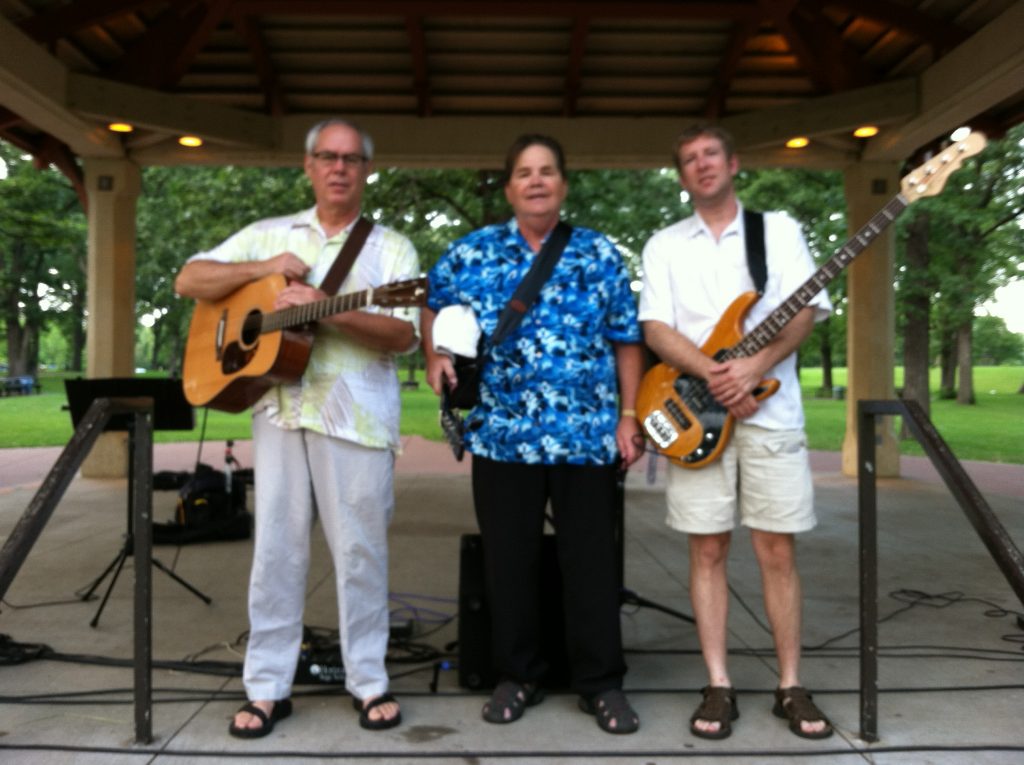
At the Gazebo Stage in Minnehaha Falls Park in Minneapolis with Mark Kreitzer on lead guitar and Jason Kapel on bass guitar
Not many major cities can boast a waterfall like this within their city limits; just a few hundred yards downstream is the Mississippi River
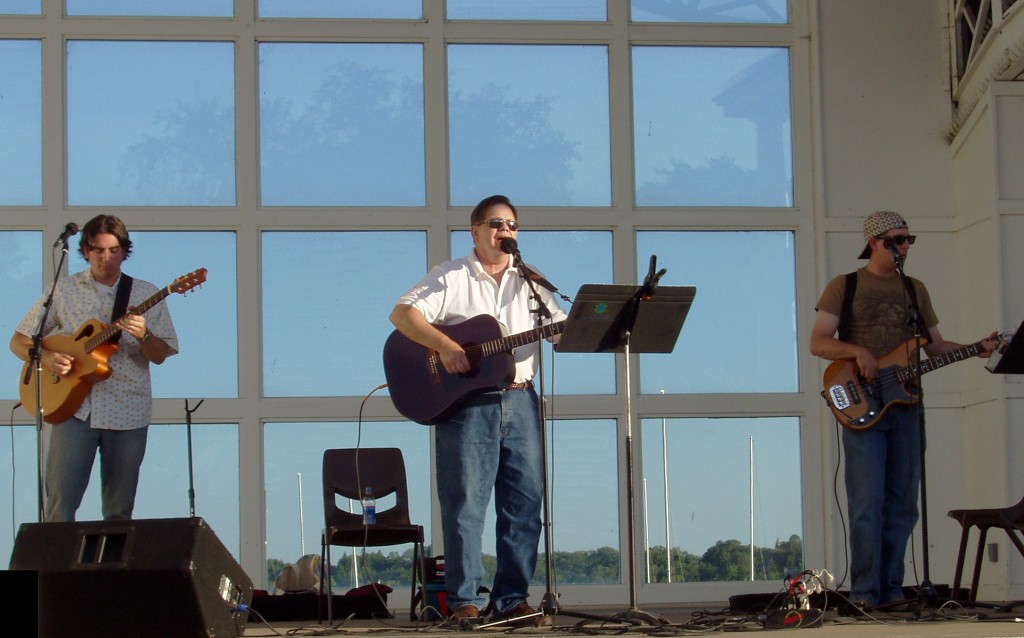
At the Lake Harriet Bandshell in Minneapolis
In 1993, Wayne met a smart, beautiful woman who lived in Saint Paul. They have been happily married since 1994. The wedding, performed in her back yard, gave Wayne’s son two younger brothers and created the need for Wayne and his son to move across the Mississippi River into Saint Paul.
For the next several years, Wayne was focused on his family, his job, writing songs and performing music. Around 2005, he traded in his Peavey for a Bose L1 system with all the attachments, and his notebooks were replaced by an iPad with a page-turning app controlled with his right foot. Anything to “lighten his load”…!
Sometimes he was alone onstage, sometimes he offered a 50/50 split of any income with talented instrumentalists, most often other guitarists. Once he appeared at any location, he was typically invited back. The link below will take readers to a typical show, this one outdoors, in Blaine, Minnesota with friend Dan Chapman. Wayne and Dan played many shows together and Wayne is grateful to have this professional recording of our performance together in 2006. To see/hear it again, just go to the “Timelines” selection at the top of any page and click on Wayne & Dan.
A COUPLE OF TRIPS TO ATLANTA
On the job front, Wayne became aware of some of the perks of being a Marketing executive in a technology company. One advantage was representing the company at local and national trade shows. While there, Wayne also got to “go shopping” for any necessary gear required by his company’s sales team. In January of 1996, he was dropping his business card into fishbowls of businesses at trade shows that sold the latest in video and sound projection systems.
One day in March, the phone rang at his desk. Wayne answered in his standard way: “Tricord Marketing. Wayne Hamilton speaking.”
“Mr. Hamilton, this is [John Josephson * not a real name] at Panasonic in Minneapolis. Are you sitting down, sir?”
Wayne smiled and replied, “Should I be?”
“When you hear what I have to say, you might wish you were.”
“OK,” said Wayne. “I’m sitting down. What can I do for you?”
“Actually, it’s the other way around. As you probably know, Panasonic is a World sponsor of the 1996 Centennial Olympics coming up in July. I’m calling to invite you and your guest to an all-expenses-paid, week-long trip to the Atlanta Olympics.”
Wayne waited a long, slow count of three before responding. Then he said, “OK…who is this REALLY?”
He heard three or four voices laughing at the other end of the line before “John Josephson” spoke. “Let me assure you, Mr. Hamilton, I am who I say I am and my employer, Panasonic Corporation, sincerely hopes you will accept this offer, made with no expectation of return favor. Obviously, if YOUR employer approves, we’d like you and your guest to visit our office for a publicity photograph; that’s it. Just so you know we ARE legitimate, I’ll send a courier over to your office with a formal offer for you to show your CEO.”
The offer WAS legitimate, and Wayne and his wife were flown to Atlanta on July 21 and back home on July 27, 1996. Panasonic had booked the entire hotel. When we got to our room, we found huge GYM BAGS STUFFED with Olympic SWAG, all emblazoned with sponsor-festooned wearables: athletic pants, jackets, t-shirts, socks, shoes, hats, YOU NAME IT! AND CAMERAS! WITH EXTRA ROLLS OF FILM!
Panasonic was even generous enough to provide various PINS for selective countries and sports to their guests so they might participate in the popular “pin trading” activity while attending the Games. Especially valuable were the NEW Olympic sports pins, like Beach Volleyball (built at a former auto junkyard), Mountain Biking, Softball, Women’s Soccer, Lightweight Rowing, Team Rhythmic Gymnastics and Women’s Triple Jump.
But clothes and pins were just gifts in the guests’ rooms. Each morning at the hotel, there was a “themed” breakfast, served by a costumed staff of waiters and waitresses, all dressed for that meal’s theme. For example, one morning’s breakfast might be built on a theme of “Hawaiian Sunrise”. Hawaiian food served by Hawaiian-costumed staff. Guests were on their own for lunch at the Olympic Park, but after delivery and return to the hotel via limo, dinner might be themed “Pirate Island”. Use your imagination as to the food and costumes for THAT meal. Wayne was “laughing all the way” at the theatricality of it all!
But the best part of all was probably the fact that Panasonic ensured that their guests could gain entry to any sport they wanted to see. The “hot ticket” at the Summer Olympics is always the women’s gymnastics finals, and Wayne and wife were there, seated not far from where the US President and First Lady were seated.
Because of his experience in the sport, Wayne and his wife wanted to visit the Swimming venue. No problem. They simply went to the concierge desk on the day they intended to visit a specific competition and they were issued vouchers for viewing that event. They were standing in a long line, and right behind them was a lady with a huge tote bag full of 5×7-inch American flags. Wayne said to her, “Well, you are either a parent of a competitor or a member of the IOC (International Olympic Committee)!”
The woman responded, “GUILTY on BOTH counts! Do you know any of today’s competitors?”
Wayne said, “No, but I used to compete in and coach age-group AAU swimming years ago. My coach was Ed Solotar.”
The woman said, “Oh, my God! You swam for Ed Solotar? You KNEW Ed Solotar? Honey, this man swam for Ed Solotar!” Ed had died over a decade earlier, but you’d have thought Wayne had just flown in on a spaceship from Mars. She insisted Wayne and his wife take some of her flags and kept repeating, “This man swam for Ed Solotar…” as they entered the venue.
If they got hungry or thirsty or tired while at the Olympic Park, Wayne and his wife had full access to the “Sponsor Village”. This was a group of buildings paid for by individual sponsors, and guests simply found the one built by THEIR sponsor. A “host” or “hostess” would greet them at the door and, identifying them by their badges, welcomed them inside, where fresh food, cool drinks, comfortable seating and televised events from all over the Atlanta area waited for them.
Finally, their last full day, July 27, was upon them. It was as busy as all the others and “Wayne and wife” crammed as much fun as possible into those last fantastic hours, knowing that it was back to reality all too soon. So after their last “themed” supper, they made sure they had all their “treasures” from the Olympics packed and went to bed at 10 pm. They had rented a car for the day to drive to Marietta, Georgia to visit a high school buddy for breakfast at his house, then get all their “stuff” to the airport for their flight back to St. Paul.
At least, that was the plan. But when they woke up, they turned on the TV to get the latest word on the weather (it’s just something people in Minnesota do). What they got was a lot more shocking. After they’d gone to bed, a nut case had set off a bomb in Olympic Park that killed and injured people who were celebrating after midnight not far from where Wayne and wife had been earlier in the day.
Their timing to depart from Georgia couldn’t have been better. They’d been invited to have breakfast with Wayne’s high school classmate Jody Dyer and his wife Ella. Wayne and Jody had been friends since they were twelve years old. Jody got Wayne interested in music and in wrestling and had introduced Wayne to more pretty girls than Wayne could remember, let alone count.
Jody’s dad was an Army Colonel, and where the Colonel went, his family went. When Jody was 17, his family followed the Colonel to his next assignment in Germany. While there, Jody was involved in an auto accident that paralyzed him from the waist down. He returned to Annandale and graduated with his class there.
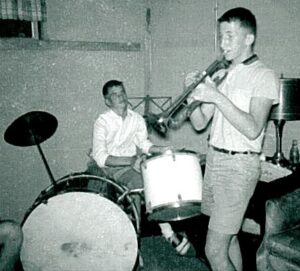
Jody and Wayne jammin’ at age 14
There were several members of Wayne and Jody’s high school class who applied to the Georgia Institute of Technology, otherwise known as Georgia Tech, in Atlanta. When Jody applied there, he was told that no one had ever graduated from that school in a wheelchair. Jody simply told them that he intended to be the first. He requested that he be assigned dormitory space in the same dorm where the football team stayed. Long and short of it: Jody tutored the Georgia Tech football team in their science courses, the team members helped Jody get where he needed to go physically around campus. Everybody won, and Jody WAS the first person in a wheelchair to graduate from Georgia Tech.
After graduation with an Engineering degree, Jody invented a brilliant system that saved hospitals millions of dollars in their intensive care departments. Instead of having expensive Registered Nurses personally monitoring each intensive care patient, Jody worked with medical professionals to connect those patients to computerized monitors that would set off alarms if parameters exceeded or fell below predetermined levels. This allowed a single trained Registered Nurse to call in teams of physicians at a moment’s notice when notified by a patient’s computer. Jody’s systems made him a fortune as he sold them to hospitals; he made another fortune when he sold his company to a larger concern a few years later.
Needless to say, the breakfast reunion with his boyhood pal was a joy for Wayne, but there was another surprise waiting at his friend’s house that day. It seems that, at every Olympic Games and even qualifying competitions, some SNAFU always crops up. For one reason or another, athletes qualify to compete, travel to the host country, but are not allowed to participate. They are not even extended the hospitality of a place to stay. Such was the case with my friend Jody. He had another guest at his home when we arrived on July 28th. Due to some paperwork foul-up, Rashed Judeh, a Palestinian boxer from Jerusalem, had been banned from the Games.
Mr. Judeh was also not allowed to stay with his team in the Olympic Village. The IOC requested help from the Atlanta community: Could anyone house Mr. Judeh for three weeks? The answer was yes. Jody Dyer could. After the Games, Rashed did not return to Palestine. He had a brother in San Francisco, so he applied for a visa and visited him there. Oddly enough, in San Francisco he met and married a lovely woman from Saint Paul, Minnesota, where Wayne and his wife live. They married, moved to Saint Paul, had two beautiful daughters and became restaurateurs, offering authentic Middle Eastern dishes (straight from Rashed’s mother’s kitchen).
A few years later, Wayne was a minor player in a “surprise” birthday party being planned by Jody’s wife, Ella. The couple had left Marietta and purchased a condo in the city, not far from Jody’s beloved Georgia Tech campus. There was a party room with space for plenty of guests. Ella had put Wayne in charge of music for the affair, so Wayne recommended a karaoke music machine, about the size of a small juke box, which was pre-loaded with top hits from the 1950s to the early 2000s. Ella also introduced Wayne to a singer/actress friend of Jody’s named Maryline Blackburn, who had been invited to perform a number of Jody’s favorite R&B songs during the celebration!
Maryline Blackburn
Of course, Wayne consulted Maryline on the placement of the equipment, which came with wireless mics, and she invited Wayne to “sing along” during part of her show. Wayne was only too happy to comply. As they talked, Wayne learned that Maryline once lived in Alaska and had been a contestant in the MISS ALASKA competition of 1984.
At breakfast the next morning, conversation revealed that Maryline not only participated in the Miss Alaska competition, she actually WON that 1984 contest! But the BEST part of that story is that one of the other contestants she beat for that 1984 title was former Alaska governor and 2008 Vice Presidential candidate Sarah Palin (remember HER?)!
WAYNE JOINS THE MINNESOTA ASSOCIATION OF SONGWRITERS
In 1998, a fellow musician told him about a music organization he had not yet heard about: the Minnesota Association of Songwriters, AKA MAS. Wayne attended his first meeting of MAS on Wednesday, November 11, 1998. At that time, the group was meeting on the second and last Wednesdays of the month at a place on First Avenue in Minneapolis called MusicTech, a music school that would later move to St. Paul and be renamed McNally Smith College of Music. But now, in November of 1998, the group was meeting in Osgood Hall, the largest classroom at the site. The name of the room came from local guitarist Chris Osgood, part of a punk rock trio called Suicide Commandos formed in 1974. Chris was also, a few years later, an influential contributor to what became known as “The Minneapolis Sound.”
As usual, Wayne arrived early. As members were filing in, Wayne was writing a check to pay for his membership in the organization. He gave the check to one of the people at the head table, who said, “Welcome to MAS. Do you have a song to present tonight?”
Wayne had brought multiple printed copies of one of his songs with him, so his answer to that question was “Yes, I do.”
The process went as follows: The signup list determined the order of presentation. When it was “your turn”, each songwriter passed out a copy of his or her song lyric with the chords to each meeting attendee. Commenting members were required to print their name at the bottom of the lyric sheet and write their comments about the song (lyrics, melody, whatever) on the sheet while the presenting member was playing the song LIVE at that meeting, typically while accompanying themselves on guitar. The room also had a piano. No mics, no amps. Just lyrics and chords.
At the bottom of the printout, commenting members would write the capital letter E if they felt the song was exceptional and deserved the endorsement of the Association. Only endorsed songs (three-fourths of attending members) could be included on MAS-produced CDs, which were mailed annually to a list of radio DJs around America who had agreed to listen and give air time to MAS writers.
The comment sheets and endorsement certificates (suitable for framing) were returned to song presenters at the next meeting, which would ordinarily be two weeks later. However, in 1998, that would have put the meeting on the day before Thanksgiving. Therefore, MAS leaders agreed to meet again the very next week on Wednesday, November 18. Wayne was ready. He presented a second song to his MAS colleagues on that date, and at the end of that second meeting, he got his comments back from his first presentation along with his very first endorsement certificate!
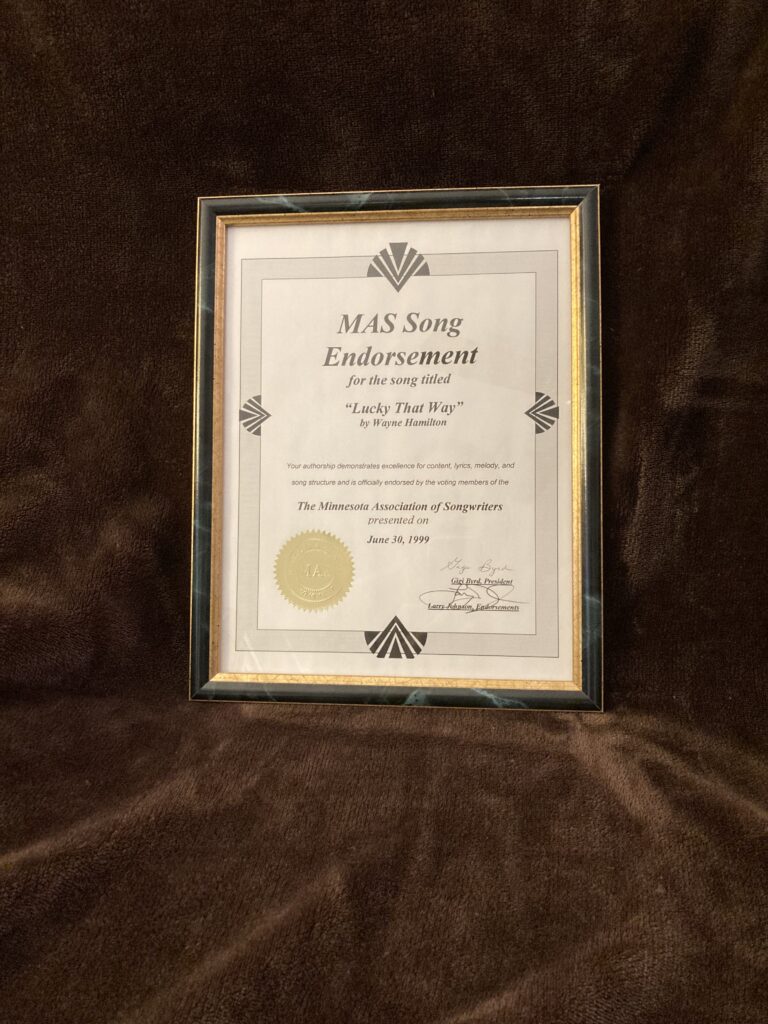
During his first year, Wayne only missed two meetings and presented a total of fourteen (14) songs. Of those fourteen, TWELVE were awarded endorsements! He was so proud of those twelve songs, he connected with fellow MAS member Mike Loonan, a very talented musician who had a “home studio” and agreed to co-produce Wayne’s first CD release in 1999, titled “Lucky That Way“. All twelve songs on that CD are available elsewhere on this site and may be downloaded at no charge HERE!
WAYNE BECOMES A CONCERT (AND CD) PRODUCER
Another unexpected call came in from Monica Hoel, then the Dean of Students at Wayne’s undergraduate Alma Mater (Emory & Henry College) in June of 1999. Apparently, the College’s Alumni Association had met at some point in the late Spring of that year and decided it would be a great idea to celebrate the end of the millennium by sponsoring a CONCERT OF LIVE FOLK MUSIC! Moreover, this concert would be performed by musicians who were E&H Alumni. Furthermore, this concert should be presented DURING HOMECOMING WEEKEND IN OCTOBER at the old (built in 1923) Martin-Brock Gymnasium, which, during the 1960s, was the ONLY gymnasium on campus and the ONLY place where the school’s basketball team hosted opposing basketball opponents and one of the few places on campus where the College could sponsor dances for students (and where Wayne’s R&B band, The Glad Hand, could perform for student organizations and get paid for it). The committee planned on billing the event as THE LAST CONCERT OF THE CENTURY! The Alumni Association would pay all the bills, but they needed someone who knew all the “old folkies” to call, arrange the order of performances, etc, etc, etc.
As there were several active members of Wayne’s class on the organizing committee for this big idea, they all agreed that Wayne would be an appropriate person to pull all the right strings to successfully make this concert a reality, Wayne DID get the call. Before he got to campus, he called his former drama professor, Alan Pickrell, and told him about the project. Alan laughed and said, “First, they suggest that we open one of the plays in our season during Homecoming, THEN they schedule a huge competitive event, A FOLK CONCERT, on our opening night! LOVELY!”
Wayne said, “I didn’t know anything about the conflict in the schedules, so I hope you’ll forgive me for asking a favor. If you have them available, may I please use a 12 by 30-foot section of curtain, a 40-foot batten and two twenty-foot lengths of rope?
“Of course, of course, I’ll also have the crew bring an A-frame extension ladder to the gym. Ask the gym crew to bring the pieces back to Wiley by Monday afternoon, OK?”
“Consider it done. And thanks, Alan. Y’all break a leg, OK?”
As it turned out, Wayne did add one stipulation to the college’s request. Wayne would volunteer his time, talent and expertise to the project; however, he insisted that the college HIRE Woody’s Pro Sound & Music (located in Chilhowie, Virginia) to digitally record the entire concert and pay another company in Minneapolis to press one thousand copies of the concert. A fixed number of the recordings would be given to the performers for their participation and the rest would be sold at the Emory Emporium (the college’s bookstore) to recoup the college’s cost.
Wayne provided all the packaging art to the duplicating company, and the college was responsible for the marketing and sale of the disks, via advertisements in regular mailings to alumni. Copies of the disk could also be ordered online from the Emporium. Wayne even arranged with the College’s Media Department to videotape the concert. However, Wayne takes no responsibility for the dismal output that resulted (so bad it never surfaced) from the student crew that videotaped the event. Let no more be said about that.
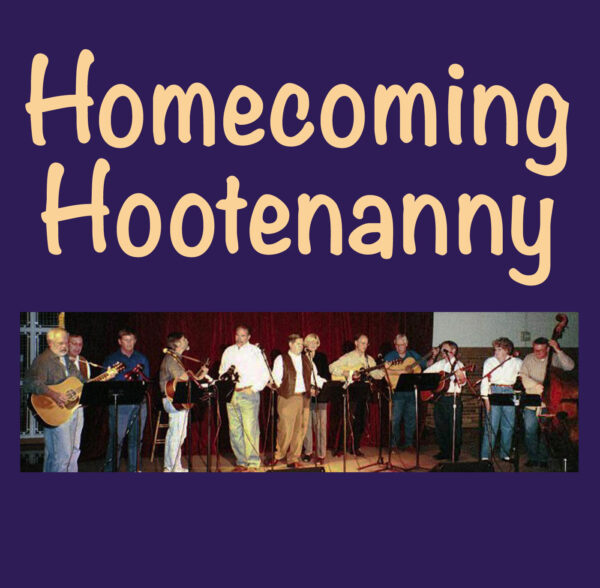
Audio from this HOMECOMING HOOTENANNY event is available at this link. We invite you to click a few, as we are guessing that, if you’ve ever listened to folk music before, you’ll find a favorite or two among those performed during that concert! The old gymnasium was absolutely packed during the event, and the audience LOVED every minute of the concert. One attendee summed it up for Wayne with a comment after the concert. He simply said to Wayne: “Thank you for the memory of a lifetime!”
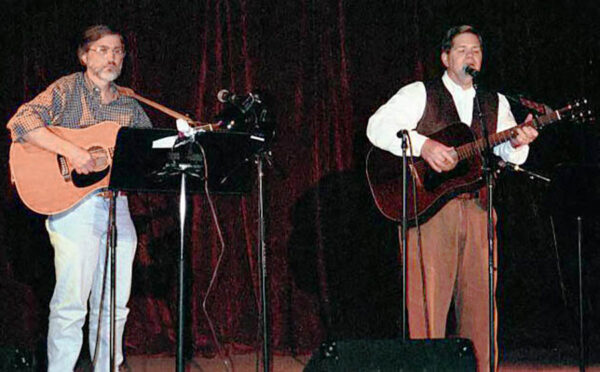
Wayne on stage with pickin’ pal Heath Jones, who also played guitar in their 60s R&B GLAD HAND band
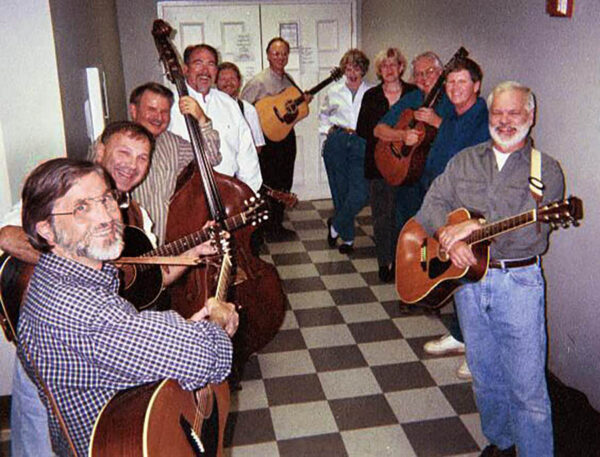
ALL the performers waiting to go on for the closing number – beyond those white doors await a gym full of 60s-era folk fans
Listen to audio tracks of songs performed at HOMECOMING HOOTENANNY concert in 1999.
STARTING A NEW “CHAPTER”
Wayne was busy with work, family, writing songs, co-writing songs, recording songs and booking and performing gigs. In addition, he heard about a new networking organization for musicians based in Indianapolis called “Just Plain Folks” (also known as “JPF”). It was designed to use the Internet and email to enable musicians to share information about resources in their area and occasionally gather for showcases, song circles and workshops. Although MAS was doing much of that for Wayne, he offered to start a JPF chapter in the Twin Cities in early 2000. He built the Twin Cities JPF group around “song circles” and got about 200 Minnesota musicians to sign up for JPF emails.
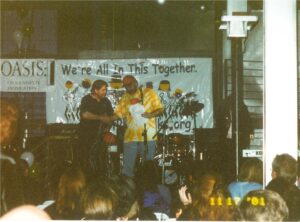
Wayne onstage in Los Angeles receiving the JPF award
Wayne organized all of those activities for the Twin Cities Chapter and even arranged for free accommodations for the JPF founder to visit Minnesota during the Summer of 2000. A year later, in the fall of 2001, Wayne was invited, at his own expense, to attend the first-ever “Just Plain Folks Awards Ceremony” in Los Angeles. Meanwhile, JPF membership grew to 50,000 members in cities worldwide. Wayne hadn’t been to the West Coast since the choir tour adventure in 1969, so he asked his wife: “Wanna go?” She did. It was just a 3-day weekend, so they splurged and rented a red Mustang convertible, “shopped” and had lunch on the sidewalk on Rodeo Drive, and cruised Sunset Boulevard and Beverly Hills. Wayne played at a couple of open mics and met a lot of interesting American songwriters during that weekend.
To Wayne’s surprise, at their first “JPF Awards” ceremony in November of 2001, JPF named the Twin Cities Chapter as “Chapter of the Year” and Wayne as “Coordinator of the Year”. JPF also nominated Lucky That Way as “Best Traditional Folk CD” in 2001; the title cut was also nominated as “Best Traditional Folk Song.”
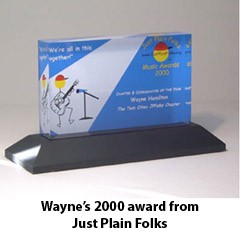
Again, to his surprise, shortly after he returned home from California, Wayne started receiving copies of NEARLY 300 songs from “JPF CENTRAL” with instructions to listen and GRADE each of them in certain categories. They were NOMINATIONS FOR 2002 JPF AWARDS AND WAYNE WAS (without being asked) A JUDGE! LIKE HE HAD NOTHING ELSE TO DO!
As a result, Wayne’s association with JPF was brief. The recordings went into a box and “RETURNed TO SENDER”. Wayne had always been a multitasker, but family, his FULL-TIME job, MAS meetings, songwriting, co-writing, recording and live solo performances demanded a re-assessment of his priorities.
In retaliation, the founder of JPF removed Wayne from the org’s web site as ever having had anything to do with JPF. Go there now, you’ll find no trace of him anywhere on the site. But it happened. The proof appears in the picture above.
THE GREATEST RIDE
Perhaps it was the “turn of the millennia”. Perhaps it was the realization that he was over the age of 50. Perhaps he had an activity schedule that exceeded that of most men HALF his age. Who knew? But for some reason, Wayne just felt that it was time for him to BUY A DIFFERENT CAR! No, not a NEW car, just a different car. So he began to shop for a car like his 1974 Volkswagen Karmann Ghia, a car that was no longer available. And he came up with the perfect answer: a 1999 Buick Riviera!
Wayne’s family had always favored the Buick brand, and suddenly Wayne realized he hadn’t done a very good job of holding up his end of that particular family tradition. So he went to see a “broker” in the Twin Cities. In the automobile business, a broker is a person who shops the market for the make and model of any automobile you wanted, right down to the color. Less than two weeks later, Wayne had the car he wanted. And he drove that car for the next 18 years!
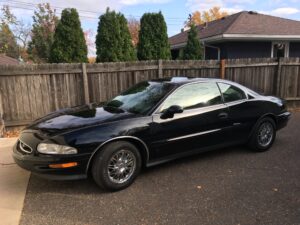
PERFORMING, WRITING AND RECORDING
Although (or perhaps BECAUSE) he was regularly performing his solo act once or twice a week, it was six years before Wayne released another CD:
2006 – The Present 12 original songs, two featuring the legendary Peter Ostroushko on fiddle

Wayne with the fabulous musician (and chef!), Peter Ostroushko
Still, life was demanding. He managed to arrange “outside of Minnesota” tours with his first two recordings to locations in Texas, Georgia, Virginia and Maryland.
House concert at former Mount St. Mary’s student Bobby Golibart’s house in Irving, Texas:
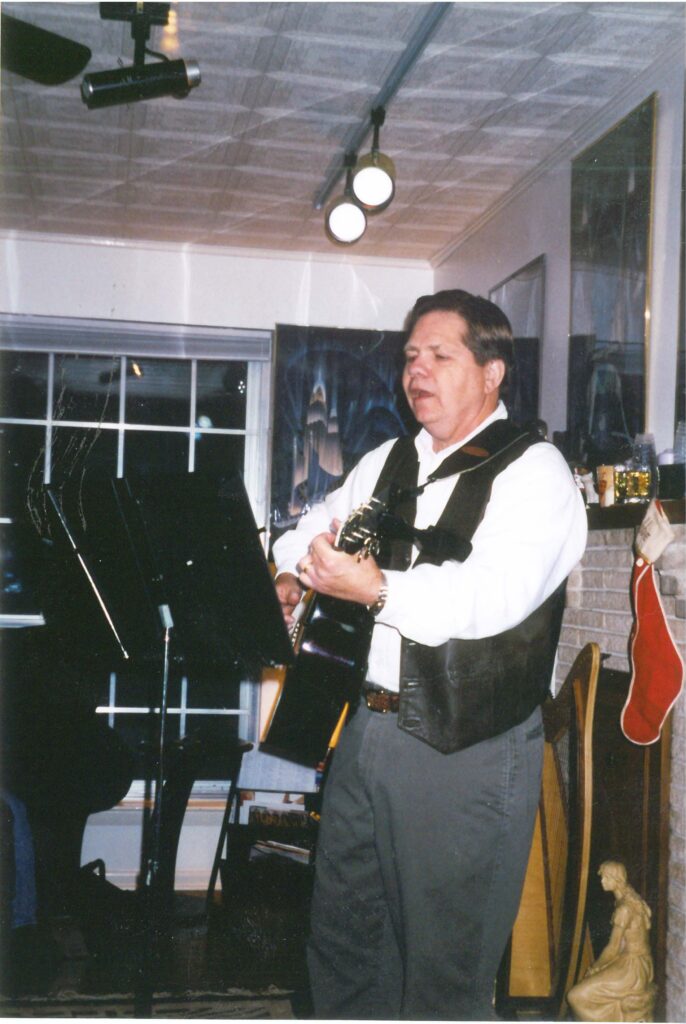
In Wayne’s home town of Annandale, Virginia with many old school friends and former students, including John Travol…no, wait, that’s not…that’s Tom O’Connor! Another Mountie, in the back room of a popular eatery on Little River Turnpike that didn’t exist when Wayne lived there:
A house concert in Gloucester, Virginia at the home of Ted and Brownie Bartley, that included guests from Norfolk, Virginia Beach, Suffolk, Williamsburg and Yorktown:
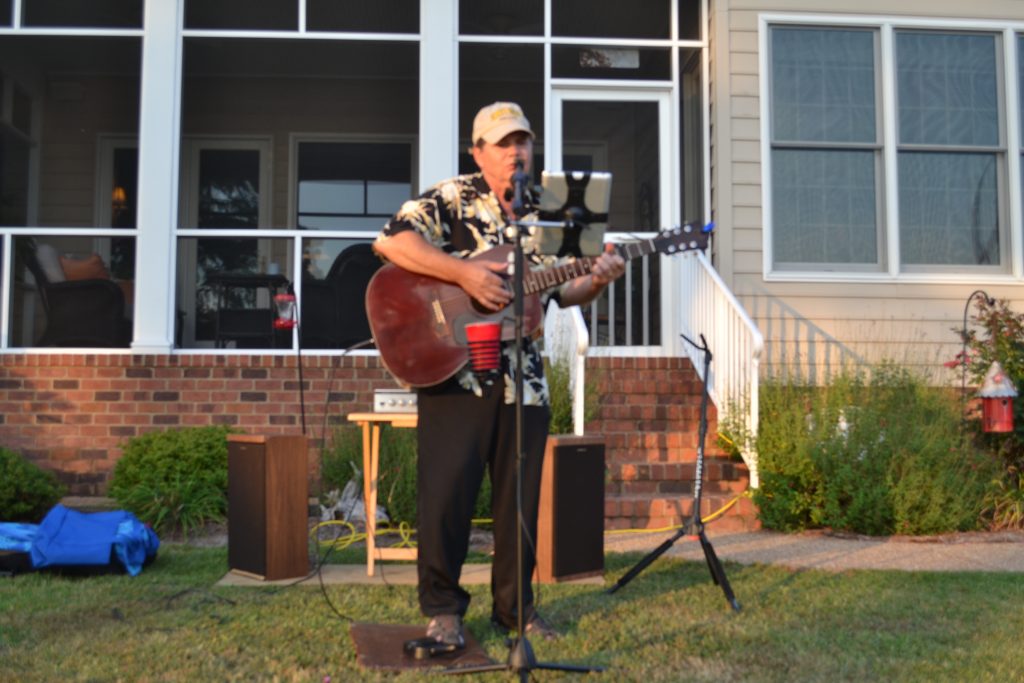
At the Bartley’s, Wayne’s view of where the Ware River meets the Chesapeake while he performed that day.
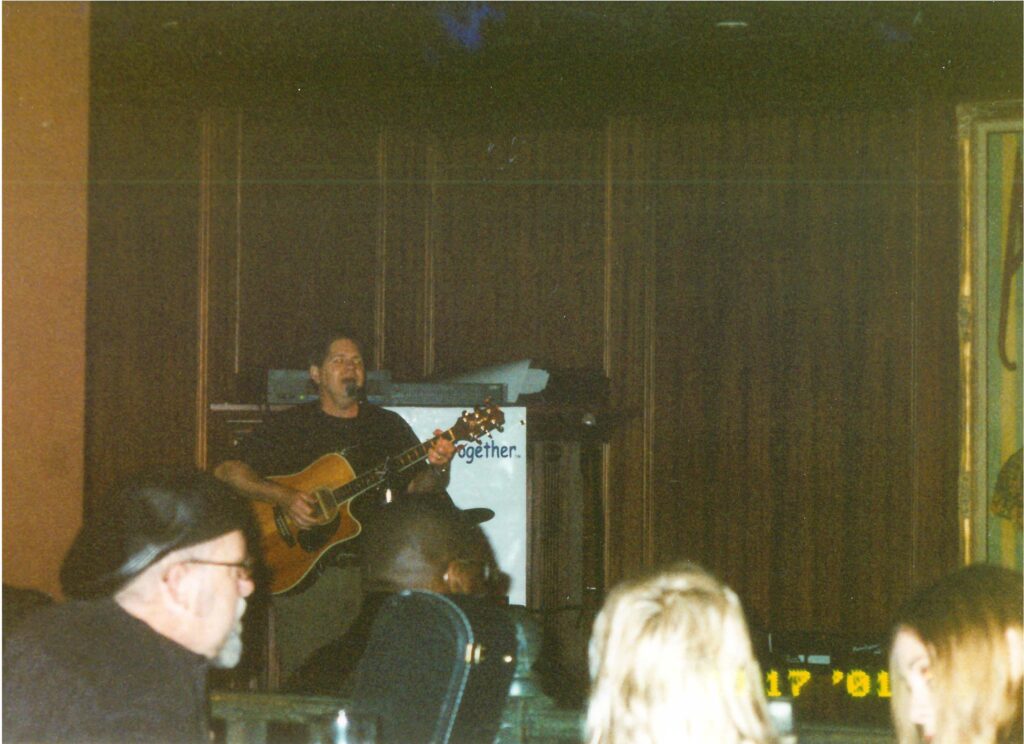
Wayne plays a solo set in Los Angeles before the JPF activities commence there
Closer to home, Wayne was grateful to have a group of performers who had been in the studio with him who were also willing to join him on stage at festivals and larger venues, adding a higher level of professionalism to his shows. And he was happy to pay them for their presence!
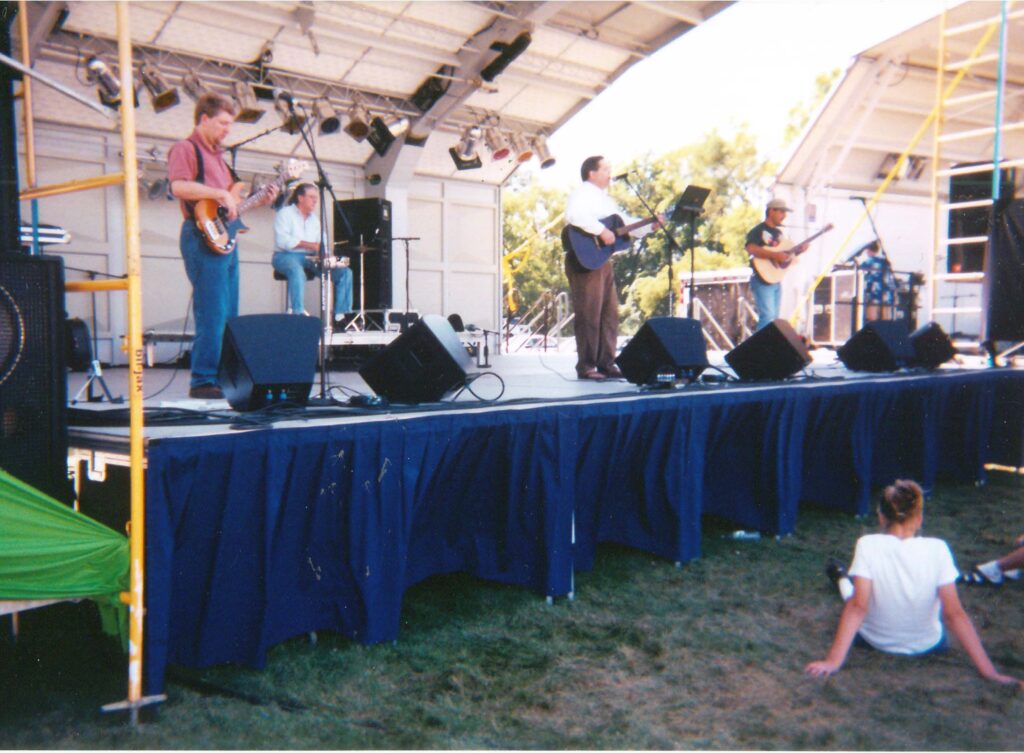
Wayne on stage at the Treefrog Folk Festival in Faribault, Minnesota with Jason & Mike Kapel on bass & drums & Dan Chapman on lead guitar.
However, a third recording took eight long years. There were two main reasons why:
1. In Wayne’s opinion, MAS required a different kind of leadership to grow, with only 14 paid-up members. At the election night of 2007, Wayne ran for the office of President and led the organization through the year 2015. During that time, the membership of MAS swelled to over 100.
2. In 2013, Wayne began a 10-year performing partnership with guitarist and electronics expert Doug Millaway, which roughly doubled the number of performances on both calendars and eliminated the need for studio time.
As a result, Wayne developed a straightforward leadership philosophy that allowed the growth required by MAS and by his own growing desire to create and promote new songs. For MAS, the philosophy was “Give the Members What They Want.” For his own creative output, he resolved to “Take Advantage of New Recording Technologies.”
For MAS, members wanted opportunities to record their original material and share it either live or over public media. Therefore, Wayne promoted an open organization with monthly live showcases, free weekend workshops with nationally known songwriters, opportunities for members to perform at popular public events like the State Fair, and a “MAS Members Only” Public Television show videotaped in Minnesota and aired on dozens of Public Television Stations all over America. The Public Television tapings were probably the single largest contributor to membership growth during this period. Wayne especially enjoyed the BYO annual PICNIC and SONG CIRCLE gatherings in his back yard every summer! Here is a list of some of the workshop leaders who were hired to help members build their songwriting skills during Wayne’s tenure:
– Jon Vezner (Grammy Winner – MN native)
– Pat Pattison (Berklee Songwriting Professor and author – MN native)
– Steve Gillette & Cindy Mangsen (Award-winning husband/wife songwriting team)
– Cliff Eberhart (Award-winning songwriter)
– Sally Barris (Nashville A-list songwriter & Grammy nominee – MN native)
– Craig Bickhardt (Award-winning songwriter)
Wayne served as President of MAS for nine years (2007-2015 inclusive). As MAS President, he joined two other music-oriented groups to see what he could learn from them. Those groups included the Minnesota Blues Society (where he is a lifetime member) and the aforementioned MBOTMA. After resigning from the Presidency of MAS, he was INVITED to join the boards of the other two music groups, which he did, but not concurrently. For a full SEVEN years (2011-2017 inclusive), Wayne actually PAID to serve on the board of St. Paul’s famous History Theatre, whose name encompasses two of Wayne’s favorite pastimes.
At this point, the pace of Wayne’s personal recording releases improved markedly:
2014 – You Never Knew 11 songs, including the talents of the late Paul Folwell and the late Lonnie Knight.
2015 – Smallest Sign 5 songs, Wayne’s first EP co-write with guitarist Doug Millaway.
2016 – We Know 7 songs, all co-writes, with 7 different writers!
2017 – Love Grows 7 songs, one solo write by Wayne and 6 co-writes
2021 – Back at the Ocean Again 10 songs, all by the team of Hamilton & Millaway
2021 – Walkin’ My Way 10 songs, 3 solo writes by Wayne & 7 co-writers
2023 – Little Kids 8 songs, all solo writes by Wayne, all inspired by his youngest granddaughter
The 7 song collections listed above were not created in studios with live talent. Most of them did use live talent on a “per track” basis, but that was music added to Band in a Box or other electronically generated files, thus reducing the overall cost and time of recording. Note that the FIRST of these seven recordings occurred a year AFTER Wayne teamed up with guitar and technology wizard Doug Millaway in 2013. The duo eventually named themselves TWO TONE and performed all over Minnesota and in parts of Western Wisconsin.
Doug is an excellent guitarist who had absolutely NO interest in singing. As much as Wayne dreamed of having another voice to offer the public, Doug would have nothing to do with helping in that regard. However, Doug had a tech solution to offer, just as he had a tech solution to offer nearly every challenge. One day he handed Wayne a box and said, “Here. See what you can do with this.”
Out of that box came the ultimate in vocal multiplexing technology: the TC Helicon Voice Live system. Wayne never completely mastered it, but that machine made his single voice sound like he was singing with one other person or sound like the Beach Boys or the Mormon Tabernacle Choir. It was fun, and we each got what we wanted.
All of the music listed above is available for downloading by the reader at no charge in the MUSIC section of this web site.
From his days in the early 1970s at Alpha Audio in Richmond, Virginia, Wayne had, in less than a quarter of a century, evolved through the studio recording process to totally digital recording, using tools like Garage Band, Band in a Box and, more recently, programs like Suno, an AI-based production support system in his writing and development of music. That evolution began in 2013 when he met Doug Millaway, who has mastered most of the new, digital tools that have come onto the market and applied those tools to most of Wayne’s recent works. In fact, Doug was not only the co-producer of most of Wayne’s recordings after 2013, he was also the co-writer of most of Wayne’s songs!
THE THEATRE NEVER LETS GO
It had been clear to Wayne for years that his love for the arts would always be a part of his life. It seemed, at least in recent years, that love might have to be demonstrated via projects that Wayne would somehow generate on his own. But every now and then, Wayne was approached by someone who discovered the artistic skillset that Wayne could offer and wanted to put one or more of those skills to work for themselves! By chance, this happened during the Fall of 2016.
A few months earlier, during the summer months, Dave Birckelbaw, an MAS member, told Wayne about his very artsy wife Jill. She had an art studio at which she worked with kids of all ages to show them how art can help them express themselves. She also created and staged original dance works and plays with teenagers “for fun”. Jill had heard from Dave about Wayne’s theatre background and asked Dave to have Wayne call her about a project she was planning with her teens for October.
Wayne’s “Governor Ratcliffe” photo superimposed in front of a background photo of the Governor’s Mansion in Williamsburg, Virginia
Wayne’s call resulted in an invitation to PERFORM A ROLE in a Musical Revue titled “Disney’s Villains”. Jill wanted Wayne to play the part of Governor Ratcliffe from the movie Pocahontas and sing “Mine, Mine, Mine!” But as it turned out, Jill had more in mind for Wayne in her Disney Villains production, as evidenced in some of the photos displayed below. She really kept Wayne busy, and Wayne discovered that he could still have fun performing live on stage!
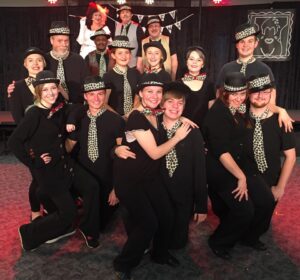
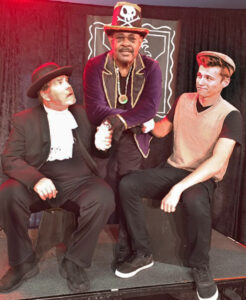
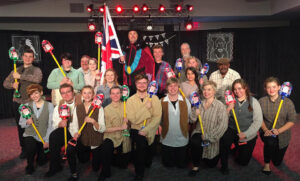
The cast of the “Mine, Mine, Mine!” number in The Disney Villains Revue
MUSICAL THEATRE FAVORITES
Some of Wayne’s favorite projects were experiments in the history of musical theatre. But for those projects, he wasn’t always on stage; he was creating web sites! This was a skill he learned while working as a marketer in corporate America. In 2010, he teamed up with friend and Cold Fusion (look it up) programmer Jim Moore to create a web site called FirstonStage.com. The complete name of the project is “First on Stage: A Collection of Historical Firsts in American Musical Theatre”. As recounted above, Wayne worked for several years as an actor and director in many musical theatre productions, and is a huge fan of the art form.
The beauty of this site is that it is database driven. When you arrive at the site, there is a blank search window at the top of the page. Visitors can enter actor names, theatre names, show names, composer names, show titles, song titles, anything related to musical theatre. If there is data about your “item of interest” on the site, you’ll be shown whatever is there.
As Wayne explains in the introduction of that site:
“Years ago, while teaching college courses in the History of American Musical Theatre, my research exposed numerous instances of innovation in the art form (“this was the first time…”) as theatrical technologies, along with musical styles and forms, evolved. I began to “collect” such phrases, which later included people, theatrical venues and other occasional oddities, into the collection and organized the data chronologically.
At this site, we focus on historical firsts. Innovation creates history, and this is a collection of innovative events, decisions and inventions. Among other things, the collection includes initial appearances of popular shows, songs and performers. Here, you’ll find descriptions of theatrical firsts in America from 1665 to 2000. Each “historical first” appears in bold type.
Generally, the New York opening is considered the finished form of any work (even if subsequent changes occur during the New York run). For the sake of maintaining some historical perspective, this site covers events through the 1999-2000 season.”
Here’s where you can read all about it:
Retired from working? Yes. Less busy? Hardly. Two Tone was gigging away, typically once a week, rehearsing and co-writing together. Wayne was attending MAS review meetings at least once per month, if not the board meetings of at least one other arts-oriented organization he belonged to, as well as activities of children and grandchildren, while following activities of another new arts group for musicians: the Minnesota Music Coalition (MMC), which was centered in St. Paul. That group was BUSSING groups of musicians to music-starved locations around the state, providing performance opportunities where small towns rarely heard them.
They also put together a “PRIZE” within the City of Saint Paul, sponsored by the Mayor’s Office. In 2017, any musical group that could introduce at least one performance in a Saint Paul venue that had never HOSTED music would receive a CULTURAL STAR AWARD from the City and MMC. Wayne’s friend from Palestine by way of the Olympics, Rashed Judeh, had just opened a new restaurant on Grand Avenue. He granted a one-night stand to Two Tone, qualifying them for the City’s Award. Mayor Chris Coleman sent Wayne the letter of recognition.
MAKING FRIENDS WITH THE PAST
From 2011 through 2017 (inclusive), Wayne served on the Board of Directors of St. Paul’s famous History Theatre. That organization worked with amateur and professional playwrights, actors and actresses to tell true stories about people and events in the upper Midwest, especially Minnesota and most especially in St. Paul. Wayne volunteered to serve as “host” to the Company’s founders, Lynn Lohr and Lance Belville, when the wife-husband team was invited by the organization’s board to “return home” to St. Paul from the West Coast for the group’s 40th Anniversary celebration in 2017.
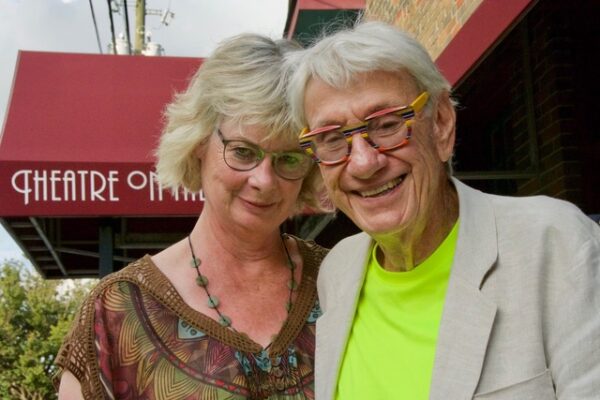
Lynn Lohr and Lance Sherman Belville (photo by Daniel Axler of Indianapolis, IN)
To commemorate the event, Wayne constructed a web site that recounted every show developed and performed during those first forty years of History Theatre’s existence, using resources from the Minnesota Historical Society, History Theatre’s archives and the University of Minnesota’s Performing Arts Library Collection. The link below will take you to the only web site celebrating those years at the History Theatre that was sanctioned by Lynn and Lance.
After their visit, Wayne’s friendship with the couple grew. Upon returning to California, Lance was inspired to write a play about a distant relative of his: William Tecumseh Sherman (Lance’s middle name was Sherman; he was the General’s great-great nephew), the Union General in the Civil War who is famous for his “march to the sea” and the burning of Atlanta. He called the play Atlanta Burning, Sherman’s Shadows, which premiered at the Twin Cities’ annual Fringe Festival in 2018. Historical note: the General never claimed to have burned the city; rather, he said the Confederates burned it to deny the Union the valuable supplies within the city walls
General William Tecumseh Sherman 1820-1891
There were two speaking parts in the play, the General and his Aide, but Lance added a third character, a Corporal, who 1) played guitar and sang a few of Sherman’s favorite songs as the audience was being seated, and 2) carried messages on and off stage during the play’s dialog. However, the Corporal was not given a single line in the entire play. Guess who played the Corporal? Correct! Wayne Hamilton.
Lynn Lohr, Lance Belville and Wayne stayed in touch over the next few years. Wayne eventually sent the couple copies of each of his recordings, and when they returned to their former Saint Paul home to visit old friends, Wayne and his wife were usually on the list of “newer” friends who were on their list to visit and/or share a meal with. One day, Lance called and told Wayne he was interested in using one of his songs in a play he was working on. Wayne wrote “I Wish I’d Met My Second Wife First” as a comic piece. But Lance asked him to re-write the bridge a little differently for use in a new play he was writing called Cowboy and Widow.
This was a play about a twenty-something cowboy who had a stage act with his “trained” American Bison. When money ran short, the Cowboy married an attractive and rich older woman and eventually inherited part of her fortune. Wayne had the privilege of working not only with playwright Lance and director Lynn, but also with songwriter/composer and gifted performer Eric Peltoniemi, who once was President of Red House Records in Saint Paul. That label is home to many gifted folk composers and performers across America. redhouserecords.com
Eric Peltoniemi
Eric and Wayne each contributed songs to Lance’s Cowboy and Widow, and both Eric and Wayne receive a royalty check whenever the play is performed (it has proved popular in California community theatres in recent years). A third songwriter and royalty recipient, who was another friend of Lance’s and the actual source of this story, also wrote a brief song that Lance included at the beginning of the play: Dolan Ellis was famous, in his youth, as an original member of The New Christy Minstrels. Dolan sang and traveled all over the world with that group! Now in his 80’s, Dolan holds the unique position of being Arizona’s “Official State Balladeer”!
Dolan Ellis, Arizona’s Official “State Balladeer”
Wayne’s research on America’s earliest musical productions with his “First on Stage” web site and working with History Theatre’s founders on documenting that company’s “first forty years of productions” prompted Wayne, in 2019, to reach out to John Kinnamon at Burn Brae Dinner Theatre (which had closed in 2001) to offer a similar site to him. John happily accepted. Several months later, Wayne announced the launch of burnbraelegacy.com, a chronology of shows produced at the original Burtonsville, Maryland theatre between 1968 and 2001.
A SURPRISE ASSIST FROM ASCAP
One day in 2005, Wayne was working at his day gig when his cell phone rang. When he answered, the person on the other end of the line introduced herself as a “project lead” at TBWA Amsterdam. Having served in some American advertising agencies, Wayne knew that TBWA was one of the top five ad agencies in the world. TBWA was calling Wayne for permission to use the title cut from Wayne’s initial 1999 release, Lucky That Way, in a TV commercial they were developing for the six State-owned Holland Casinos!
How could this stroke of luck happen from thousands of miles away? Back when radio was king, Wayne was associated with a worldwide list of radio deejays who aired acoustic folk music and kept in touch with one another on this fairly new entity called the INTERNET. As a result, he mailed dozens of copies of his first release to members of this list of deejays all over the world, and especially in Western Europe. His music was very popular on stations in Belgium, Holland, Denmark, Lithuania, Latvia and Estonia, where many citizens speak English. One of the TBWA’s employees had a copy of Wayne’s CD and thought the title cut (“Lucky That Way”) would work perfectly for one of their ads! He took it to work, played it for the creative team, and Wayne got the offer!
And it was exciting! Five grand for a year’s use of one tune! After a brief conversation, Wayne told them he would call back the next day after he’d had an opportunity to consult with his PRO (Performing Rights Organization). In Wayne’s case, this was the American Society of Composers, Authors and Publishers, or ASCAP.
But Wayne had zero experience with synch contracts and needed some advice, so the next morning, he called ASCAP’s home office in Nashville. He explained his situation to the person who answered the phone. After listening politely, she told Wayne, “Just a moment. I’ll see if Ralph Murphy is available to speak with you. Please hold.”
Wayne couldn’t believe his ears. He was on the verge of a conversation with one of his songwriting heroes, the man who wrote Murphy’s Laws of Songwriting, a book that had a spot in his studio less than two feet from where he typically did his writing. Murphy was at that time VP of Membership at ASCAP. Suddenly a voice came on the line: “Good morning. This is Ralph. Am I speaking to Wayne?”
For the next 40 minutes he talked with Wayne. He insisted Wayne tell him his story before he got around to talking about the synch contract. Ralph offered what sounded like good advice while Wayne furiously wrote down what Ralph said. Before they rang off, Ralph wished Wayne good luck and said, “Now don’t forget to call me back after you sign the papers. I wanna know how it all worked out, OK?”
Wayne called Ralph back a few days later and reported that the deal was successfully concluded with TBWA and that he was happy to have had the opportunity. They both laughed when he told Ralph that his only regret was that he didn’t have a similar deal in the works every month.
Below is a link to the commercial as it appeared on Dutch TV stations. The last line, the only line spoken in Dutch, is: “Holland Casinos advises its visitors NOT to rely on lucky numbers!”
Wayne continued to “WORK” for a dozen years after the “Last Concert of the Century” (discussed above), still performing live shows, writing new musical and non-musical material and, as mentioned above, creating web site projects as time permitted. His last job, ironically, brought him back into the academic world. In March of 2008, Wayne was hired by the Admissions Department of a small University in Aberdeen, South Dakota to recruit high school seniors in the Twin Cities metropolitan area. There were more than 180 high schools in that seven-county area; Northern State University (NSU), formerly known as Northern State Teacher’s College, enrolled just over 2,500 students at the time and offered 90 different programs of study. The challenge was to build up the enrollment at a school that was 300 miles away from the students Wayne was visiting in Minnesota. Those students were surrounded by a highly developed University system in their own state that did not charge out-of-state-tuition and did not require a lengthy drive to get there. But Wayne did his best.
One thing that NSU DID have was a GREAT basketball program, led by the second exceptional coach to cross Wayne’s path during his career in academe. Remember Jim Phelan at Mount Saint Mary’s in Maryland? Won the Division II National Championship in 1962? Don Meyer and Jim Phelan were friends and winners. Their only difference was that Jim stayed in one place and Don coached at several schools to accumulate an outstanding winning record, the most career wins by an NCAA head basketball coach in history (903):
Hamline University, Saint Paul, Minnesota (1972-1975): 37 Wins
Lipscomb University, Nashville, Tennessee (1976-1988): 665 Wins
Northern State University, Aberdeen, South Dakota (1999-2009): 201 Wins
Coach Don Meyer
Confession time. At the beginning of his second year on the faculty at Minnesota, Wayne got a call from Jim Phelan that he and his Mounties were going to play a pre-season “scrimmage” at Minnesota’s famous “Barn” court in Williams Arena. Wayne told Jim he’d be there, and he was, sitting right behind the MSMC bench with his Mountie T-shirt and baseball cap to root for his favorite coach.
But age was beginning to show, and Wayne was beginning to feel its effect. Two back surgeries took his ability to easily stand for two or three hours, making it difficult to produce the kind of vocal sound that had always drawn audiences AND EMPLOYERS to him in the past. Then a faulty heart valve ended his singing altogether when stents were placed on either side of his heart to improve “shortness of breath”. Fast-walking Wayne is now the slowest member of the group at family outings. “Two Tone”, Wayne’s ten-year-long duo with Doug Millaway, stopped booking gigs in 2023.
Fortunately, Wayne can still do what he’s doing now: WRITE!
In late summer of 2024, Wayne was approached by Dr. Julie Jordan, another author and songwriter, who invited him to contribute a chapter to a new book she intended to assemble. Her title is The Songwriter’s Journey: A window into the Songwriter’s Soul. She has developed a series of questions with which she interviews nine different songwriters, including herself. The questions are designed to give the reader some insight about the writer’s approach to his or her craft and how he or she applies specific techniques to the writing exercise. The book was released in November of 2025 and is currently available on Amazon Kindle or in paperback form via Barnes & Noble. Dr. Jordan’s book includes analysis of two of Wayne’s songs and his responses to the questions she asks each songwriter participant.

To Be Continued…